

Maddy summaryThis bill reenacts and modifies existing Minnesota laws regarding firearms, specifically addressing binary trigger devices and transfers to ineligible individuals. It maintains a ban on binary trigger activators effective from January 1, 2025, and updates penalties for transferring firearms to people who are legally prohibited from owning them. Additionally, the bill removes a legal defense that previously allowed family or household members to claim they were forced to transfer a firearm due to threats of violence. These changes apply to crimes committed after the bill is enacted, with the binary trigger ban also applying retroactively to offenses occurring since January 1, 2025.
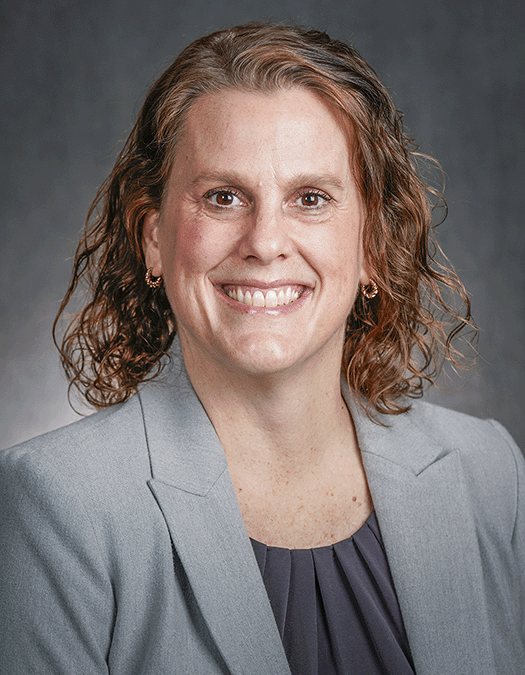
Rep. Kari Rehrauer
Sponsored bills
Maddy summaryThis bill establishes a new low-interest student loan program in Minnesota to help eligible students cover educational costs. The program provides loans with a maximum interest rate of three percent, with annual borrowing limits of $5,000 and a lifetime cap of $20,000 per student. Eligibility is restricted to Minnesota residents attending public or not-for-profit institutions in the state whose household income does not exceed 300 percent of the federal poverty guidelines. The state will fund the program with $17.5 million in fiscal years 2026 and 2027, and the commissioner of the Office of Higher Education will manage the loans and related administrative tasks.
Maddy summaryThis Minnesota bill establishes rules for artificial intelligence chatbots, requiring companies to clearly inform users they are interacting with an AI system and prohibiting chatbots from providing advice on medical, mental health, or legal matters without proper licensing. The legislation creates a legal cause of action allowing users to sue chatbot owners for damages if the AI provides unlicensed professional advice or causes harm, particularly in cases where companion chatbots encourage or enable self-harm. Companies deploying chatbots in Minnesota must display clear warnings in the same language and font size as the chatbot interface, and those operating companion chatbots must take reasonable steps to prevent self-harm while providing crisis support resources when risks are detected. The law defines specific terms like "companion chatbot" and "human-like" interaction to clarify which AI systems fall under these new requirements.
Maddy summaryThis bill modifies Minnesota's rent proration rules to require landlords to charge tenants only for the actual number of days they occupy a rental unit during the first or last month of a lease. It applies to all residential leases, including those that require advance payment of the first or last month's rent, and makes these proration requirements mandatory and unwaivable. The law also prohibits lease clauses that limit tenants' legal remedies for violations of this section, such as mandatory arbitration or class action waivers. These changes take effect immediately upon enactment and apply to new leases signed on or after that date.
Maddy summaryThis bill appropriates $200,000 from the state's general fund in fiscal year 2027 to provide a grant to Helping Paws, Inc. for breeding, training, and placing service dogs for individuals with physical disabilities, veterans and first responders with service-related PTSD, and professionals working in courthouse, educational, and mental health settings. The funding is designated as a one-time honorarium in memory of Speaker Emerita Melissa Hortman. The commissioner of health may also accept private donations to supplement the state appropriation, with all such funds deposited in a dedicated account that expires on July 1, 2028.
Maddy summaryHF 3455 renames Minnesota's State Office Building at 100 Rev. Dr. Martin Luther King Jr. Blvd. in St. Paul as the "Melissa Hortman State Office Building." The bill requires the revisor of statutes to update all official references to the building in Minnesota Statutes and Rules. This is a ceremonial renaming with no policy changes or direct impact on residents or government operations.
Maddy summaryHF 3631 bans hotels and health clubs in Minnesota from providing personal care products (like shampoo, body wash, hand soap, and disposable razors) in disposable plastic containers that guests can take home. It allows the use of refillable dispensers or non-plastic packaging and permits hotels to provide requested items. Violations result in a warning for first offenses, then daily fines up to $500 (capped at $10,000 annually). The ban takes effect January 1, 2027, for health clubs and hotels with 50+ rooms, and January 1, 2028, for smaller hotels.
Maddy summaryHF 3436 requires drivers approaching a stopped school bus displaying flashing red lights to stop at least 20 feet away. The bill amends Minnesota Statutes section 169.444 to mandate this stop until the bus retracts its stop arm and turns off the red lights. It also adds a new provision requiring drivers to prepare to stop within 20 feet when a bus shows prewarning amber lights, signaling red lights are about to activate. This law directly affects all drivers operating vehicles near school buses in Minnesota, aiming to improve safety for children boarding or exiting buses. The bill takes effect the day after final enactment.
Maddy summaryHF 3773 establishes Minnesota's Supplemental Nutrition Assistance Program (MNSNAP), a state-funded program to provide food assistance to Minnesotans who would lose federal SNAP benefits due to upcoming federal restrictions. It directly affects vulnerable groups including veterans, seniors, people experiencing homelessness, foster youth aging out of care, new Americans, and working parents who lost jobs. The bill requires counties to conduct face-to-face assessments within 30 days of enrollment to determine eligibility for federal exemptions or support for meeting federal SNAP requirements. Funding of $X for fiscal year 2027 is appropriated from the general fund to operate MNSNAP, with a moratorium on benefit terminations for those lacking medical or behavioral health assessments after July 1, 2026.
Maddy summaryHF 2461 transfers $10 million from Minnesota's general fund to the housing development fund for one-time use in FY2026. It appropriates $5 million to fund a manufactured home down payment assistance program administered by NeighborWorks Home Partners, helping buyers cover down payments for manufactured homes. Another $5 million funds a program to convert manufactured home parks to cooperative ownership, managed by Northcountry Cooperative Foundation through loans, grants, or subsidies. All converted parks must remain as manufactured home parks for 30 years under a land covenant. The bill directly affects manufactured home buyers and park owners seeking affordable housing options.