

Maddy summaryHF 3809 modifies Minnesota's expedited eviction process for specific situations, directly affecting residential tenants and landlords in cases involving safety threats or property damage. The bill requires landlords to file an affidavit with specific facts proving why an expedited hearing is needed (e.g., tenant endangering others or damaging property), sets strict hearing timelines (5-7 days after summons), and imposes a $500 civil penalty for misuse of the process. It also restricts courts from combining expedited hearings with other claims like nonpayment of rent. This bill applies only to the specified emergency eviction scenarios, not standard eviction cases.
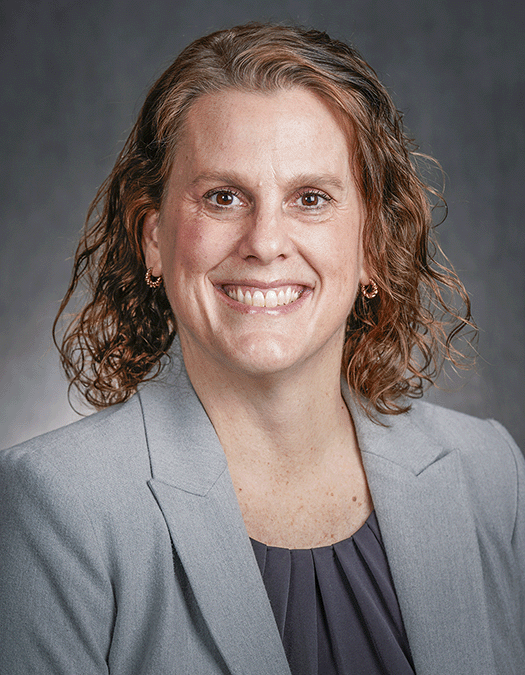
Rep. Kari Rehrauer
Sponsored bills
Maddy summaryHF 2703 extends Minnesota's prohibition on drug manufacturers interfering with access to 340B drugs by removing the law's previous expiration date of July 1, 2027. This means the restriction on manufacturers - preventing them from taking actions that limit access to discounted drugs - will remain in effect indefinitely. The law directly affects drug manufacturers by restricting certain business practices and benefits healthcare providers like hospitals and clinics that participate in the federal 340B program. These providers use 340B discounts to purchase drugs at lower prices for patients, particularly those with low incomes.
Maddy summaryThis bill allocates $1,000,000 from the state's general fund to hire eight additional school safety specialists at the Minnesota School Safety Center for fiscal years 2026 and 2027. The funding is designated as a one-time appropriation that can be used until fully spent, with no restrictions on how the money is distributed among the new positions. This legislation directly affects the Minnesota School Safety Center and the public safety system by increasing the number of available safety personnel. The bill takes effect immediately upon final passage by the legislature.
Maddy summaryThis bill increases funding for Minnesota's Independent Use of Force Investigations Unit by $550,000 for fiscal year 2027. The additional money will be used to hire two new special agents and one criminal intelligence analyst to investigate cases involving police use of force. The unit, which operates under the Bureau of Criminal Apprehension, will receive these resources to expand its investigation capacity. The funding takes effect on July 1, 2026, and is drawn from the state's general fund.
Maddy summaryThis bill requires health plans in Minnesota that offer maternity benefits to cover infertility treatment and standard fertility preservation services for their enrollees. It defines infertility based on medical criteria and specifies that coverage must match the cost-sharing terms applied to maternity care, including limits on oocyte retrievals but unlimited embryo transfers. The legislation also mandates that health plans cannot impose additional restrictions, waiting periods, or benefit maximums on these services beyond what applies to maternity coverage. Additionally, the state will reimburse health plans for the costs of providing these new benefits, but only for services that would not have been covered without this law.
Maddy summaryThis bill creates the Minnesota Business Recovery Loan Program to help businesses that have suffered financial losses due to increased immigration enforcement activities in the state. It appropriates $100 million in fiscal year 2026, with $18 million designated for zero-interest loans to businesses in greater Minnesota and $82 million for zero-interest loans to businesses in the seven-county metropolitan area through nonprofit lenders. To qualify, businesses must be located in Minnesota, owned by state residents, demonstrate a revenue loss of more than 30 percent between enactment and December 1, 2025, and show that losses resulted from staffing shortages, reduced customer access, or other immigration enforcement-related factors. The program provides loans ranging from $25,000 to $200,000 depending on business size and location, which must be used exclusively for business operations in Minnesota and cannot be used to repay prior debt or for real estate speculation.
Maddy summaryThis bill requires Minnesota municipalities to hold at least two public hearings before approving data center development projects. The law mandates that specific information about the project, including the applicant and end user names, facility size and location, security guard details, and utility requirements, be disclosed to the public at least 48 hours before each hearing. These disclosure rules apply regardless of any private agreements that might otherwise prevent the sharing of such information. The requirements would take effect on August 1, 2026, and apply to counties, cities, and towns when considering rezoning petitions or special use permits for data centers.
Maddy summaryThis bill prohibits drug manufacturers from restricting how 340B prescription drugs are delivered to participating hospitals and clinics. It directly affects healthcare facilities enrolled in the federal 340B program, which provides discounted drugs to safety-net providers. The key provision bans delivery restrictions and classifies violations as "unfair or deceptive trade practices," allowing the attorney general to enforce the law. The bill also removes an expiration date (previously set for July 2027) that would have ended the restrictions.
Maddy summaryHF 409 increases funding for Minnesota public school districts by raising local optional revenue allowances. It sets new annual allowance amounts: $250 for first-tier, $300 for second-tier, and $424 for third-tier local revenue starting in fiscal year 2026. School districts calculate their revenue using these allowances multiplied by adjusted pupil units, with levies tied to property values per student. The bill also appropriates additional state funds for general education aid in fiscal years 2026 and 2027. This directly affects all Minnesota school districts receiving state education funding.
Maddy summaryHF 2901 expands the allowable uses of funds in Minnesota's housing tax credit contribution account to include funding supportive services for residents in existing supportive housing. This bill directly affects housing providers operating supportive housing programs, which assist vulnerable populations like seniors or individuals with disabilities. The key change amends Minnesota Statutes § 462A.40 by adding "funding supportive services in supportive housing" to the list of permitted uses, alongside existing options like construction and rehabilitation. It does not create new funding but allows existing account funds to cover essential services like case management or healthcare coordination within current supportive housing developments.