

Maddy summaryThis bill is a resolution from the Minnesota Legislature that formally asks Congress to overturn the Supreme Court ruling in Citizens United v. FEC. It requests that Congress propose a constitutional amendment to clarify that only natural persons, not corporations or other artificial entities, possess rights under the Constitution. The proposed amendment would also state that spending money to influence elections is not protected speech and would allow governments to regulate or limit campaign contributions to ensure equal political access. Additionally, the bill mandates that all permissible campaign spending must be publicly disclosed. Ultimately, the resolution directs state officials to send copies of the text to federal leaders and Minnesota's congressional representatives.
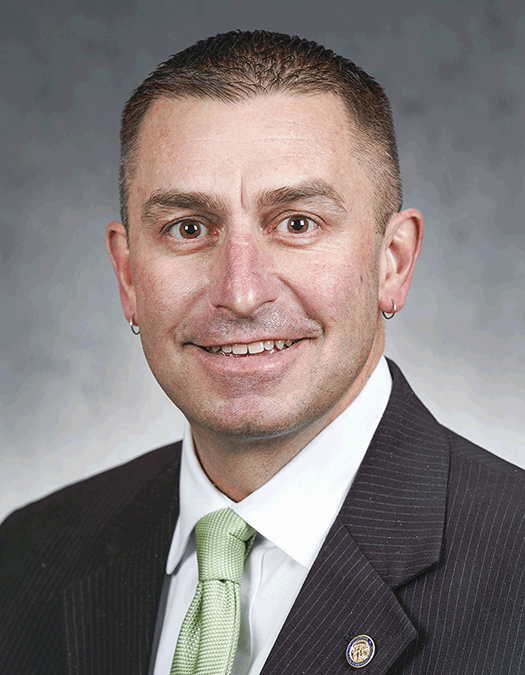
Rep. Josiah Hill
Sponsored bills
Maddy summaryThis bill proposes adding a new section to the Minnesota Constitution to guarantee equal rights and prohibit discrimination for all people. It specifically protects individuals from discrimination based on race, color, national origin, ancestry, disability, and sex, with the definition of sex explicitly including pregnancy, gender identity, and sexual orientation. If voters approve the amendment at the 2026 general election, the change will become effective on January 1, 2027. The text also establishes that any state action denying these rights must be the least restrictive way to achieve a very important government goal.
Maddy summaryThis bill modifies Minnesota's individual income tax rules by allowing taxpayers to subtract Social Security benefits and public pension income from their taxable income. It establishes specific dollar limits and phase-out thresholds based on a taxpayer's filing status and provisional income, ensuring that higher earners gradually lose access to these subtractions. The changes apply to retirees receiving benefits from state pension plans and aim to align state tax treatment more closely with federal standards for public pensions. These provisions take effect for taxable years beginning after December 31, 2022.
Maddy summaryThis bill proposes adding a new section to the Minnesota Constitution to guarantee equality under the law. The amendment would prohibit the state, its cities, counties, and other political subdivisions from denying or abridging rights based on race, color, creed, sex, sexual orientation, gender identity or expression, age, disability, ancestry, or national origin. If approved by voters at the 2024 general election, the change would take effect on January 1, 2025. The measure is titled the "Equal Rights Amendment" and requires a simple yes or no vote from the public.
Maddy summaryThis bill directs the Minnesota Legislature to provide a one-time funding of $25,000,000 from the state's general fund to the Department of Transportation for the Small Cities Assistance Account. The money is intended to support transportation projects in smaller cities within the state, with all funds required to be distributed in the July 2024 payment cycle. The legislation becomes effective immediately upon final passage by the legislature.
Maddy summaryThis omnibus education bill establishes a statewide policy requiring school districts and charter schools to adopt rules governing student cell phone use by March 15, 2025, while directing educational associations to share best practices for managing device-related behavior and learning issues. The legislation also clarifies procedures for high school students to enroll in nonsectarian college courses, mandating that institutions notify schools when students withdraw or miss extended periods of class. Additionally, the bill sets specific limits on online teaching, prohibiting instructors from teaching more than 40 students in a single online course unless a waiver is granted, and ensures that digital instruction remains accessible to students with disabilities.
Maddy summaryThis bill establishes a new program in Minnesota to collect and recycle electronic waste from households and small businesses. It defines specific items that must be recycled, such as computers, monitors, and gaming consoles, while excluding devices like cameras, telephones, and household appliances. The legislation creates a system where an approved organization, known as a clearinghouse, will manage the collection, transport, and recycling of these covered devices. Additionally, the bill sets up new state accounts to fund the program and requires the state agency to submit a report on its progress.
Maddy summaryThis bill authorizes the state to issue approximately $39 million in bonds to fund a grant for the city of Stillwater. The money will be used to design, build, and equip up to three water treatment plants specifically to remove PFAS contaminants from the city's drinking water wells. The legislation also directs the commissioner of management and budget to sell and issue these state bonds to provide the necessary funding. Once enacted, the funds become available immediately for the city to begin the project.