

Maddy summaryHF 536 changes Minnesota's malt liquor licensing by replacing the current 3.2% alcohol limit with a new license allowing up to 5.5% alcohol by volume. It requires cities and counties to automatically issue the new license to existing license holders for both off-sale and on-sale 3.2% malt liquor, eliminating the need for separate applications. The bill repeals specific statutes that defined 3.2% malt liquor and its licensing rules, including restrictions on alcohol content and sale hours. This update removes the legal barrier for retailers to sell stronger malt liquor under the same license structure.
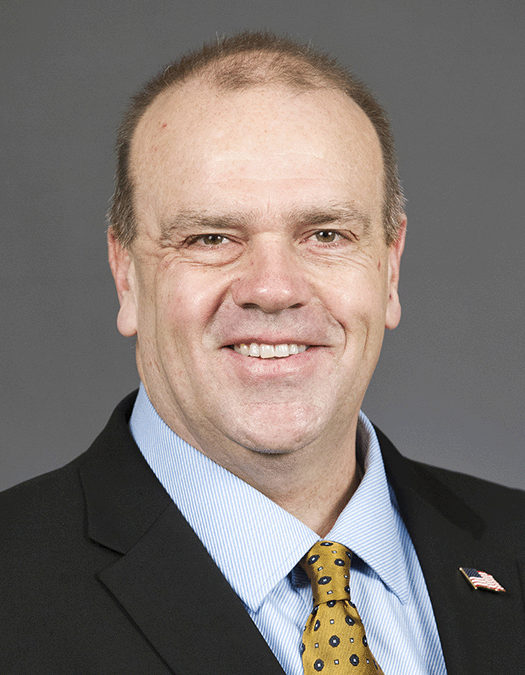
Rep. Matt Bliss
Sponsored bills
Maddy summaryThis bill modifies Minnesota's individual income tax code to clarify that compensation for National Guard and reserve military service qualifies for a tax subtraction. It specifically defines "active service" to include state-activated duty (e.g., disaster response), federally funded service under Title 32, and Active Guard Reserve (AGR) program pay. The change directly affects Minnesota National Guard members, members of neighboring state National Guard units (North Dakota, South Dakota, Iowa, Wisconsin), and other U.S. military reservists performing qualifying service. The policy takes effect for tax years starting after December 31, 2024.
Maddy summaryHF 183 repeals a tax on retail delivery services and changes how transportation tax revenue is distributed. It creates a "Transportation Advancement Account" to allocate funds from sales taxes, directing 36% to metropolitan counties, 28% to county highway funds, and smaller shares to city and town road programs. The bill modifies several tax statutes (including sections 297A.94 and 270C.15) to implement these changes, effective July 1, 2025. This directly affects how Minnesota distributes transportation funding from sales tax revenues.
Maddy summaryHF 4071 modifies the state appropriation for farm down payment assistance grants by adjusting funding levels for various agricultural organizations and programs. The bill specifically changes the budget amounts for entities such as county agricultural societies, the Minnesota Turf Seed Council, GreenSeam, Second Harvest Heartland, and the Emerging Farmers Office. These changes include increasing or decreasing specific dollar amounts allocated for activities like food bank support, local food promotion, agricultural research, and assistance to emerging farmers. The legislation also updates reporting requirements for some recipients to ensure transparency on how the funds are used and the outcomes achieved.
Maddy summaryThis bill requires voters in Minnesota to present a government-issued photo identification card to register to vote and to cast a ballot in person. To support this requirement, the legislation creates a new state voter identification card and mandates that counties waive fees for certified vital records, such as birth certificates, when those documents are needed to obtain the ID. The bill also establishes a process for provisional ballots for voters who cannot produce the required ID on election day and directs the state to report on the number of records issued and the funds appropriated for this program.
Maddy summaryThis bill requires businesses in Minnesota to accept United States currency, including Federal Reserve notes, as payment for goods and services. The rule applies to in-person transactions and allows sellers with multiple locations to comply by accepting cash at just one of their sites. However, banks, credit unions, and businesses that require security deposits or credit card numbers for potential damages are exempt from this requirement. Sellers who refuse cash payments face a civil penalty of up to $250 for each transaction or attempted transaction. The law will take effect on January 1, 2025.
Maddy summaryThis bill removes burial fees for the spouses and dependents of eligible veterans who are interred in Minnesota state veterans cemeteries. It achieves this by deleting the requirement for a fee schedule for these family members and explicitly stating that no plot or interment fees may be charged for them. The change also expands the category of individuals receiving free burial to include all eligible persons defined under federal law, not just those who died on active duty. Directly affected are the families of veterans who would no longer have to pay costs for their loved ones' burial in these specific cemeteries.