

Maddy summaryHF 636 removes the requirement for a permit to carry a firearm in public places for eligible Minnesotans, while creating an optional permit system. The bill amends Minnesota Statutes 624.714 to state that anyone not prohibited by state or federal law (and at least 21 years old) may carry a firearm without a permit in public places - defined as government-owned property or private property open to the public, excluding homes, businesses, gun shops, and hunting areas. An optional permit, which requires proof of pistol safety training and background checks for disqualifying offenses, remains available for those who choose it. This change directly affects eligible residents who currently need permits to carry firearms in public, eliminating that barrier while preserving the option for a permit.
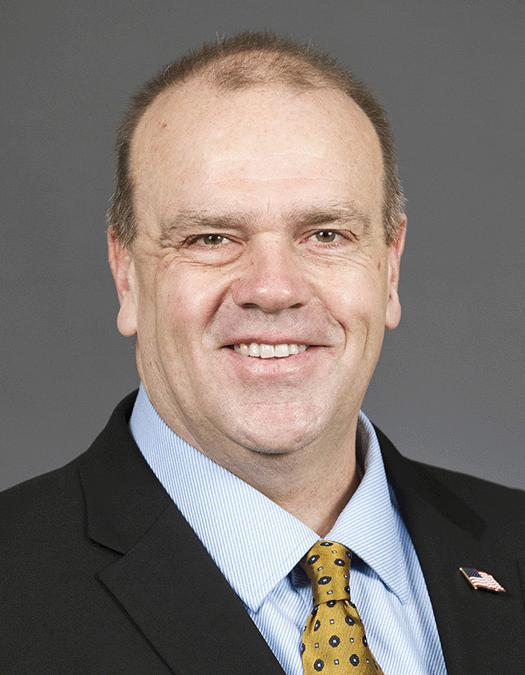
Rep. Matt Bliss
Sponsored bills
Maddy summaryHF 537 allows small farm producers with fewer than 12 animal units (e.g., one cow, five goats, or five sheep) to sell fluid raw milk and raw milk products directly to consumers under specific conditions. It requires annual registration ($0 for under $5,000 sales, $50 for up to $78,000), proof of food safety training, and animal disease testing, along with clear labeling and a "raw milk not inspected" sign at point of sale. The bill exempts these sellers from Minnesota’s pasteurization requirements under Section 32D.20, modifying existing law to permit direct sales at home, farmers' markets, or community events. It directly affects small-scale dairy producers seeking to sell raw milk products without state inspection.
Maddy summaryHF 527 allows developers to use alternative methods for wetland replacement in areas with over 80% wetland coverage, instead of the standard replacement ratio. It permits projects like restoring riparian corridors, stabilizing waterways, or completing approved water quality projects within designated areas, as long as they provide equivalent public value to the impacted wetlands. The bill directs the state board to create rules for implementing these alternatives, including how to measure their public value. This primarily affects developers and land managers working in high-wetland regions of Minnesota.
Maddy summaryHF 528 prohibits state agencies and nonprofit organizations from acquiring land (through purchase or easement) for flood control or water retention projects if the state already owns land within the project area. The bill directly affects entities planning such projects by blocking new land purchases in locations where state-owned land already exists. Its key provision, found in Section 1.8(a), explicitly states this restriction to prevent redundant land acquisitions for flood management. This creates a concrete policy change by requiring project planners to work with existing state-owned land rather than acquiring new parcels.
Maddy summaryHF 535 broadens Minnesota's existing natural disaster debt service aid program to include school districts where at least 30% of property value is excluded from taxable property (e.g., tax-exempt land or buildings). This change allows districts affected by disasters to qualify for aid even if they don't meet the prior $500,000 damage threshold, as long as their tax base is significantly reduced by non-taxable property. The bill amends statutes to adjust how aid is calculated, ensuring districts with high tax-exempt property percentages receive support for debt service costs. It directly affects school districts with substantial non-taxable property, helping them manage financial strain after natural disasters. The amendment applies to bond issues approved on or after July 1, 2025.
Maddy summaryHF 353 provides a refundable sales and use tax exemption for construction materials used in Itasca County's government center projects. It allows businesses to pay tax upfront on eligible materials purchased between May 1, 2021, and December 31, 2024, then get the tax refunded later. The refund process follows existing procedures for similar projects, with claims accepted until January 1, 2026, and payments beginning July 1, 2025. This directly affects Itasca County for its government center construction, reconstruction, or renovation work during the specified period. The bill is funded through the state general fund.
Maddy summaryHF 529 prohibits recipients of certain state legacy funds from using those funds to pay for general overhead costs like rent, utilities, or building maintenance. The bill specifically targets four funds: parks and trails, outdoor heritage, clean water, and arts and cultural heritage. It requires organizations to document any specific increase in overhead costs directly tied to administering a funded program before using legacy funds for those expenses. This applies to all recipients of these state funds, ensuring the money is used only for program-specific costs rather than general operational expenses. The bill amends Minnesota Statutes to clarify these restrictions across all four funding programs.
Maddy summaryHF 534 expands how applicants can submit applications for a Minnesota handgun carry permit. The bill adds electronic submission, fax, certified mail, and certified delivery as acceptable methods alongside in-person submissions. It does not change the required application content, fees, or eligibility criteria. This directly affects individuals applying for or renewing a permit to carry a handgun in Minnesota. The change aims to provide more accessible submission options for applicants.
Maddy summaryHF 533 expands Minnesota's list of offenses that disqualify incarcerated individuals from earning an early release credit based on good behavior. The bill adds specific crimes to the existing exclusions, including certain murders, violent sexual offenses, gang-related crimes, drug trafficking with mandatory minimums, and offenses involving weapons against staff. This directly affects prisoners convicted of these added offenses who would otherwise qualify for the earned incentive release credit under Minnesota Statutes section 244.45. The change makes it harder for individuals convicted of these specific crimes to reduce their sentences through good conduct while incarcerated.
Maddy summaryThis bill requires Minnesota counties to assess and restore historic U.S. public land survey monuments within their boundaries by 2028. It establishes a court petition process for counties seeking to alter preexisting boundary lines, mandating they file documentation and provide notice like other boundary disputes. Counties must document survey corners and file records with county offices, including certificate of location for restored monuments. These requirements apply to boundary changes filed on or after August 1, 2025, with assessments due by December 31, 2027.