

Maddy summaryHF 2526 expands exceptions to Minnesota's ban on gifts to local officials. It adds two new exceptions: (1) free mental health services (like counseling) from nonprofits supporting first responders, provided they're voluntary and not tied to official decisions; and (2) meals or events offering comfort after traumatic incidents involving first responders, open to all affected personnel. These changes apply to local officials like mayors and council members who interact with first responders. The bill modifies Minnesota Statutes section 471.895, adding these provisions while maintaining existing gift restrictions.
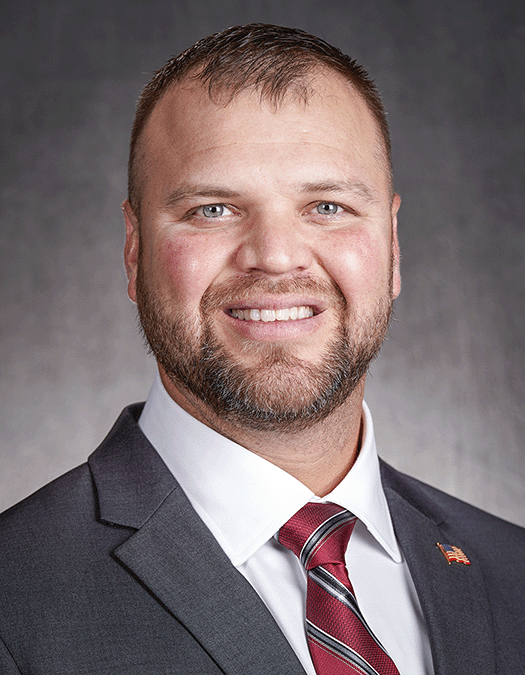
Rep. Bidal Duran
Sponsored bills
Maddy summaryThis bill requires social media platforms to report behavioral threat assessments to educational facilities and religious institutions in Minnesota when users pose a potential threat of targeted violence. The legislation defines key terms such as social media platforms, user-generated content, and targeted violence to establish clear boundaries for compliance. Platforms must implement systems to identify and report threats while protecting user privacy and maintaining existing safety protocols. The bill directly affects social media companies operating in Minnesota and institutions that receive threat reports, creating a new reporting framework for potential violence scenarios.
Maddy summaryThis bill prevents Minnesota's Office of Higher Education from using state funds to support degree programs that have lost eligibility for federal financial aid. It directly affects postsecondary institutions in Minnesota by restricting state money from going toward student financial aid, loans, or grants for these specific programs. The law requires the Office of Higher Education to maintain a public list of affected programs and submit annual reports to legislators detailing enforcement actions and estimated savings. Additionally, the commissioner must create rules to implement these restrictions and track how much state money is redirected away from low-earning programs.
Maddy summaryThis bill requires all property insurance policies in Minnesota to include a formal appraisal process for determining damage amounts when the insurer and policyholder cannot agree. It mandates that both parties select independent appraisers within 20 days of a written demand, who must then choose an impartial umpire to resolve any disagreements on the loss value. The legislation also establishes a two-year statute of limitations for filing lawsuits related to property claims, extending the current one-year deadline for hail insurance cases. These changes will take effect on January 1, 2027, and apply to losses occurring on or after that date.
Maddy summaryHF 3541 clarifies and strengthens the responsibilities of Minnesota's Division of Capitol Security. It requires the division to provide security and emergency escorts throughout the Capitol Area (until July 2026) when requested by state constitutional officers, establish an emergency manager role for security planning and training, and maintain at least one state trooper on duty at the Capitol complex 24/7 with specific investigative training. The bill designates the division as the lead agency for criminal investigations occurring in the Capitol Area, with provisions allowing other agencies to take over only through written agreement. These changes directly affect Capitol Security staff, state constitutional officers, and all individuals accessing the Capitol complex for public or official business.
Maddy summaryThis bill aligns Minnesota's state tax law with the federal tax treatment of tip income. It adds a provision allowing Minnesota taxpayers to deduct qualified tips under the federal Internal Revenue Code (section 224) as a subtraction from taxable income. The deduction applies to taxable years beginning after December 31, 2028, but is effective retroactively for years starting after December 31, 2024. This directly affects Minnesota residents who earn tip income and file individual income tax returns, potentially reducing their state tax liability.
Maddy summaryHF 3524 would allow Minnesota taxpayers to deduct qualified overtime pay from their state taxable income, aligning Minnesota's tax code with a federal deduction for overtime compensation. This bill directly affects Minnesota residents who earn overtime pay and file state income taxes. The key provision adopts the federal definition of "qualified overtime compensation" under Internal Revenue Code section 225, permitting this deduction for taxable years beginning after December 31, 2028, though it applies retroactively to years starting after December 31, 2024. The bill amends Minnesota Statutes 2024, section 290.0132, to add this deduction as a subtraction from taxable income.
Maddy summaryHF 3436 requires drivers approaching a stopped school bus displaying flashing red lights to stop at least 20 feet away. The bill amends Minnesota Statutes section 169.444 to mandate this stop until the bus retracts its stop arm and turns off the red lights. It also adds a new provision requiring drivers to prepare to stop within 20 feet when a bus shows prewarning amber lights, signaling red lights are about to activate. This law directly affects all drivers operating vehicles near school buses in Minnesota, aiming to improve safety for children boarding or exiting buses. The bill takes effect the day after final enactment.
Maddy summaryThis bill exempts certain agricultural land in Minnesota from wetland replacement plan requirements, directly affecting farmers and landowners who work on designated agricultural properties. It removes the need for replacement plans for activities like normal farming practices, soil and water conservation projects, aquaculture, wild rice production, and specific agricultural uses in seven named counties that meet particular planting and land use history criteria. The law requires landowners to provide certified wetland determinations to local governments and the Natural Resources Conservation Service for verification purposes. These changes apply to impacts on wetlands occurring on land labeled as prior-converted cropland or other specific agricultural designations by the USDA's Natural Resources Conservation Service.
Maddy summaryThis bill creates a sales tax exemption for preowned motor vehicles in Minnesota, meaning buyers would not pay the standard sales tax when purchasing a used car. The legislation defines a preowned vehicle as any motor vehicle that has been previously sold, titled, registered, or transferred to someone else and operated before the current sale. The exemption applies to sales and purchases made after June 30, 2026, and would directly affect private individuals and businesses buying used vehicles in the state. The bill amends existing tax statutes to add this new exemption category alongside other existing tax exemptions for specific groups and vehicle types.