

Maddy summaryHF 1260 authorizes special license plates for Minnesota firefighters who are also certified emergency medical technicians (EMTs), advanced EMTs, or paramedics. To qualify, applicants must provide proof of state certification from the Office of Emergency Medical Services, a letter from their fire chief confirming active membership, and own a passenger car, one-ton pickup, or motorcycle. The special plates require an additional fee, must display a distinct emblem, and become invalid if the holder loses either fire department membership or EMT certification. The bill also allows limited plate transfers between qualifying vehicles for a $5 fee and takes effect January 1, 2026.
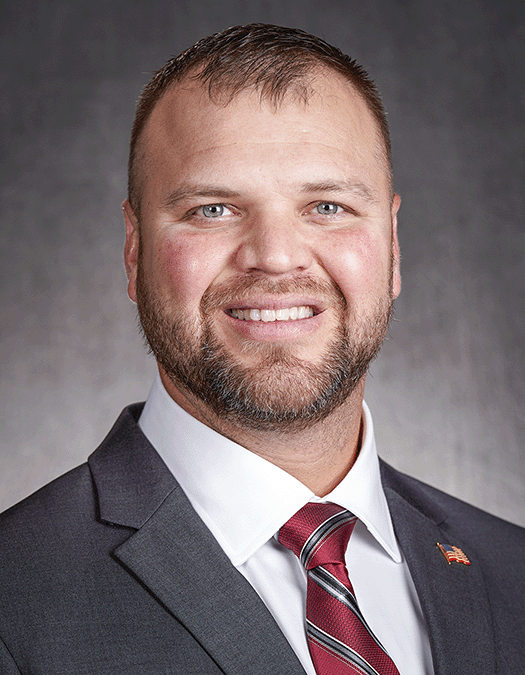
Rep. Bidal Duran
Sponsored bills
Maddy summaryHF 541 establishes a $2.5 million reimbursement program to cover training costs for peace officers on use of force, including deadly force. Certified postsecondary schools providing approved in-service training must meet specific requirements, including scenario-based drills with nonlethal ammunition, stress management instruction, and de-escalation techniques. Schools receive $450 per officer completing the free training, which must be offered at no cost to officers or their law enforcement agencies. The program is administered by the Office of Higher Education using funds from the state general fund.
Maddy summaryHF 3 requires Minnesota's legislative auditor to annually report to the legislature by February 1 on whether state agencies have implemented audit recommendations from the prior five years. The bill mandates that agencies' commissioners must also submit detailed reports by September 1 each year, specifically itemizing unaddressed recommendations and explaining why they weren't implemented. This directly affects all state agencies subject to legislative auditor reviews and their commissioners, who must now document progress on audit findings. The law creates a structured process for tracking accountability without altering agency funding or creating new programs.
Maddy summaryHF 22, titled "Parent's Bill of Rights," establishes specific rights for parents of minor children (under 18) in Minnesota. It requires schools and healthcare institutions to respect parental authority over education, access to school/medical records, moral/religious training, and consent for medical procedures or recordings of minors. The bill prohibits employees from coercing children to withhold information from parents or discriminating against parents who exercise these rights. It explicitly states these rights do not override child abuse laws or court orders, and does not limit other existing parental rights. This bill directly affects parents, schools, and healthcare providers serving minors.
Maddy summaryHF 1528 appropriates $14 million from state bond proceeds to fund a new sanitary sewer system in Northern Township, Beltrami County, specifically for the north and east sides of Lake Bemidji. The bill authorizes the state to issue bonds up to $14 million to cover this cost, with funds administered through the Public Facilities Authority for the township's design, construction, and equipment. This directly affects residents and local infrastructure in Northern Township by upgrading aging sewer collection and treatment systems. The funds are drawn from the bond proceeds fund, as specified under Minnesota Statutes governing state bond sales.
Maddy summaryHF 10 prohibits Minnesota state-funded financial assistance, including health coverage and college scholarships, for undocumented noncitizens. The bill explicitly excludes undocumented noncitizens (defined as those residing without U.S. Citizenship and Immigration Services approval) from MinnesotaCare (state health insurance) and the North Star Promise scholarship program. It amends state statutes to require that these programs deny eligibility to individuals without lawful immigration status. The policy change takes effect upon final enactment, with scholarship eligibility applying to awards beginning in the 2025-2026 academic year.
Maddy summaryHF 1922 requires Minnesota's commissioner of natural resources to submit a report by December 1, 2026, analyzing the state's payment in lieu of taxes (PILT) system for natural resource lands. The report must examine current payment rates, whether payments adequately compensate local governments for lost tax revenue (compared to private land ownership), and the funding impact of acquiring additional land. It directly affects local governments that rely on PILT payments to offset revenue loss from natural resource lands. The report will inform potential changes to Minnesota Statutes sections 477A.11-477A.14, which govern PILT payments. This is a procedural bill focused on analysis, not immediate policy change.
Maddy summaryHF 1875 restricts social media access for minors in Minnesota. It prohibits social media platforms from allowing children under 14 to create accounts, requiring immediate termination of existing accounts (with a 90-day dispute period) and permanent deletion of personal data. For 14-15 year olds, platforms must obtain parental consent for account creation or maintenance; without consent, accounts must be terminated after 90 days. The bill also requires anonymous age verification for websites deemed harmful to minors, meaning platforms must confirm a user’s age without collecting personal information. These rules apply to platforms meeting specific criteria, including features like infinite scrolling or autoplay.
Maddy summaryHF 1463 appropriates $25 million annually (fiscal years 2026-2027) from the general fund for Minnesota town roads and $10 million annually for town bridges. The funds will be distributed under existing rules in Minnesota Statutes section 162.081 to support local road and bridge maintenance programs. This bill directly affects Minnesota's town road and bridge systems by providing dedicated state funding for upkeep. It does not create new policies or alter current distribution methods, only allocating existing budget resources.
Maddy summaryHF 1874 requires a lifetime ban on operating commercial motor vehicles (CMVs) for drivers who use a CMV to commit specific felony offenses. The ban applies to crimes involving controlled substances (like drug trafficking) or forced labor/human trafficking offenses. This law, effective August 1, 2025, also imposes civil penalties for such violations. It directly affects commercial drivers convicted of these crimes by permanently prohibiting them from operating CMVs.