

Maddy summaryHF 14 proposed a temporary moratorium on most light rail transit project development spending by the Metropolitan Council in seven Minnesota counties (Anoka, Carver, Dakota, Hennepin, Ramsey, Scott, and Washington). The bill prohibited funds for planning, design, environmental analysis, land acquisition, and construction of new light rail projects, but exempted the Southwest Light Rail (Green Line Extension) and prior contractor payments. The moratorium would have expired once the Green Line Extension began revenue operations. The bill was introduced, amended, and ultimately not passed by the legislature.
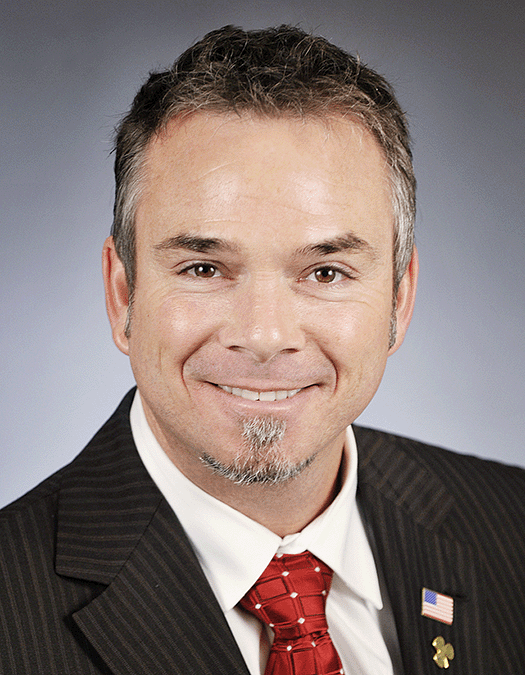
Rep. Joe McDonald
Sponsored bills
Maddy summaryHF 1331 requires the commissioner of natural resources to conduct an annual statewide survey to estimate Minnesota's wolf population. The survey must cover the entire state - not just historic wolf habitats - and be completed each year. This amendment to Minnesota Statutes section 97B.646 (wolf management) adds this requirement to the existing framework, which already includes a wolf management plan and quarterly mortality reporting. The bill directly affects state wildlife management practices under the Department of Natural Resources.
Maddy summaryHF 740 creates a new sales tax exemption for nonprofit animal shelters in Minnesota. It exempts shelters from sales tax on purchases directly used for rescuing, sheltering, and rehoming animals, such as supplies and equipment. However, the exemption does not cover construction materials, lodging/food at fundraising events exceeding 24 days yearly, or gambling-related activities. The exemption applies to sales of animals, associated supplies, and certain fundraising events, effective after June 30, 2025. This directly affects qualifying nonprofit shelters by reducing their operational costs.
Maddy summaryHF 638 prohibits Minnesota cities, counties, townships, and school districts from adopting or enforcing ranked-choice voting (RCV) for local elections. The bill defines RCV as any system where voters rank candidates by preference, and states that any local rules conflicting with this prohibition are void. It directly affects all local governments seeking to implement RCV for local offices, preventing them from using this voting method. The law takes effect after enactment and applies to future elections. This is a policy change restricting local election method choices, not a procedural or commemorative measure.
Maddy summaryHF 1115 adds specific income types as tax subtractions for Minnesota individual income tax filers. It allows taxpayers to subtract overtime pay, tips, bonuses, and winnings from nonprofit gambling organizations from their taxable income. The bill directly affects workers who earn these income types, potentially lowering their state tax burden. All provisions take effect for tax years beginning after December 31, 2024.
Maddy summaryThis bill defines "animal feedlot" in Minnesota law. It specifies that an animal feedlot is a confined area (either designed for manure accumulation or with animal density preventing vegetation) used for raising or holding animals. The definition explicitly excludes pastures and small poultry operations (12 or fewer chickens). This is a procedural definition change with no new regulations or requirements.
Maddy summaryHF 1043 appropriates $10.5 million from state bond proceeds to fund capital improvements at Wright Technical Center in Buffalo, Minnesota. The funds will cover predesign, construction, renovation, and equipment for mechanical, electrical, security systems, utility infrastructure, and site upgrades at the center and its affiliated facilities. The state will issue up to $10.5 million in bonds to provide this funding, following standard state bond procedures. This bill directly affects Wright Technical Center's physical infrastructure and operations.
Maddy summaryHF 114 appropriates $500,000 for fiscal year 2026 and $500,000 for fiscal year 2027 from the arts and cultural heritage fund to provide grants to all 95 Minnesota county agricultural societies. The funds must be distributed equally to each county fair to enhance arts access, education, and the preservation of Minnesota's agricultural, historical, and cultural heritage. This grant program operates in addition to existing funding under Minnesota Statutes section 38.02. The commissioner of agriculture will develop grant criteria and seek public input to guide funding for projects supporting these goals.
Maddy summaryHF 636 removes the requirement for a permit to carry a firearm in public places for eligible Minnesotans, while creating an optional permit system. The bill amends Minnesota Statutes 624.714 to state that anyone not prohibited by state or federal law (and at least 21 years old) may carry a firearm without a permit in public places - defined as government-owned property or private property open to the public, excluding homes, businesses, gun shops, and hunting areas. An optional permit, which requires proof of pistol safety training and background checks for disqualifying offenses, remains available for those who choose it. This change directly affects eligible residents who currently need permits to carry firearms in public, eliminating that barrier while preserving the option for a permit.
Maddy summaryHF 637 clarifies that election judges in Minnesota are not considered employees of the local government body (like a county) that appoints them. The bill specifically prohibits appointing authorities from requiring election judges to meet employment conditions unrelated to their election duties, such as background checks or training typically required for permanent staff. This directly affects election judges and local election officials who appoint them. The bill amends Minnesota law to prevent local governments from imposing unnecessary employment rules on temporary election judges.