

Maddy summaryHF 1513 requires Minnesota voters to present a photo ID when registering to vote and when casting a ballot. It creates a new state-issued voter ID card, which can be obtained without fees for vital records needed to verify identity (per Section 3.1-3.3). The bill establishes provisional ballots for voters who lack ID but provide required documentation, and mandates annual reports on ID card usage. These changes take effect June 1, 2026, and apply to all voters participating in Minnesota elections.
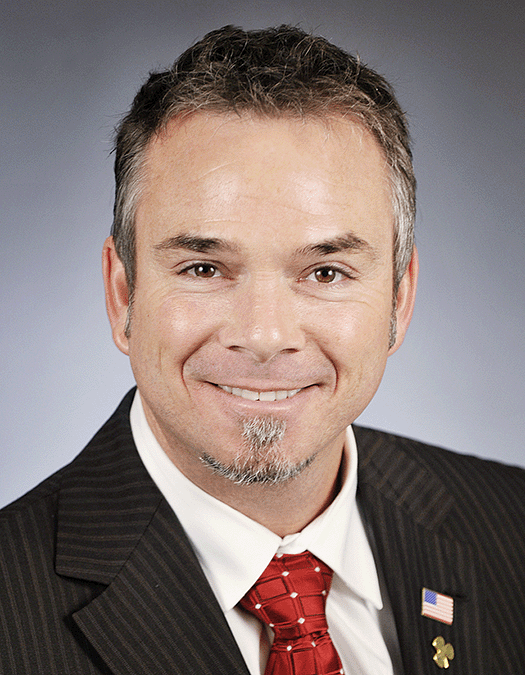
Rep. Joe McDonald
Sponsored bills
Maddy summaryThis bill increases the maximum outstanding debt limit for the State Agricultural Society from $30 million to $50 million, allowing it to borrow more for projects like fairgrounds improvements. It also exempts admissions, parking, and separately ticketed events at the state fair from sales tax, but only for regular state fair events held on the fairgrounds. The debt limit change takes effect July 1, 2025, and the tax exemption applies to sales after June 30, 2025. These changes directly affect the State Agricultural Society's ability to fund operations and the cost for fair attendees.
Maddy summaryHF 749 establishes performance targets for Minnesota's Northstar Commuter Rail line, operated by the Metropolitan Council. It requires annual ridership of at least 900,000 passengers (measured June 1-May 31) or a farebox recovery ratio of 40% or higher starting in 2026. If these targets are not met, the bill mandates automatic termination: ending all service, closing stations, dissolving related agreements, and selling assets. The Metropolitan Council must seek federal waivers for termination obligations and deposit any resulting revenue into the state general fund. This law directly affects the rail line's operations and the entities managing it (Metropolitan Council and state transportation authorities).
Maddy summaryHF 1259 appropriates $350,000 for fiscal years 2026 and 2027 from Minnesota's arts and cultural heritage fund to the Minnesota FFA. The funding directly supports FFA members participating in art- and history-related activities, including creating a history book and video series to commemorate 100 years of FFA work, and covering costs for events like FFA band/choir, talent competitions, and fair displays. Up to $125,000 annually must be used for historical documentation, with remaining funds allocated to other qualifying art and history activities. The commissioner of agriculture will develop grant criteria in consultation with the Minnesota FFA.
Maddy summaryThis bill expands Minnesota's sales tax exemption to include additional baby products, directly affecting parents and caregivers who purchase these items. It adds baby wipes, cribs and bassinets (including mattresses and sheets), changing tables and pads, strollers, car seats and bases, baby swings, bottle sterilizers, and infant eating utensils to the list of tax-exempt items. The exemption applies to sales and purchases made after June 30, 2025. This change removes sales tax from these specific baby products, aligning with the existing exemption for items like breast pumps and baby bottles.
Maddy summaryHF 1476 appropriates $1.65 million from state bond proceeds to fund the rehabilitation of the Salisbury Bridge in Meeker County. This bill directly affects Kingston Township, Forest City Township, or both, by providing grants for designing and constructing the bridge work. The key mechanism involves authorizing the state to issue up to $1.65 million in bonds, following standard state bond procedures, to cover these costs. The funding is specifically for the bridge's rehabilitation, not for other projects.
Maddy summaryHF 1423 amends Minnesota Statutes section 273.124, subdivision 8, to increase the maximum number of shareholders, members, or partners allowed for certain agricultural entities to qualify for homestead property tax treatment from 12 to 18. This change directly affects family farm corporations, joint farm ventures, limited liability companies (LLCs), and partnerships operating farms, allowing them to have up to 18 qualifying members while still qualifying for class 1b or class 2a property tax classifications. The bill does not alter tax rates but expands eligibility for existing homestead tax benefits by raising the shareholder cap. It takes effect for homestead applications filed in 2025 and later.
Maddy summaryHF 1405 amends Minnesota campaign finance rules to require full disclosure of all contributors for legislative or statewide candidates and ballot questions. It lowers the disclosure threshold from $500 to $200 per contributor per year, mandating that campaigns report each contributor's name, address, occupation, and contribution amounts in alphabetical order. This applies directly to candidates running for state legislature or statewide offices, as well as committees supporting ballot questions. The bill changes existing reporting requirements under Minnesota Statutes 2024, section 10A.20, subdivision 3, by expanding transparency for smaller donations.
Maddy summaryHF 2 requires state agency employees to immediately report suspected fraud to law enforcement and legislative committee leaders when they have reason to believe fraud exists in agency programs. It mandates that all state agencies post current organizational charts online with contact details for leadership and division heads. The bill strengthens grant management by requiring agencies to conduct unannounced monitoring visits before final payments for grants over $50,000 (and annually for grants over $250,000), perform financial reconciliations prior to disbursement, and withhold funds from grantees failing to submit required progress reports. Violating these grant management requirements constitutes a misdemeanor under the bill.
Maddy summaryHF 1000 would allow Minnesota taxpayers to deduct all Social Security benefits from their state taxable income without income-based phaseouts. Currently, deductions for Social Security benefits decrease or disappear once income exceeds thresholds (e.g., $100,000 for joint filers). This bill removes those phaseout limits, making the deduction "unlimited" for all qualifying taxpayers. It directly affects Minnesota residents receiving Social Security benefits who file state income tax returns. The change applies to taxable years beginning after December 31, 2024.