

Maddy summaryThis bill allows school districts in Minnesota to use agricultural credit for certain debt service payments on school building bonds. It directly affects school districts, particularly those spanning multiple counties, by clarifying which portions of their tax levies qualify for this agricultural credit. The key provision updates the definition of "levied for debt service" to include specific bond levies and cooperative unit assessments, while excluding amounts used for other postemployment benefits. The changes will take effect starting with taxes payable in 2027.
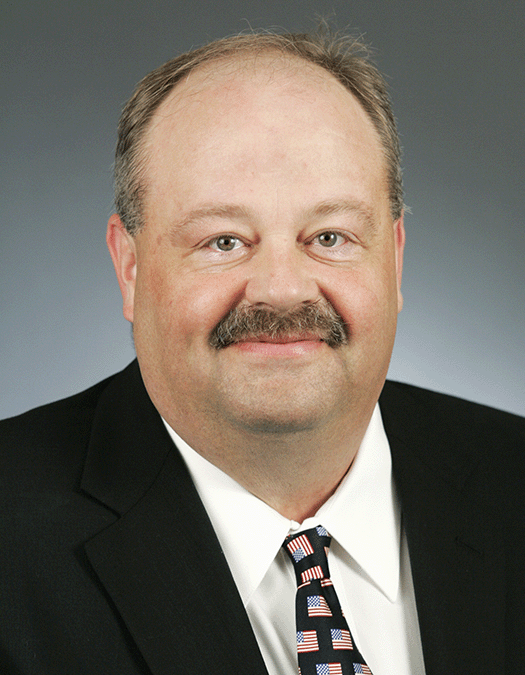
Rep. Greg Davids
Sponsored bills
Maddy summaryThis bill modifies Minnesota's property tax exemption rules for certain properties owned by federally recognized Indian tribes. It allows property used exclusively as medical clinics to be exempt from property taxes if located in cities with fewer than 100,000 people and owned by a tribe within Minnesota. The exemption is limited to no more than five contiguous parcels totaling 30,000 square feet and does not apply to properties used for housing, apartments, agriculture, or forestry. The changes take effect with the 2027 tax assessment year and the exemption will expire after taxes payable in 2038.
Maddy summaryThis bill modifies Minnesota's Mary C. Murphy Library Construction Grants Program to increase funding for public library building projects. It raises the maximum grant amount from $1 million to $2 million for renovating or expanding existing library buildings or constructing new ones, while also requiring libraries to match grants with non-state funds. The legislation authorizes the state to issue up to $10 million in bonds to fund these grants and appropriates that money to the commissioner of education. These changes will take effect for grants awarded after June 30, 2026, and the bond sale can begin immediately after the bill is enacted.
Maddy summaryThis bill updates Minnesota's tax code to align with a recent federal change that excludes employer-paid student loan payments from employees' gross income. It directly affects Minnesota residents whose employers pay their student loans, ensuring their state tax treatment matches federal rules. The legislation amends Minnesota Statutes section 290.01 to explicitly include the federal exclusion for employer student loan payments in the definition of the Internal Revenue Code. Changes made by this bill take effect the day after final enactment, with retroactive application to match the timing of the corresponding federal law changes.
Maddy summaryThis bill authorizes Sherburne County to collect a new 0.25% local sales and use tax if approved by voters in a special election. The tax revenue would be used to fund up to $75 million for building a law enforcement center that includes a jail, covering both construction costs and associated bond expenses. The tax would last for up to 20 years or until the project is fully funded, with any remaining funds going to the county's general fund. The legislation also allows the county to issue bonds without being subject to certain debt limits and without requiring a separate voter approval for the bonds themselves.
Maddy summaryHF 3396 establishes a property tax task force to investigate rising property taxes across Minnesota counties, cities, and school districts. The task force, composed of 6 members including legislators, local government leaders, and the state revenue commissioner, will study causes of tax increases and recommend ways to improve transparency in local government budget reporting. It must submit a report with these recommendations to the legislature by January 15, 2027, which will then require a public hearing during the next legislative session. This bill creates a process for studying property tax issues but does not change current tax laws or rates.
Maddy summaryMinnesota's HF 1269 requires health insurance plans to cover all FDA-approved medical services and prescription medications for treating dementia, including diagnostic tests to assess treatment effectiveness. It also prohibits health plans from using "step therapy" (requiring patients to try cheaper drugs first) for dementia treatments. The bill modifies prior authorization rules for certain medications, ensuring automatic 60-day coverage for brand-name mental health drugs when generics become available, and streamlines approval for oral liquid drugs used with feeding tubes. These changes apply to health plans offered in Minnesota starting January 1, 2026.
Maddy summaryHF 1829 modifies Minnesota's property tax rules for a specific type of resort property called "homestead resort properties." It affects owners of properties that qualify as both recreational resorts (with 3+ rental units, seasonal use, and recreational services) and homesteads (where the owner or a family member lives there). The bill changes how these properties are taxed by adjusting the tier limits: the first $500,000 of value would be taxed at a lower rate, while higher value portions would follow different rules. This amendment applies to properties abutting water or state trails that meet all the specified criteria for seasonal rental and homestead use.
Maddy summaryHF 3332 removes dental, podiatric, chiropractic, optometric/optician, and psychological services from the definition of "health care provider" for tax purposes under Minnesota's health care provider tax. This means providers offering these specific services (like dentists, chiropractors, and optometrists) will no longer be subject to the tax that previously applied to certain health care providers. The bill amends Minnesota Statutes section 295.50, specifically adding these services to the list of excluded providers under subsection 2(b)(6). This change directly affects practitioners in these fields by eliminating a tax burden on their services.
Maddy summaryHF 2062 modifies Minnesota's sales tax payment rules for retailers. It requires large retailers (with $250,000+ annual tax liability) to pay 84.5% of estimated June tax by June 30 and the remainder by August 20, while smaller retailers pay monthly. The bill also creates a "vendor allowance," allowing retailers to retain a portion of collected sales tax (at least $10 or 1% of eligible taxes) to offset collection costs, provided taxes are reported and paid on time. This directly affects most Minnesota retailers, particularly construction material sellers (defined in the bill), and takes effect for sales after June 30, 2025.