

Maddy summaryHF 3127 modifies Minnesota's pass-through entity tax election process, allowing certain businesses (like partnerships and S corporations) to file a single tax return instead of requiring each owner to file individually. It specifies that qualifying entities must meet ownership thresholds (over 50% of qualifying owners) to elect this tax, and the election is irrevocable for the tax year. The bill clarifies that the tax amount equals each qualifying owner's income multiplied by Minnesota's highest individual tax rate, without allowing standard deductions. This directly affects pass-through business owners and entities filing under Minnesota Statutes 289A.08 and 290.06. The changes streamline tax filing for these entities while maintaining the tax calculation method.
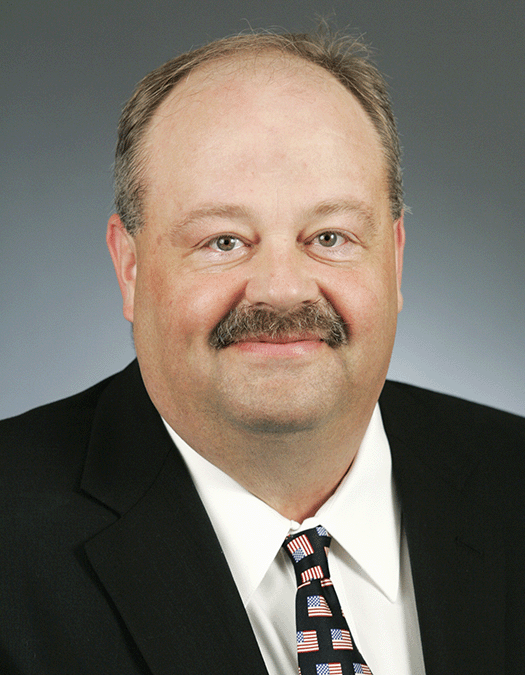
Rep. Greg Davids
Sponsored bills
Maddy summaryThis bill updates Minnesota's state tax code to align with recent federal changes regarding dependent care assistance programs. It directly affects Minnesota taxpayers who receive employer-provided dependent care benefits by ensuring their state tax treatment matches federal rules. The key provision amends the state's definition of the Internal Revenue Code to include new federal exclusions for dependent care assistance, with changes applying retroactively to when the federal law took effect. This adjustment ensures Minnesota residents do not pay state tax on dependent care assistance that is already excluded from federal taxable income.
Maddy summaryThis bill authorizes the city of La Crescent to impose a local sales and use tax if approved by voters in a special election. The tax revenue would be used to cover the costs of collecting the tax and to fund up to $4 million for renovating the La Crescent regional ice arena, including replacing the ice system and installing a solar energy system. The city may issue up to $4 million in bonds to help finance the project, and the tax would expire once the project costs are paid or after a set number of years.
Maddy summaryThis bill requires certain Minnesota businesses to include foreign sales factors when calculating their state tax apportionment percentage, changing how income from foreign operations is counted for state tax purposes. The law applies to taxpayers with foreign sales and modifies the apportionment formula by increasing the weight of sales made within Minnesota relative to total sales, while reducing the weight of property and payroll factors over time. Additionally, it creates a special rule for qualified manufacturers that include global intangible low-taxed income, allowing them to include specific foreign sales in their sales factor calculation. The changes take effect for taxable years beginning after December 31, 2025, and affect businesses subject to Minnesota corporate income tax.
Maddy summaryThis bill allocates $900,000 from the state's general fund to support a transportation management organization serving ten southeastern Minnesota counties. The money is designated for planning, implementation, and operational services related to transit and other transportation options in Dodge, Fillmore, Freeborn, Goodhue, Houston, Mower, Olmsted, Rice, Steele, Wabasha, and Winona counties. The funding is a one-time appropriation available through June 30, 2029, and the bill specifically prohibits using any portion of these funds for administrative expenses.
Maddy summaryThis bill requires Fillmore County jurisdictions to receive back payments for disparity reduction aid from 2024 and 2025 that were not previously distributed. The legislation directs the state revenue and education commissioners to include these missed payments in the 2027 aid distribution to local governments and school districts, ensuring the total aid does not reduce any jurisdiction's 2027 tax levy below zero. The bill also cancels previously appropriated funds for 2025 aid and allocates $530,358 to the revenue commissioner and $482,868 to the education commissioner from the general fund to cover these payments in fiscal year 2028.
Maddy summaryThis bill exempts certain Minnesota counties from complying with specific state mandates if meeting those requirements would cost more than a set percentage of their average tax levy or if their per capita tax base falls below $1,500. Counties seeking this exemption must annually apply to the commissioner of revenue by June 1, who then certifies eligibility by August 1 and notifies relevant oversight agencies. The exemption does not apply to laws governing financial audits or those directly affecting resident safety and health. The bill amends Minnesota Statutes chapter 275 and becomes effective the day after final enactment.
Maddy summaryThis bill provides a specific calculation adjustment for base year formula aid to the city of Northern in Minnesota. It sets the 2026 aid amount used for 2027 funding calculations at $116.91 multiplied by the city's 2024 population. The measure directly affects the city of Northern by determining how much state aid it will receive in 2027. This is a procedural financial adjustment that does not change the overall state aid formula but establishes a fixed value for one municipality's calculation.
Maddy summaryThis bill creates a sales tax exemption for construction materials purchased by contractors working on public projects funded by state money. It directly affects contractors, subcontractors, and builders who supply materials for eligible capital projects financed by the state of Minnesota or local governments. The key mechanism requires the state to collect the sales tax initially and then refund it after June 30, 2026, using funds from the general state budget. The exemption applies only to projects receiving direct appropriations or grants from bills enacted in 2026, and the tax refund process must follow existing procedures for similar public projects.
Maddy summaryThis bill establishes a property tax exemption for specific land owned by federally recognized Indian Tribes in Minnesota. The exemption applies only to property used to store medical clinic equipment and materials, located in cities with populations between 12,400 and 12,800 as of the 2020 census. The law limits the exemption to one qualifying parcel per tribe and excludes any land used for housing, parking, agriculture, or forestry. The exemption will take effect for property taxes payable in 2027.