

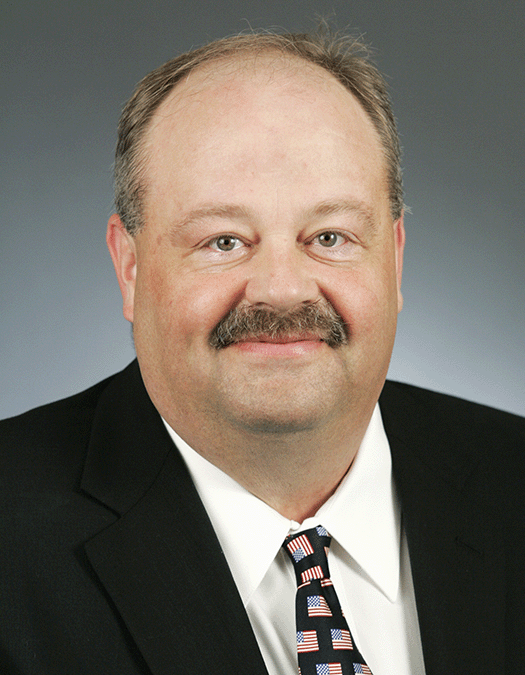
Photo of Greg Davids
R Minnesota House · District 26B On the 2026 ballot

Rep. Greg Davids

Compare
Total votes
2,070
all sessions
Attendance
88%
286 missed
Higher than 75% of chamber peers
With party
95%
of cast votes
Lower than 77% of chamber peers
Bipartisan score
2%
crosses aisle rarely
Higher than 75% of chamber peers
Sponsored
1,350
bills & resolutions
Higher than 87% of chamber peers
Committees
3
assignments
1,350 bills and resolutions

Sponsored bills

Total
1,350
Primary
385
Co-sponsor
965
This page
1,350
matching current filters
Co-sponsor HF 1129
In committee · Minnesota House · Co-sponsor
Sparsity factor established in city aid formula, and money appropriated.

Maddy summaryHF 1129 modifies Minnesota's city aid formula to include a "sparsity adjustment" based on population density. Cities with very low population density - those with fewer than 150 people per square mile for cities over 10,000 residents, or fewer than 30 people per square mile for smaller cities - will receive an additional $200 in their aid calculation. This adjustment directly affects qualifying cities by increasing their state aid amount under the new formula, which takes effect for aid payments starting in 2026. The bill does not change the total annual aid pool but alters how it is distributed based on geographic spread.

In committee Feb 19, 2025 1 co-sponsor
Co-sponsor HF 1104
In committee · Minnesota House · Co-sponsor
Retail delivery fee modified.

Maddy summaryHF 1104 modifies Minnesota's definition of "retail delivery" for tax purposes. It clarifies that retail delivery includes tangible goods sold in Minnesota (excluding diapers and cloth), but excludes in-store pickups or curbside delivery. The bill repeals an outdated definition of "clothing" from existing law, as it is no longer needed. These changes take effect July 1, 2025, and directly affect retailers shipping goods within Minnesota. The bill focuses on defining what triggers the retail delivery fee, not altering the fee amount itself.

In committee Feb 19, 2025 1 co-sponsor
Co-sponsor HF 1115
In committee · Minnesota House · Co-sponsor
Individual income tax subtractions for overtime pay, tips income, bonuses, and winnings from nonprofit lawful gambling organizations provided; and changes to withholding provisions made.

Maddy summaryHF 1115 adds specific income types as tax subtractions for Minnesota individual income tax filers. It allows taxpayers to subtract overtime pay, tips, bonuses, and winnings from nonprofit gambling organizations from their taxable income. The bill directly affects workers who earn these income types, potentially lowering their state tax burden. All provisions take effect for tax years beginning after December 31, 2024.

In committee Feb 19, 2025 1 co-sponsor
Primary HF 1123
In committee · Minnesota House · Lead sponsor
Minneapolis-St. Paul International Airport; refundable sales and use tax exemption provided for construction materials for airport renovation.

Maddy summaryHF 1123 exempts sales and use tax on construction materials used for renovations at Minneapolis-St. Paul International Airport. It directly affects contractors and subcontractors purchasing materials for airport infrastructure projects between July 2023 and December 2027. The bill requires the tax to be collected upfront but then fully refunded through the state's existing refund process. This applies retroactively to purchases made after June 30, 2023, and expires on January 1, 2028.

In committee Feb 19, 2025 0 co-sponsors
Primary HF 940
In committee · Minnesota House · Lead sponsor
Income tax; definition of resident trust modified.

Maddy summaryHF 940 modifies Minnesota's definition of a "resident trust" for income tax purposes. It affects non-grantor trusts (trusts where the grantor isn't taxed on trust income) that may be subject to Minnesota taxation. For trusts established after December 31, 1995, the bill requires two of three location-based criteria to qualify as "resident": (1) most investment decisions made in Minnesota, (2) most distribution decisions made in Minnesota, or (3) trust records kept in Minnesota. This clarifies which trusts must pay Minnesota income tax based on where trust administration occurs.

In committee Feb 17, 2025 0 co-sponsors
Primary HF 947
In committee · Minnesota House · Lead sponsor
Individual income and corporate franchise taxes; subtraction for global intangible low-taxed income established, corporate net operating loss deduction increased, and dividend received deduction increased.

Maddy summaryHF 947 modifies Minnesota's individual and corporate tax codes to provide tax relief for businesses. It creates a subtraction for "global intangible low-taxed income" (GILTI) - foreign profits taxed at low rates under federal law - reducing corporate taxable income. The bill also increases the deduction for corporate net operating losses (allowing businesses to offset more past losses against current profits) and raises the deduction for dividends received from other corporations. These changes directly affect Minnesota corporations, effective for taxable years beginning after December 31, 2024.

In committee Feb 17, 2025 0 co-sponsors
Primary HF 949
In committee · Minnesota House · Lead sponsor
Tax increment financing; uses of unobligated increment clarified.

Maddy summaryHF 949 clarifies how local authorities can use unused tax increment financing (TIF) funds. It allows these funds to be spent on private development projects that create or retain jobs in Minnesota, provided construction begins before December 31, 2025, or to make such projects financially feasible through equity investments. Authorities must create a public spending plan approved by the municipality after a hearing, and all funds must be spent by December 31, 2025 - any unused funds must be returned to the TIF district. This bill directly affects local TIF districts and private developers seeking job-creating projects.

In committee Feb 17, 2025 0 co-sponsors
Primary HF 968
In committee · Minnesota House · Lead sponsor
Individual income tax; eligible expenses for the Minnesota education credit expanded.

Maddy summaryHF 968 expands Minnesota's education tax credit by adding new eligible expenses for families with children in career and technical education programs. It allows tax credit claims for transportation costs related to these programs (section 2.15), required student organization fees (2.21), and specialized equipment not covered by existing textbook provisions (2.23-2.24). This directly affects Minnesota taxpayers with dependents enrolled in approved career and technical education programs. The credit now covers expenses beyond standard tuition and textbooks, including program-specific transportation and materials. The changes take effect for taxable years beginning after December 31, 2024.

In committee Feb 17, 2025 0 co-sponsors
Primary HF 951
In committee · Minnesota House · Lead sponsor
Sales and use tax exemption for telecommunications or pay television services machinery and equipment modified.

Maddy summaryHF 951 modifies Minnesota's sales and use tax exemption for telecommunications and pay television service providers. The bill expands the existing exemption to explicitly include equipment purchased or leased by contractors or subcontractors working for these providers, clarifying that such purchases qualify for tax exemption. Key provisions define covered equipment broadly, including network hardware (routers, fiber, satellites), transportation tools (microwave equipment), and essential support systems (power supplies, HVAC). This change takes effect for transactions after June 30, 2025, directly affecting telecom and pay TV companies purchasing qualifying infrastructure.

In committee Feb 17, 2025 0 co-sponsors
Primary HF 950
In committee · Minnesota House · Lead sponsor
Individual income tax exemption provided for income earned by certain nonresident employees.

Maddy summaryHF 950 exempts Minnesota income tax on wages earned by nonresident workers who perform employment duties in Minnesota for 30 days or fewer annually. It applies only to workers whose primary residence is in another state, who work in multiple states during the year, and whose home state offers similar tax treatment or has no income tax. Employers must track work days via a time and attendance system or documented records to qualify for the exemption and avoid penalties. The policy takes effect for tax years beginning after December 31, 2025.

In committee Feb 17, 2025 0 co-sponsors
Showing 201 to 210 of 1,350 bills
Previous 1 20 21 22 135 Next