

Maddy summaryHF 1773 creates a property tax exemption for personal property at specific natural gas-powered electric generation facilities in Minnesota. The exemption applies only to facilities between 40-50 megawatts with natural gas as the primary fuel, owned by municipal power agencies, located outside the metro area near existing gas pipelines, and meeting resource planning requirements. Facilities must also secure local government approval and begin construction between 2026-2028. The exemption takes effect for property taxes payable in 2029 and excludes transmission lines, pipelines, and interconnections. This directly affects qualifying municipal power agencies building new natural gas plants meeting all specified criteria.
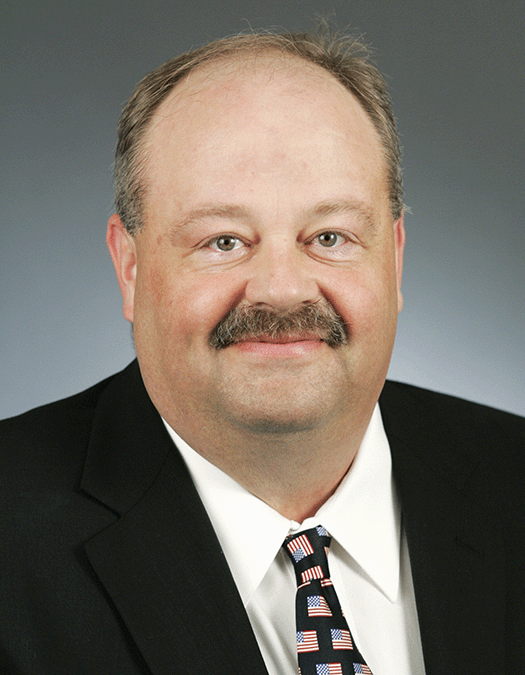
Rep. Greg Davids
Sponsored bills
Maddy summaryHF 1718 updates Minnesota's estate tax law by automatically allowing surviving spouses to use their deceased spouse's unused estate tax exclusion amount. This change eliminates the need for personal representatives to actively file a separate election - portability is now automatic unless explicitly declined on the estate tax return. The bill also removes outdated filing requirements and permits estates not otherwise required to file a return to claim this exclusion by submitting a return. These provisions apply to estates of decedents dying after June 30, 2025, and affect surviving spouses and their personal representatives managing estates with unused exclusion amounts.
Maddy summaryThis bill increases the maximum outstanding debt limit for the State Agricultural Society from $30 million to $50 million, allowing it to borrow more for projects like fairgrounds improvements. It also exempts admissions, parking, and separately ticketed events at the state fair from sales tax, but only for regular state fair events held on the fairgrounds. The debt limit change takes effect July 1, 2025, and the tax exemption applies to sales after June 30, 2025. These changes directly affect the State Agricultural Society's ability to fund operations and the cost for fair attendees.
Maddy summaryHF 1697 modifies Minnesota's tax code to allow Class II and Class III railroads to transfer unused tax credits for infrastructure upgrades (like track, bridges, and sidings) to other businesses. The bill creates a process where eligible railroads can apply for a "credit certificate" for qualified investments, then transfer the unused credit amount via written agreement to eligible taxpayers subject to state income tax. Transferees must document the transfer with the state, and the credit can be used over five years. This applies retroactively to tax years beginning after December 31, 2022, affecting railroads and businesses under Minnesota Statutes chapter 290.
Maddy summaryHF 1006 allows Minnesota local governments to grant property tax abatements (temporary tax reductions) specifically for land bank organizations holding vacant, blighted, or foreclosed properties. It directly affects land banks - defined as nonprofits or affiliated LLCs managing such properties for future development - by adding "allowing the property to be held by a land bank organization for future development" as a valid reason for tax abatements under state law. The bill amends tax statutes to require that abatements for land bank properties last no longer than five years. This change aims to support land banks in stabilizing neighborhoods and preparing properties for redevelopment without long-term tax revenue loss for communities.
Maddy summaryHF 1359 increases funding for solid waste management by changing how fees collected from waste management are allocated. Starting in 2026, 7% of these fees will go to a resource management account (rising to 20% in 2027 and 30% after 2028), instead of the general fund. The funds must be distributed to counties for waste management programs under state law. This directly affects counties receiving these allocations and changes the percentage of fees dedicated to environmental resource management over time. The bill takes effect July 1, 2025.
Maddy summaryHF 1687 creates a sales tax exemption in Minnesota for purchases made by nonprofit organizations focused on preserving specific bird habitats. It directly affects 501(c)(3) nonprofits whose primary work involves developing, preserving, restoring, or maintaining waterfowl, pheasant, or quail habitats in Minnesota. The exemption applies to qualifying items used for these habitat purposes, excluding building materials (under lump-sum contracts), lodging, prepared food, certain beverages, and motor vehicle leases. The law takes effect for sales after December 31, 2025.
Maddy summaryHF 180 establishes "Donate Life" special license plates in Minnesota. Vehicle owners who pay an additional fee (as set for special plates), registration taxes, and a minimum $10 annual contribution to the Donate Life account can obtain these plates. The plates may be transferred between vehicles owned by the same person for a $5 fee. All funds collected from the $10 contributions are deposited into a special account, with money first covering administrative costs and the rest funding Donate Life Minnesota’s mission to promote organ and tissue donation. The program takes effect January 1, 2026.
Maddy summaryHF 1000 would allow Minnesota taxpayers to deduct all Social Security benefits from their state taxable income without income-based phaseouts. Currently, deductions for Social Security benefits decrease or disappear once income exceeds thresholds (e.g., $100,000 for joint filers). This bill removes those phaseout limits, making the deduction "unlimited" for all qualifying taxpayers. It directly affects Minnesota residents receiving Social Security benefits who file state income tax returns. The change applies to taxable years beginning after December 31, 2024.
Maddy summaryHF 1248 modifies Minnesota's sales tax rules to expand exemptions for construction materials purchased by contractors working on projects for specific public and nonprofit entities. It adds a new exemption category (section 297A.71, subdivision 55) covering materials used in buildings or facilities owned by school districts, local governments, hospitals/nursing homes operated by political subdivisions, public libraries, nonprofits, and certain healthcare providers. Contractors must pay sales tax upfront on these materials but will receive a refund under existing procedures (section 297A.75), effectively eliminating the tax burden for these qualifying projects. The bill takes effect for sales after June 30, 2025.