

Maddy summaryHF 3290 would expand a 10% reduction in auto insurance premiums to all car insurance policyholders, removing the current age restriction that limited the discount to drivers aged 55 and older. To qualify, any policyholder must complete a four-hour approved accident prevention course and provide a completion certificate to their insurer. The bill amends existing law to require insurers to offer this discount to all eligible participants, regardless of age. Currently, only drivers 55+ received this benefit under Minnesota Statutes §65B.28.
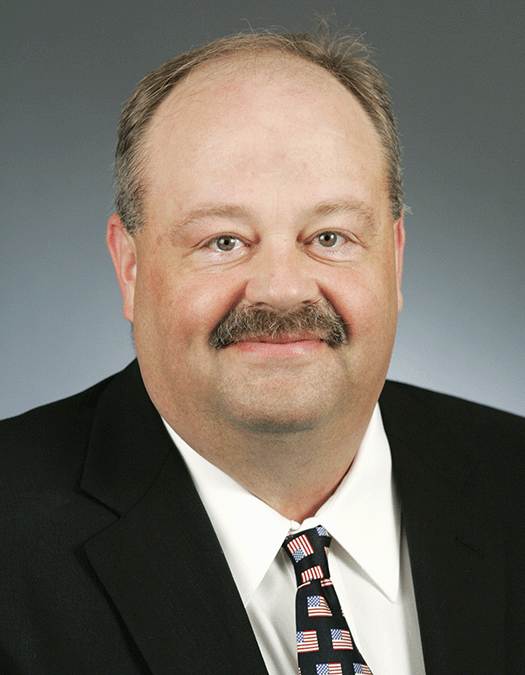
Rep. Greg Davids
Sponsored bills
Maddy summaryHF 200 appropriates $35 million in state funds for Minnesota towns' road and bridge maintenance, with $25 million specifically for roads and $10 million for bridges. The funds will come from bonds issued by the state under Minnesota law, to be distributed by the commissioner of transportation according to existing rules (Minnesota Statutes §162.081). This bill directly affects Minnesota towns needing infrastructure repairs by providing dedicated funding for local road and bridge projects. The bond sales and fund distribution follow established procedures outlined in Minnesota Statutes and the state constitution.
Maddy summaryThis bill modifies Minnesota's property tax classification rules for special agricultural homesteads. It clarifies that properties initially classified as class 2a agricultural homesteads (typically under 10 acres with specific land use requirements) maintain that classification even if adjacent land changes use, as long as the owner still owns at least 20 acres of noncontiguous agricultural land within four townships/cities and meets the agricultural value threshold. The bill also specifies that noncontiguous land must be notified to county assessors to be included in homestead classification. It primarily affects Minnesota farmers who own qualifying agricultural properties meeting these revised maintenance criteria.
Maddy summaryHF 3277 creates tax exclusions for specific railroad property improvements in Minnesota, directly affecting railroad companies operating within the state. The bill adds three new valuation exclusions: one for public transit/light rail improvements (like track upgrades), one for safety improvements funded by state/federal programs (such as rail replacement), and one for environmental safety upgrades (like emission-reducing locomotives). To qualify, improvements must have occurred after 2016, require annual applications by December 31, and are applied proportionally across all railroad property. The bill also modifies how the state calculates property tax rates for railroads by requiring comparison with neighboring states' rates and setting a minimum rate. These exclusions apply retroactively to 2024 assessments and are effective for taxes payable in 2025 and beyond.
Maddy summaryHF 3107 modifies Minnesota's sales and use tax exemption for businesses building large-scale agriculture processing facilities. The bill sets a $100 million capital investment threshold for eligibility, exempting building materials and supplies used in facilities processing agricultural crops (excluding livestock, poultry, or wood products). Tax must be collected at standard rates and then refunded per existing procedures. This change affects businesses planning major processing facility investments exceeding $100 million, effective after June 30, 2025.
Maddy summaryHF 3205 appropriates $235,000 from Minnesota's arts and cultural heritage fund for the 2026 fiscal year to reinstall the Christopher Columbus statue on the State Capitol Mall. The funds are directed to the commissioner of administration, who must work with the Capitol Area Architectural and Planning Board to complete the reinstallation. This bill is procedural, allocating existing funds for a specific physical display without creating new laws or affecting citizens.
Maddy summaryHF 1722 designates a specific segment of U.S. Highway 63 in Minnesota as the "Officer Jason B. Meyer Memorial Highway." The bill specifies the location as the stretch from the intersection with Trunk Highway 16 to the southerly city limit of Racine. It requires the state commissioner to install appropriate signage marking this highway segment. This is a commemorative measure honoring Officer Jason B. Meyer, with no substantive policy changes or direct impact on constituents beyond the highway designation.
Maddy summaryHF 2613 allows irrigators with water-use permits to transfer unused water gallons to other permit holders using the same water source, with the commissioner verifying compliance. It permits using "excess water" (unused gallons from the prior year) during declared drought conditions (D3/D4 on the U.S. Drought Monitor), provided use remains sustainable. The bill also adds 27,154 gallons per acre for irrigation of cover crops when needed, subject to sustainability checks by the commissioner. These provisions directly affect Minnesota irrigators managing groundwater or surface water permits.
Maddy summaryThis bill lowers the age threshold for early retirement reductions in Minnesota's Teachers Retirement Association from 62 to 60. It directly affects teachers who retire before normal retirement age but want to avoid reduced benefits. Specifically, members retiring before age 60 will now face the early retirement reduction, whereas previously the reduction applied only for retirement before age 62. The bill also clarifies procedures for delaying postretirement adjustments, though the exact mechanism isn't detailed in the provided text.
Maddy summaryHF 1680 establishes a property tax exemption for agricultural riparian buffers (vegetation zones along waterways) on specific land classes (2a/2b) in Minnesota, directly affecting landowners who maintain these buffers. To qualify, landowners must apply through county assessors and comply with buffer requirements under section 103F.48, verified by soil and water conservation districts. The bill requires the state to reimburse local governments and school districts for lost property tax revenue caused by the exemption, calculated annually and paid in two installments. Reimbursements are funded from the state general fund, starting in 2026 for property tax exemptions and 2027 for school districts.