

Maddy summaryHF 1161 creates a new funding mechanism for Minnesota school districts with significant seasonal property (like lakeshore areas). It establishes "seasonal tax base replacement aid" that adjusts a district's local tax levy based on the ratio of seasonal property value to total property value, with the adjustment capped between 50% and 100%. The bill appropriates funds to cover this aid, reducing districts' required tax levies without lowering them below zero, starting with taxes payable in 2026. This directly affects school districts that rely on seasonal property taxes for local funding.
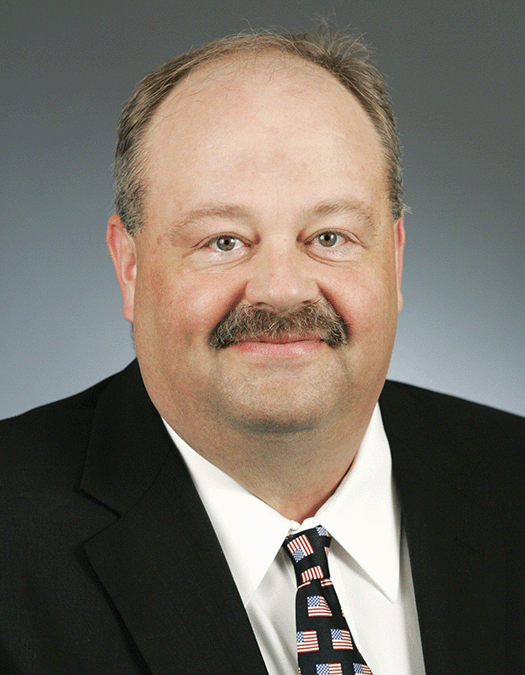
Rep. Greg Davids
Sponsored bills
Maddy summaryThe bill HF 16, titled "Data center regulatory bill," aims to establish regulatory frameworks for data centers in the state. However, the provided context does not include the bill's specific provisions, such as environmental standards, permitting requirements, or tax incentives it may introduce, nor does it identify which entities or communities would be directly affected. The recent actions (adding authors and committee referral to Elections Finance and Government Operations) describe procedural steps but do not clarify the bill's policy content. Without details on the regulatory mechanisms or scope, a substantive summary of the policy changes cannot be provided. For a factual summary, the bill's text or committee report would be needed.
Maddy summaryHF 9 is a comprehensive tax reform bill that modifies multiple tax provisions across Minnesota. It directly affects individuals (through changes to income tax brackets and credits), businesses (including data centers losing electricity tax exemptions), and local governments (by eliminating cannabis aid funding). Key provisions include making the research and development tax credit partially refundable, increasing taxes on cannabis products, and removing the sales tax exemption for electricity at data centers. The bill also adjusts property tax exemptions, modifies corporate franchise taxes, and makes technical changes to various tax statutes.
Maddy summaryHF 3345 eliminates Minnesota's Clean Car rules and prohibits state agencies from adopting rules that restrict consumer choice of fuel types for specific motorized equipment. The bill directly affects consumers, retailers, and manufacturers by banning requirements for retailers to stock certain fuel types (like electric or gas) and preventing rules that limit which fuel sources consumers can purchase for items such as generators, lawn mowers, snowmobiles, and passenger vehicles. Key provisions include repealing specific Clean Car rulemaking authority (Minnesota Rules parts 7023.0150-7023.0300) and explicitly prohibiting agency rules that mandate fuel-source-based inventory or restrict fuel choices. This bill modifies regulatory authority to prioritize consumer choice over fuel-source mandates for the listed equipment categories.
Maddy summaryThis bill (HF 475) is a memorial resolution from Minnesota requesting the Joint Committee on the Library of Congress to approve replacing the statue of Henry Mower Rice in the U.S. Capitol's National Statuary Hall with a statue of Hubert H. Humphrey. It follows a 2000 law allowing states to replace statues after 10 years of display, noting Rice's statue has been in place since 1916. The resolution cites Humphrey's roles as a U.S. Senator, key architect of the Civil Rights Act of 1964, and former Vice President, and states Minnesota will cover costs for removal and installation. The bill itself is procedural - it requests approval but does not enact any policy change.
Maddy summaryHF 2437 creates a $1.50 per gallon tax credit for businesses producing or blending sustainable aviation fuel (SAF) in Minnesota. To qualify, the SAF must be sold to purchasers who certify it will be used in aircraft departing Minnesota airports. Businesses can also earn an additional supplemental credit of up to $0.50 per gallon for SAF achieving carbon emissions reductions beyond 50% compared to conventional jet fuel. This bill directly affects Minnesota-based SAF producers and blenders, aiming to incentivize cleaner aviation fuel production within the state.
Maddy summaryHF 2318 updates Minnesota's Teachers Retirement Association (TRA) system. It increases pension adjustment revenue for school districts (e.g., setting St. Paul's rate at 3.25% for 2026+ and other districts at 2.0% for 2026+), raises employer contribution rates (e.g., requiring 9.5% for coordinated members and 13.5% for basic members by 2025), and provides unreduced retirement annuities for teachers who reach age 62 with 30 years of service. These changes directly affect public school districts (as employers) and TRA members (teachers). The bill appropriates funds to support these adjustments and amends specific sections of Minnesota Statutes.
Maddy summaryHF 2730 modifies how Minnesota counties and cities finance capital projects through bonds. It changes approval requirements: counties can now approve certain bonds (like for capital improvements) with a 3/5 vote of the county board (2/3 for metro counties) without a public vote, unless a petition by 5% of voters triggers a vote. The bill expands eligible projects for state-backed debt guarantees to include jails, courthouses connected to law enforcement facilities, water systems, social services facilities, and certain housing projects. It also requires a $500 fee per bond issue for applications seeking this guarantee, with fees deposited into a dedicated account.
Maddy summaryHF 2257 modifies Minnesota's property tax exemption rules for public charity institutions. It adds a requirement that organizations seeking exemption must provide a "reasonable justification" and factual basis if they cannot meet certain criteria (like community benefit or funding sources), unless they qualify under new exceptions. The bill also clarifies that rental housing properties can only qualify for exemption if the housing directly supports the charity's purpose - not just by housing low-income residents - and excludes government rent assistance or tax credits from counting as donations. This affects nonprofit organizations seeking property tax exemptions under Minnesota Statutes section 272.02, with changes effective for 2025 property taxes.
Maddy summaryHF 2201 increases local optional aid for Minnesota schools and limits state-paid free school lunches to families with incomes at or below 500 percent of the federal poverty level. The bill establishes a "free enhanced school meals program" requiring participating schools to provide two free meals per day (breakfast and lunch) to students from families earning between 185% and 500% of the federal poverty level. It amends school meal financing rules to adjust state aid payments and appropriates funds to support these changes, effective for fiscal year 2026. This directly affects schools, families with children in the specified income range, and the state's education budget.