

Maddy summaryHF 1724 establishes legal definitions and regulatory exemptions for direct primary care service agreements in Minnesota. The bill clarifies that these agreements - where patients pay a direct fee for primary care services (like check-ups and chronic disease management) instead of using insurance - are not considered insurance or health plans under Minnesota law. This means primary care providers (such as physicians or nurse practitioners) offering these agreements do not need insurance licenses or comply with insurance regulations (chapters 60A, 62A, 62C, 62D, or 62N). The bill directly affects primary care providers seeking to offer subscription-based care and patients choosing this alternative to traditional insurance.
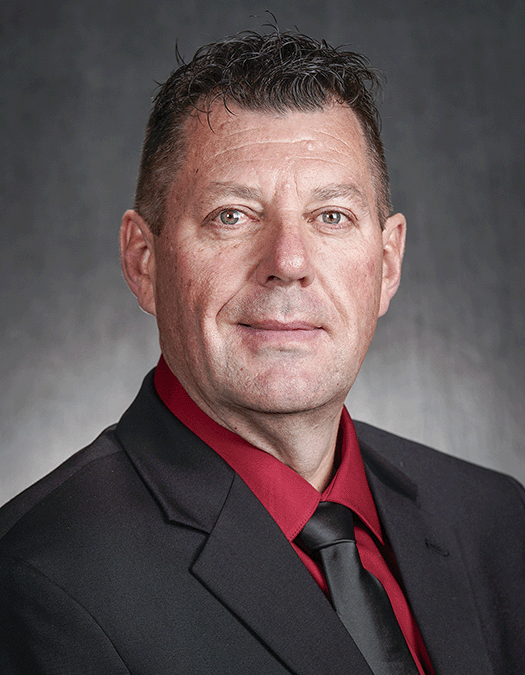
Rep. Ripper Repinski
Sponsored bills
Maddy summaryThis bill creates two new advisory bodies in Minnesota to oversee the modernization of state human services information technology systems used by counties, Indian Tribes, and state agencies. It establishes a dedicated fund that automatically receives money from the general budget whenever the state has a financial surplus, ensuring resources are available for updating these digital systems. The newly formed councils will meet regularly to provide recommendations on how to improve, integrate, and replace existing technology while considering the needs of providers and the public. Additionally, the legislation requires these groups to report their findings to the legislature and mandates that any necessary funding transfers be completed by a specific deadline each year.
Maddy summaryHF 1082 establishes the Minnesota Victims of Crime Account, funded by increased fees/penalties from criminal cases and additional general fund transfers. It appropriates specific funds for fiscal years 2026-2027 to provide grants to organizations that received crime victim service grants in 2024. These grants must support direct services for victims of sexual assault, domestic violence, child abuse, and general crime - including client assistance, housing supports, culturally responsive programming, and prevention efforts like restorative justice. The bill requires services to prioritize underserved communities and reflect Minnesota’s diversity, with up to 10% of funds allowed for grant administration.
Maddy summaryThis bill clarifies how Minnesota school districts and charter schools receive state library aid based on student enrollment. It specifies that regular school districts get aid equal to the greater of $16.11 per student or $40,000, while charter schools receive the greater of $16.11 per student or $20,000. The change retroactively applies to fiscal year 2024 and future years, ensuring consistent funding calculations. This directly affects all public school districts and charter schools eligible for state library aid under Minnesota Statutes.
Maddy summaryThis bill temporarily suspends the state motor fuels tax in Minnesota for a specific period in 2026, directly affecting drivers, fuel retailers, and businesses that purchase gasoline and diesel. Under the legislation, the tax rate is set to zero cents per gallon or per thousand cubic feet for all fuel types during the designated timeframe, which begins shortly after the bill is enacted and ends in early September 2026. To offset the lost revenue from this suspension, the state will transfer money from its general fund to the Department of Transportation to cover the costs that would have been collected from fuel taxes. The bill also allocates a one-time appropriation to the Department of Revenue to cover the administrative expenses required to implement this temporary tax pause.
Maddy summaryHF 3490 authorizes Minnesota to participate in a federal tax credit program by establishing rules for scholarship-granting organizations (SGOs). These SGOs must be 501(c)(3) nonprofits that spend at least 90% of funds on student scholarships, verify household income, prioritize returning students/siblings, and avoid targeting specific students. Organizations must report annually to the Minnesota Department of Education, which will post a public list of approved SGOs. The bill clarifies it does not grant schools additional control over nonpublic schools or their students.
Maddy summaryHF 3793 requires large groundwater users (those exceeding 100 million gallons annually or 50% of a municipality's current water allocation) to apply for their own water-use permits instead of modifying existing municipal permits. This affects industrial and commercial entities, including data centers, whose water use meets these thresholds. Key provisions include mandatory public comment periods for new permits, potential aquifer testing, and monthly reporting for threshold users - compared to annual reporting for smaller users. The bill aims to strengthen oversight of significant groundwater withdrawals while ensuring public input and watershed protection.
Maddy summaryHF 2380 prohibits discrimination against individuals with disabilities in services, programs, or activities receiving state funding in Minnesota. It directly affects public and private entities (like schools, hospitals, and businesses) that receive state money. The bill requires these entities to provide reasonable accommodations and bans exclusion or denial of benefits due to disability. It also specifically prohibits businesses from banning service animals or charging extra fees for them, defining "disability" broadly to include conditions substantially limiting major life activities.
Maddy summaryHF 1327 amends Minnesota's definition of "all-terrain vehicle" (ATV) by increasing the maximum allowable dry weight from 2,000 pounds to 3,000 pounds. The bill clarifies that ATVs must have three to six low-pressure or non-pneumatic tires and a width of 65 inches or less, while explicitly excluding electric-assisted bicycles, golf carts, mini-trucks, dune buggies, and vehicles designed for specific commercial uses like farming or logging. This change directly affects ATV operators, manufacturers, and law enforcement by expanding the weight threshold for vehicles classified as ATVs under state law. The policy adjustment updates regulatory definitions without altering enforcement requirements or creating new restrictions.
Maddy summaryThis bill amends Minnesota statutes to update pension contribution rates and annuity calculation formulas for teachers in the state's retirement systems. It establishes specific employer contribution percentages for certain districts like Minneapolis and Duluth while adjusting the rates for other districts. Additionally, the legislation modifies how retirement annuities are computed based on years of service, distinguishing between different periods of employment and membership types. These changes directly affect teachers and school districts in Minnesota by altering the financial terms of their retirement benefits.