

Maddy summaryHF 654 amends Minnesota's PFAS ban to exempt safety-related items (like helmets, boots, and eye protection) used by juveniles operating all-terrain vehicles or dirt bikes. It allows PFAS in these specific safety products, which are otherwise prohibited under Minnesota Statutes § 116.943, but requires manufacturers to display a permanent warning label stating: "This product contains intentionally added PFAS..." The exemption applies only to safety accessories designed for juvenile operators and does not affect the general ban on PFAS in other juvenile products. This bill directly affects manufacturers and sellers of juvenile ATV/dirt bike safety gear.
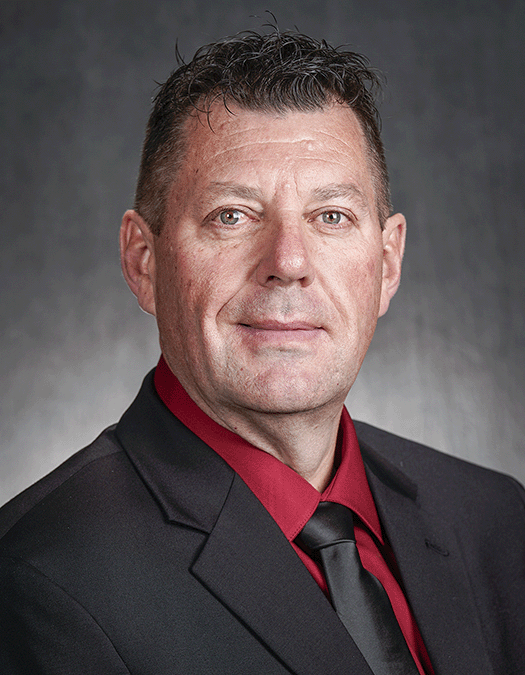
Rep. Ripper Repinski
Sponsored bills
Maddy summaryHF 1463 appropriates $25 million annually (fiscal years 2026-2027) from the general fund for Minnesota town roads and $10 million annually for town bridges. The funds will be distributed under existing rules in Minnesota Statutes section 162.081 to support local road and bridge maintenance programs. This bill directly affects Minnesota's town road and bridge systems by providing dedicated state funding for upkeep. It does not create new policies or alter current distribution methods, only allocating existing budget resources.
Maddy summaryHF 1350 modifies Minnesota's county veterans service office grant program by increasing funding based on each county's veteran population. Counties receive a base $7,500 grant plus supplemental amounts up to $20,000 depending on veteran population size (e.g., $10,000 for counties with 10,000-20,000 veterans). The bill appropriates $60,000 annually for fiscal years 2026-2027 to the Minnesota Association of County Veterans Service Officers, allocating $20,000 each for specialized coordinators focused on women veterans, suicide prevention, and justice-involved veterans. These funds support training, administrative costs, and technical assistance to enhance veteran services statewide. The bill directly affects counties with veterans service offices and the statewide association.
Maddy summaryHF 1473 modifies a $26 million state appropriation for Hennepin County to build a new anaerobic digestion recycling facility in Brooklyn Park. The bill requires Hennepin County to submit a plan for closing the existing Hennepin Energy Recovery Center before funds can be used, and specifies that the project includes demolishing the County Sheriff's facility on the site. This funding covers predesign, construction, and equipment for the new recycling recovery facility. The bill directly affects Hennepin County and residents of Brooklyn Park through the facility's development and the transition from the old recovery center.
Maddy summaryHF 753 allows licensed veterans organizations in Minnesota to use gross profits from lawful gambling for repairing, maintaining, or improving their buildings. Specifically, it amends Minnesota law to permit these organizations to cover costs like water, fuel, electricity, and sewer expenses for their primary headquarters buildings. This change directly affects veterans groups operating legal gambling activities under state licensing. The policy expands their allowable uses of gambling revenue beyond previous restrictions, focusing on facility upkeep rather than other community programs.
Maddy summaryHF 1537 appropriates $44 million from state bond proceeds to fund Minnesota's Port Development Assistance Program under Chapter 457A of state law. The funds must be used for publicly owned port infrastructure improvements, such as docks or equipment. The commissioner of management and budget will issue up to $44 million in state bonds to provide this funding, following established bond procedures. This bill directly affects Minnesota ports seeking capital improvements for public use.
Maddy summaryHF 1466 expands the list of people ineligible for earned incentive release credit under Minnesota's Rehabilitation and Reinvestment Act. It adds specific violent offenses to the existing ineligibility criteria, including second-degree murder (section 609.19), third-degree murder (609.195), first-degree manslaughter (609.20), and second-degree manslaughter (609.205). This means inmates serving sentences for these crimes will no longer qualify for the credit that can reduce their prison time based on good behavior. The bill amends Minnesota Statutes sections 244.45 and 244.46 to reflect these changes.
Maddy summaryHF 1464 appropriates $1.2 million from the general fund in fiscal year 2026 to the Pollution Control Agency for a grant to Rice County, specifically to address water quality concerns at French Lake. Rice County may use these funds for water quality testing, infrastructure improvements, services, training, and maintenance related to the lake. The bill also extends the availability of an existing grant for the same French Lake project through June 30, 2027, under prior law. This legislation directly affects Rice County and French Lake residents by providing dedicated funding for water quality management.
Maddy summaryHF 1467 transfers management of the Minnesota Braille and Talking Book Library from the Department of Education to the Department of Employment and Economic Development. This bill changes who oversees the library's services for people with visual or physical disabilities, requiring the new department to provide these services through a cooperative plan with the National Library Service for the Blind. It also updates rules for the library's advisory committee, including how meetings can be held virtually while ensuring public access and proper voting procedures. The change directly affects library users and the state agencies responsible for delivering these specialized services.
Maddy summaryHF 763 prohibits falsely impersonating a military service member, veteran, or public official with the intent to gain politically or to wrongfully obtain money, property, or other tangible benefits. The bill amends Minnesota Statutes to explicitly add "for political gain" as a prohibited motive, making such impersonation a misdemeanor. This law directly affects individuals who might impersonate these figures to influence elections, campaigns, or political activities. The policy change clarifies and expands existing protections under Minnesota law to address political misuse of identities.