

Maddy summaryHF 2220 prohibits Minnesota state agencies from charging parking fees to state employees at facilities owned or operated by the state. It directly affects all state employees who park on state property, whether working or with manager approval for personal use. The bill amends Minnesota Statutes (sections 16B.04 and 16B.58) to require free parking, removing all fees, fines, or penalties for eligible employees. This change applies to all state parking lots managed under the Department of Administration, ensuring employees receive a free parking permit.
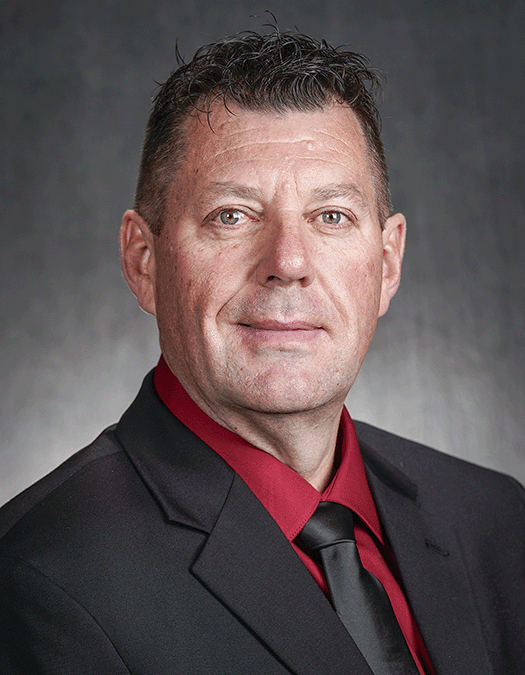
Rep. Ripper Repinski
Sponsored bills
Maddy summaryHF 1358 authorizes Winona County mental health facilities to negotiate an additional monthly rate of up to $750 per bed (including inflation adjustments) for up to 53 beds. This supplementary rate applies specifically to housing support providers operating five facilities in Winona County that offer permanent supportive housing for adults with mental health and substance use disorders. The bill amends Minnesota law to allow counties to cover these extra costs starting July 1, 2025, beyond the standard room and board rate. It directly affects eligible Winona County providers meeting these specific facility and service criteria.
Maddy summaryHF 1261 increases penalties for tampering with motor vehicles and establishes a new offense for passengers who knowingly ride in a vehicle they reasonably should have known was taken without permission. The bill directly affects drivers who tamper with vehicles (e.g., breaking in or damaging them) and passengers who are aware a vehicle was stolen. Its key provision creates a separate crime for passengers who should have known a vehicle was taken, expanding accountability beyond just the driver. The bill amends Minnesota Statutes 609.546, effective August 1, 2025.
Maddy summaryHF 2069 creates new Minnesota license plates specifically for veterans of each U.S. military branch (Army, Navy, Air Force, Marines, Coast Guard, and Merchant Marine). Eligible veterans who meet existing criteria (including having discharge papers) can apply for a free plate featuring "VETERAN" and their branch's emblem. The plates must be the same size as standard plates for the vehicle type (e.g., motorcycle) and can be transferred to another vehicle owned by the same veteran for a $5 fee. This bill, effective January 1, 2026, expands Minnesota’s existing veterans' plate program by adding branch-specific designs.
Maddy summaryHF 1285 declares Minnesota a "mining-friendly state" by amending Minnesota Statutes section 93.001. The bill establishes a formal state policy supporting mineral exploration, development, production, and commercialization through long-term state support. This policy change directly affects the mining industry, state agencies responsible for mineral regulation, and communities near potential mining sites. It does not create new regulations or funding but sets a guiding principle for future state actions related to mineral development.
Maddy summaryThis bill requires Minnesota State Colleges and Universities to locate the IRAP (higher education retirement) account for specific former Winona State University employees who worked from 1991-1996 and have documented payroll deductions for contributions made between 1991-1994. If the account cannot be located within 60 days of the bill's effective date, the institution must pay the eligible person $25,000. The bill specifically applies to employees with verified pay stubs showing deductions for those years, as proof of contributions. It does not create new retirement benefits but addresses a historical record-keeping issue for a defined group of former employees.
Maddy summaryHF 1260 authorizes special license plates for Minnesota firefighters who are also certified emergency medical technicians (EMTs), advanced EMTs, or paramedics. To qualify, applicants must provide proof of state certification from the Office of Emergency Medical Services, a letter from their fire chief confirming active membership, and own a passenger car, one-ton pickup, or motorcycle. The special plates require an additional fee, must display a distinct emblem, and become invalid if the holder loses either fire department membership or EMT certification. The bill also allows limited plate transfers between qualifying vehicles for a $5 fee and takes effect January 1, 2026.
Maddy summaryHF 764 eliminates the statute of limitations for prosecuting first-degree arson in Minnesota. This means prosecutors can file charges for any first-degree arson offense at any time, regardless of when it occurred. The bill amends Minnesota Statutes section 628.26 to remove the previous time limit (previously six years for some cases) specifically for violations of section 609.282 related to arson. It directly affects individuals who commit first-degree arson and the state's ability to pursue such cases, with the change applying to crimes committed on or after August 1, 2025.
Maddy summaryHF 1286 amends Minnesota's vehicle registration tax to provide reduced rates for disabled veterans. It requires the tax on a disabled veteran's vehicle to be lowered to a percentage matching their U.S. Department of Veterans Affairs disability rating, with only one vehicle per veteran eligible for the reduction. The bill also mandates that the state treasury transfer funds from the general fund to the highway user tax fund each July to cover the tax reductions provided under this provision. This change directly affects disabled veterans who own vehicles in Minnesota and alters how vehicle registration tax proceeds are handled for this specific group.
Maddy summaryHF 1951 appropriates $36.5 million from state bond proceeds to fund a new regional public safety facility in Winona. The funds will cover acquiring land, planning, constructing, and equipping a single building to house Winona police, fire, sheriff, and ambulance services. The state will issue up to $36.5 million in bonds to finance this project, following Minnesota's bond laws. This bill directly affects the city of Winona and its public safety departments by enabling a shared facility to replace separate buildings.