

Maddy summaryHF 3293 creates the Minnesota Consumer Financial Protection Bureau (MCFPB) to enforce consumer financial laws and protect residents from unfair or deceptive practices in banking, lending, and other financial services. The bill establishes a commissioner appointed by the governor to oversee the bureau, which will investigate complaints, monitor financial markets, and enforce anti-discrimination rules in consumer finance. It appropriates funding for the bureau’s operations in fiscal years 2026 and 2027, and directs the commissioner to recruit staff with federal CFPB experience. The bureau directly affects Minnesota consumers and financial institutions operating in the state by providing a dedicated enforcement agency for consumer financial protection.
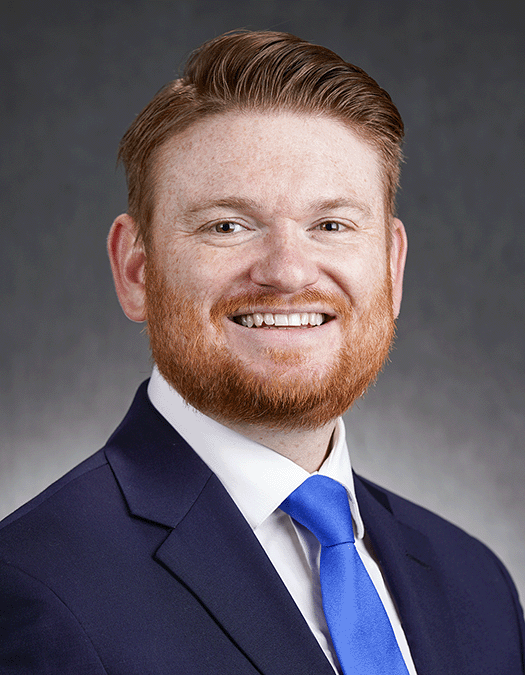
Rep. Andy Smith
Sponsored bills
Maddy summaryHF 2500 prohibits health insurance companies (health carriers) in Minnesota from using algorithms or artificial intelligence to approve or deny prior authorization requests for medical treatments. This applies to all health plans offered, sold, issued, or renewed on or after January 1, 2026. The bill directly affects insurers by requiring human review for these coverage decisions, rather than automated systems. It amends Minnesota Statutes section 62A.59 to explicitly ban AI/algorithm use in this specific process.
Maddy summaryThis bill modifies Minnesota's law on concealing identity in public places. It adds "protection from smoke, gas, or other airborne toxin" as a valid exception for wearing masks or disguises, while clarifying that the law generally prohibits such concealment (except for religious, entertainment, weather, or medical reasons). The bill specifically creates two new exceptions for law enforcement: undercover officers may conceal identity when necessary for investigations or safety, and tactical team members may wear face masks to prevent facial disfigurement. The law would not apply to these officers while performing official duties under these specified circumstances. (Note: This is a proposed bill pending in committee as of February 2026.)
Maddy summaryThis bill modifies eligibility requirements for the Dairy Assistance, Investment, Relief Initiative (DAIRI) program in Minnesota, which provides financial support to dairy farmers. The legislation adjusts the program's funding structure and specifies how allocated money will be distributed across various agricultural research and development initiatives. Key provisions include directing funds toward dairy-related research, equipment modernization, and supporting beginning and transitioning livestock operations. The bill also outlines reporting requirements to ensure transparency in how agricultural funds are utilized and administered.
Maddy summaryHF 3612 prohibits Minnesota state agencies from withholding federal income tax from state employee paychecks. It directly affects all Minnesota state employees whose salaries are processed through the commissioner of management and budget or agency payroll systems. The bill adds a new provision to Minnesota law requiring that federal tax not be deducted during payroll processing and repeals the existing statute (Minnesota Statutes 16A.13) that previously governed this tax withholding process. This changes the state's payroll procedure for federal tax obligations for employees.
Maddy summaryHF 3405 requires Minnesota's Bureau of Criminal Apprehension (BCA) to use its existing Use of Force Investigations Unit to investigate incidents involving federal agents. Specifically, it amends Minnesota Statutes 2024, section 299C.80, to include "federal agents" (defined as those employed by DHS, ICE, CBP, or USCIS) under the unit's duty to investigate cases involving peace officers or federal agents. The bill expands the unit's current mandate - which already covers incidents with state/local officers - to now cover all incidents involving the specified federal agencies. This change directly affects federal law enforcement personnel from those agencies operating in Minnesota.
Maddy summaryHF 3413 prohibits Minnesota state, county, and local government units - including county sheriffs - from entering new agreements with the federal government that allow them to enforce civil immigration law. The bill also requires immediate termination of any existing agreements of this type within 24 hours of the law taking effect. It defines "immigration enforcement agreement" broadly to include contracts, memorandums, or intergovernmental agreements that authorize local entities to carry out federal immigration enforcement actions. This policy change directly affects all state and local law enforcement agencies that previously participated in such federal programs. The law takes effect the day after final enactment, eliminating both new and ongoing participation in these specific federal-local immigration enforcement partnerships.
Maddy summaryHF 3414 creates a new legal pathway for Minnesotans to sue government officials who violate their civil rights under the U.S. or Minnesota Constitution. It allows individuals harmed by such violations to seek damages, injunctions, and attorney fees within six years of the incident. The bill also requires state and local law enforcement agencies to obtain written agreements from federal partners before collaborating, ensuring federal officers follow both U.S. and Minnesota constitutional standards and can be held liable under this new law. This directly affects people experiencing civil rights violations and law enforcement agencies entering federal partnerships.
Maddy summaryHF 3783 requires all local officials in Minnesota to file annual statements of economic interest, expanding the requirement beyond previous categories. It modifies reporting deadlines to 60 days for new hires and 14 days for certain officials after election, and changes where statements must be filed (to the local governing body instead of a central board). The bill amends Minnesota Statutes sections 10A.07, 10A.08, and 10A.09 to implement these changes. This directly affects elected and appointed local officials, including city council members, county officials, and other municipal roles. The law aims to increase transparency around financial interests in local government decisions.
Maddy summaryThis bill prohibits Minnesota law enforcement officers from detaining or transporting suspects in vehicles not specifically designed for human transport, such as standard patrol cars. It requires all such vehicles to be owned/leased by a law enforcement agency, clearly marked with the agency's identification, and equipped with seats and seat belts for each person transported. Exceptions apply during emergencies threatening life/safety or for undercover operations. The law directly affects police departments and officers who transport detainees, aiming to standardize safe transport conditions.