

Maddy summaryHF 1005 adjusts payment rates for healthcare providers under Minnesota's medical assistance program. It increases reimbursement rates for certain residential services, sets a new statewide rate for behavioral health home services, and adjusts physician professional service rates. These changes directly affect hospitals, clinics, and care providers receiving state medical assistance payments for these specific services. The bill amends existing statutes to implement these rate adjustments while requiring budget neutrality for hospital payments. It does not create new programs but modifies existing payment structures for covered services.
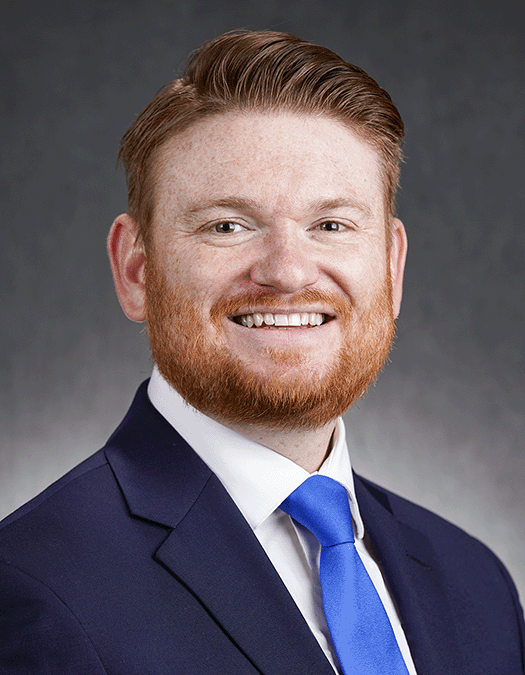
Rep. Andy Smith
Sponsored bills
Maddy summaryHF 2987 establishes fair lending requirements for non-bank lenders providing loans to cannabis businesses in Minnesota. It requires lenders to provide borrowers (cannabis license applicants or holders) with clear, written disclosures at least five days before a loan agreement, including interest rates, fees, payment schedules, and total repayment amounts. The bill prohibits deceptive advertising and makes loans violating these rules void, meaning borrowers wouldn’t owe any payment on such loans. The law applies to loans of $10,000 or more and takes effect August 1, 2025, excluding traditional banks and credit unions.
Maddy summaryHF 1083 amends Minnesota law to prohibit domestic abuse advocates (such as counselors or shelter staff) from disclosing certain client information without consent. The bill specifically states that these advocates cannot share information acquired during professional services, except when the client provides written consent, a crime is involved, or the client sues the advocate. This directly affects domestic abuse survivors seeking help and the advocates who support them. The change updates Minnesota Statutes 595.02 to add this restriction, aligning with existing confidentiality rules for other professionals like social workers and counselors.
Maddy summaryHF 2325 requires Minnesota employers to pay non-exempt employees at least 1.5 times their regular hourly rate for work performed on designated holidays. The bill directly affects hourly workers in Minnesota who are scheduled to work on holidays defined under Minnesota Statutes section 645.44, subdivision 5. It amends existing law (Minnesota Statutes 2024, section 177.25) to add a new provision mandating this overtime pay rate specifically for holiday work. This changes the current standard by explicitly requiring higher pay for holiday shifts, rather than allowing employers to use alternative compensation methods. The bill does not change the definition of "holiday" but specifies the required pay rate when work occurs on those days.
Maddy summaryHF 2505 allows local governments (cities and counties) to adopt alternative road design standards without needing state approval for projects using state-aid funding. It permits them to use specific, nationally recognized design guides (like AASHTO or NACTO standards) instead of following standard state engineering rules, eliminating the need for variance requests for these approved designs. The bill also requires the state transportation commissioner to notify legislators if a variance request is denied, establishes an advisory committee to review such requests, and specifies that certain safety-focused changes (like narrower lanes near schools) must receive special consideration. This directly affects how local road projects are designed and approved under state-aid programs, streamlining the process for communities using approved design frameworks.
Maddy summaryHF 1392 establishes a dedicated "consumer protection restitution account" to handle unclaimed funds from consumer protection cases in Minnesota. It requires that 50% of money recovered by the Attorney General in consumer enforcement actions - where funds aren't specifically designated for victims - be deposited into this account instead of the general fund. The account is used to distribute restitution to eligible consumers (those directly harmed by unlawful practices) who cannot be located or to whom payments weren't redeemed within 120 days, prioritizing cases with the oldest final court orders. This ensures unclaimed restitution money directly benefits victims rather than flowing into general state funding.
Maddy summaryHF 2930 cancels $15 million previously allocated for ALS research and redirects that same amount to fund a new, one-time collaboration between the University of Minnesota Board of Regents and the Mayo Clinic. The $15 million in fiscal year 2026 will support ongoing ALS research aimed at improving patient lives and finding a cure, with funds to be used by the partnership until fully expended or by January 15, 2030. The bill requires the University of Minnesota to submit annual reports starting in 2026 detailing how the funds were used. This replaces prior funding mechanisms established in 2022 and 2024, which are now repealed.
Maddy summaryHF 1522 modifies Minnesota's definition of "agricultural land" for property tax classification purposes. It specifies that agricultural land must consist of either contiguous acreage of 10+ acres used for farming last year, or land used for intensive livestock/poultry confinement (excluding grazing-only land). This change affects farmers and landowners who qualify for lower tax rates on agricultural property, ensuring only land meeting these criteria receives the reduced 0.5% or 1% classification rate. The bill clarifies how mixed-use parcels (like land with windbreaks or timber) are classified under existing tax categories.
Maddy summaryHF 856 creates a new position for a Common Interest Community Ombudsperson within Minnesota’s Department of Commerce to help resolve disputes between unit owners (like condo or HOA residents) and community associations. The ombudsperson will provide free dispute resolution services, maintain a public website with resources about rights and rules, and compile complaints - without making legal rulings or decisions. The bill classifies all personal data collected by the office as "private" or "nonpublic," requiring individual consent or court order for release. It appropriates funding for the office starting in fiscal year 2026, with the position effective July 1, 2025.
Maddy summaryHF 1655 appropriates $627,000 from Minnesota's general fund for fiscal year 2026 to provide technical assistance grants through Community and Economic Development Associates (CEDA). The bill directly supports small rural Minnesota communities that cannot afford economic development services, prioritizing those with the greatest need. Key provisions include funding for CEDA to design and administer tailored community development programs, with up to $270,000 of the appropriation available for implementing specific economic development projects alongside technical assistance. This is a one-time appropriation to enhance local capacity for economic growth in underserved rural areas.