

Maddy summaryHF 666 modifies Minnesota's medical assistance program for employed people with disabilities. It allows individuals who earn above $65 per month (after a $65 earned income disregard) to keep coverage, including a four-month extension if they temporarily lose a job or have a medical condition requiring time off. Enrollees must pay a minimum $35 premium or a sliding-scale fee based on income (1%-7.5% of earnings), with American Indians exempt from premiums. The bill affects Minnesotans with disabilities who work and might otherwise lose health coverage due to earnings changes or job loss.
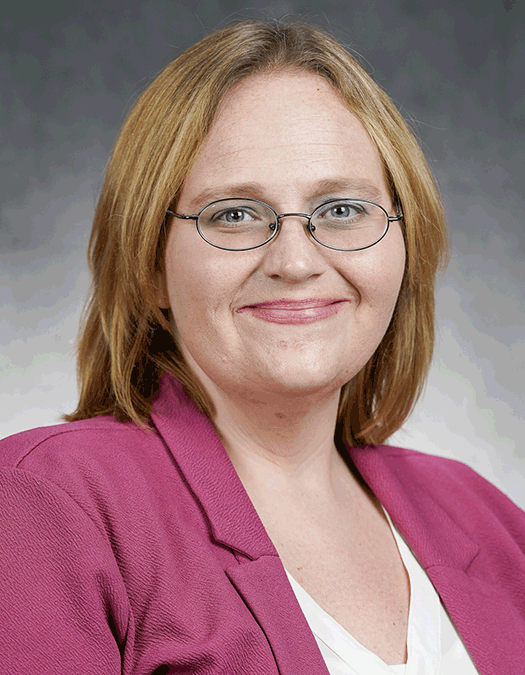
Rep. Kim Hicks
Sponsored bills
Maddy summaryHF 1189 appropriates $250,000 from Minnesota's general fund for the Rochester Area Foundation's Pamoja Women program during fiscal year 2026. The funding supports two specific services: women's health education and parent education programming. This is a one-time appropriation available until June 30, 2027, and directly affects the Rochester Area Foundation's program operations. The bill does not change existing laws but provides dedicated funding for these community services.
Maddy summaryHF 1158 modifies Minnesota's diaper distribution program by awarding a sole-source grant to the Diaper Bank of Minnesota instead of competitive grants. The bill requires the Diaper Bank to demonstrate specific capabilities, including statewide distribution infrastructure, equity commitments, and partnerships with organizations serving high-poverty communities. Grant funds must be used to purchase diapers and wipes, with up to 10% allowed for administrative costs. This change directly affects underresourced families statewide by ensuring consistent diaper access through the Diaper Bank of Minnesota.
Maddy summaryHF 776 appropriates $1.5 million for fiscal year 2026 and $1.5 million for fiscal year 2027 from the general fund to support Minnesota's Family Assets for Independence program. The funding is directed to the commissioner of children, youth, and families to implement the initiative under section 142F.20. This bill provides ongoing financial support for the program but does not change eligibility or program structure. It directly affects the state's administration of the Family Assets for Independence initiative.
Maddy summaryHF 773 prohibits health insurance companies in Minnesota from requiring cost-sharing (like copays or deductibles) for specific short office visits for infants, children, and adolescents. The bill applies when visits are under 15 minutes and focus on evidence-based preventive care aligned with federal Health Resources and Services Administration guidelines. It also requires insurers to allow providers to bill separately for preventive services delivered during these visits. This directly affects health insurers, pediatric providers, and families seeking routine preventive care for young patients. The law amends Minnesota Statutes section 62Q.46 to add these protections.
Maddy summaryHF 665 amends Minnesota's medical assistance rules to raise the income threshold for aged, blind, or disabled individuals from 100% to 133% of the federal poverty guidelines. This change directly affects Minnesotans in these categories who seek state medical assistance, allowing them to earn more while remaining eligible. The bill modifies the existing statute (Minnesota Statutes 256B.056, subd. 4) to align the income limit for this group with other eligibility categories, effective July 1, 2025.
Maddy summaryHF 664 increases Minnesota's medical assistance income limit for two groups: Minnesotans with disabilities and people age 65+ who qualify for state medical aid. The bill amends Minnesota Statutes § 256B.056, raising the income threshold from 100% to 133% of the federal poverty guidelines. This change, effective January 1, 2026, allows more individuals in these categories to qualify for medical assistance without losing benefits due to higher income. It directly affects current or prospective recipients of medical assistance under specific eligibility categories (subdivisions 7, 7a, and 12 of § 256B.055).
Maddy summaryHF 351 establishes a minimum aid amount for cities in Minnesota with unmet needs, specifically requiring that cities located in counties containing a first-class city receive aid of at least $150 multiplied by their population (if their unmet need exceeds zero). The bill amends Minnesota Statutes to set total annual aid distributions at $644 million for 2024-2025 and $722 million for 2026 onward. It modifies how city aid is calculated when certified aid exceeds unmet needs, ensuring no city receives less than its prior year's certified amount minus a small adjustment. The changes take effect for aid payments starting in 2026. This directly affects cities relying on state-local aid programs under Minnesota’s tax system.
Maddy summaryHF 350 establishes guaranteed minimum aid amounts for Minnesota cities receiving state aid. It requires that cities receive at least their previous year's certified aid amount (adjusted for population or levy limits) or their current unmet need, whichever is greater. For first-class cities, it sets a minimum of $150 multiplied by the city's population. The bill also specifies annual aid funding levels, increasing to $657,681,729 for aid payable in 2026 and later. This applies to all cities receiving state local government aid under Minnesota Statutes.
Maddy summaryHF 265, also known as "Brent's Law," requires Minnesota 911 call centers to identify mental health crisis calls and prioritize mental health crisis teams as primary responders when available. It mandates that 911 telecommunicators receive specific training or mental health staff screen calls to recognize crises, and establishes protocols for public safety answering points to comply. The bill also creates a civil lawsuit option for individuals or families harmed by violations, allowing claims for damages, attorney fees, and up to $15,000 in punitive damages for willful violations. This directly affects all Minnesota public safety answering points and the government entities operating them.