

Maddy summaryHF 67 repeals Minnesota's automatic voter registration system, which previously added eligible residents to voter rolls when they applied for or renewed a driver's license or state ID. The bill removes provisions requiring DMV staff to offer automatic registration and eliminates related requirements in statutes governing voter registration (Minnesota Statutes 2024, sections 13.607 and 201.161). It also amends related laws to adjust processes for voter preregistration and application forms. This change directly affects voters who would have been automatically registered through DMV interactions, requiring them to proactively register instead.
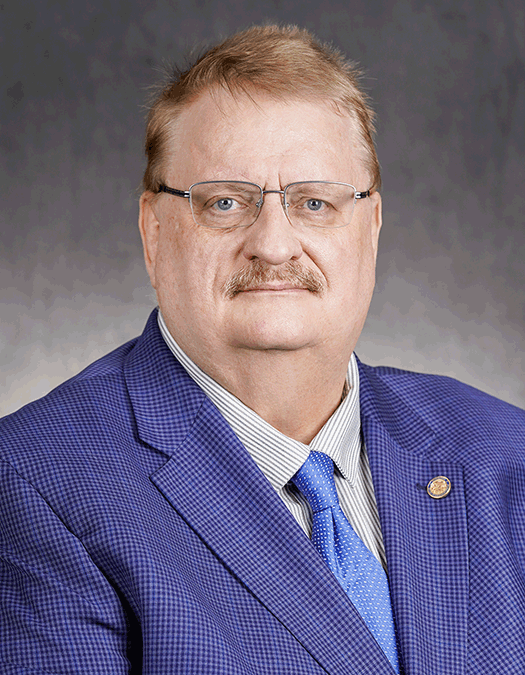
Rep. Duane Quam
Sponsored bills
Maddy summaryHF 1496 requires Minnesota voters applying for absentee ballots to verify their identity before the ballot is mailed. The bill amends election law to mandate that applicants provide a Minnesota driver's license number, state ID number, or last four Social Security digits. The secretary of state must verify this information against government databases before county auditors can mail ballots. This applies to all absentee ballot applicants except those in town elections held in March. The law aims to prevent fraudulent applications by confirming voter identities prior to ballot delivery.
Maddy summaryHF 558 authorizes law enforcement and licensing agencies to include arrest and investigative records (not convictions) in criminal history background checks. This affects job applicants, particularly for public safety positions or roles requiring background checks, as it expands the information considered beyond final convictions. The bill adds a specific provision to Minnesota Statutes (chapter 299C) allowing background checks to include records of arrests that did not result in criminal charges. It does not change existing requirements for background checks but explicitly permits the inclusion of this additional information.
Maddy summaryMinnesota's legislature has passed a resolution requesting Congress to call a constitutional convention under Article V of the U.S. Constitution. The resolution asks for proposed amendments to impose budget rules on federal spending, reduce federal government authority over states, and limit terms for federal officials and members of Congress. This is a procedural step - Minnesota is formally petitioning Congress, not creating new laws. The resolution serves as Minnesota's ongoing application for such a convention, pending similar actions by two-thirds of states.
Maddy summaryHF 914 allows Minnesota school districts hiring a teacher currently employed by another district to request access to that teacher's personnel file. The hiring district can inspect the file, but the teacher's current district must provide it, inform the teacher of the request, and the hiring district cannot cancel a scheduled interview based on the file contents. This bill directly affects school districts seeking new teachers and the teachers themselves who are considering job changes. It creates a new procedure for accessing personnel files while adding protections for teachers regarding interview processes. The bill amends Minnesota Statutes sections 122A.40 and 122A.41 to establish these specific access rules.
Maddy summaryHF 561 amends Minnesota law to authorize law enforcement agencies to use drones (unmanned aerial vehicles) for specific safety purposes. It directly affects law enforcement agencies across Minnesota by expanding permitted drone use to locate missing persons (including children and vulnerable adults), track individuals fleeing arrest, and find incarcerated persons who have escaped from correctional facilities. The bill specifies these uses must occur during emergencies, natural disasters, or when there's reasonable suspicion of criminal activity. It updates Minnesota Statutes § 626.19, subdivision 3, to explicitly include these scenarios as authorized drone applications. The law does not permit general surveillance but restricts drone use to the listed safety-related circumstances.
Maddy summaryHF 2343 changes Minnesota's state primary election date from August to May, affecting all voters participating in statewide primary elections. It also modifies the timing for primary elections conducted by local political subdivisions (like cities or towns) under specific circumstances. The bill amends multiple election statutes to implement these date changes, including sections governing primary scheduling and polling place operations. This policy change directly impacts election administrators, local governments, and voters participating in Minnesota's primary elections.
Maddy summaryHF 66 establishes a fixed 7- to 10-day filing period (excluding holidays) for candidates seeking to fill vacant Minnesota state legislative seats through special elections. It standardizes the timeline by requiring such elections to occur within 35 to 45 days of the governor issuing a writ, depending on the vacancy timing, and prohibits elections during specific holiday periods. This bill replaces prior flexible rules with clear, consistent deadlines for all legislative vacancies. The changes apply to vacancies occurring on or after the bill's effective date.
Maddy summaryHF 2272 provides $8 million in state funding to improve intersections along U.S. Highway 14 in Byron, Minnesota. The bill appropriates $5.6 million from the state transportation fund and $2.4 million from the trunk highway fund, financed through state bonds, to replace at-grade intersections and traffic signals with grade-separated interchanges. This specifically targets intersections with Olmsted County State-Aid Highways 3 and 5 in Byron, covering environmental analysis, design, right-of-way acquisition, and construction. The funding directly supports Byron city and Olmsted County for infrastructure upgrades on this highway corridor.
Maddy summaryHF 1358 authorizes Winona County mental health facilities to negotiate an additional monthly rate of up to $750 per bed (including inflation adjustments) for up to 53 beds. This supplementary rate applies specifically to housing support providers operating five facilities in Winona County that offer permanent supportive housing for adults with mental health and substance use disorders. The bill amends Minnesota law to allow counties to cover these extra costs starting July 1, 2025, beyond the standard room and board rate. It directly affects eligible Winona County providers meeting these specific facility and service criteria.