

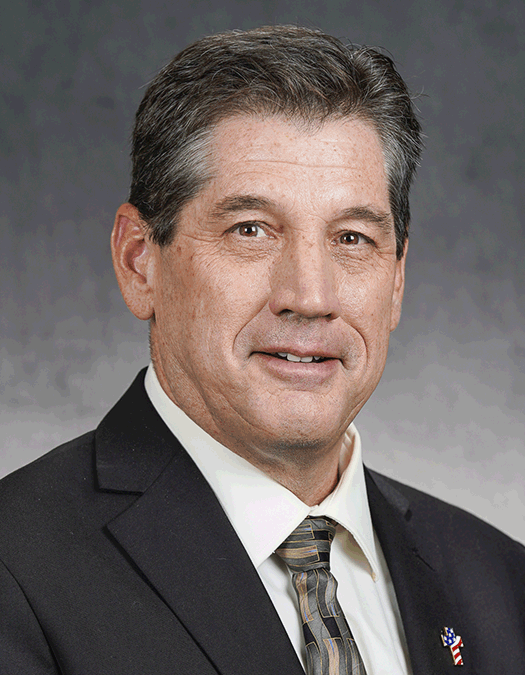
Photo of Steve Jacob
R Minnesota House · District 20B

Rep. Steve Jacob

Compare
Total votes
1,335
all sessions
Attendance
98%
21 missed
Higher than 77% of chamber peers
With party
94%
of cast votes
Lower than 96% of chamber peers
Bipartisan score
3%
crosses aisle rarely
Higher than 94% of chamber peers
Sponsored
189
bills & resolutions
Near the chamber average
Committees
4
assignments
189 bills and resolutions

Sponsored bills

Total
189
Primary
36
Co-sponsor
153
This page
189
matching current filters
Co-sponsor HF 3251
In committee · Minnesota House · Co-sponsor
License to sell scrap metal copper eliminated.

Maddy summaryHF 3251 eliminates the requirement for a license to sell copper scrap metal in Minnesota. The bill repeals Minnesota Statutes 2024, section 325E.21, subdivision 2c, which previously mandated the license. This change means sellers of copper scrap metal no longer need to obtain or maintain a separate license. The bill directly affects copper scrap metal sellers and scrap metal dealers, who no longer need to verify a copper-specific license for transactions. The repeal removes the existing licensing requirement without introducing new rules for copper sales.

In committee Feb 17, 2026 1 co-sponsor
Co-sponsor HF 15
In committee · Minnesota House · Co-sponsor
Student and staff safety measures required to be included in each school district's long-term facilities maintenance school facility plan, school security systems grants created, report required, and money appropriated.

Maddy summaryHF 15, the "Safe Haven In Every Local District (SHIELD) Act," requires all Minnesota public school districts and charter schools to include specific student and staff safety measures in their long-term facility plans by August 2025. The bill creates new grants to fund comprehensive security systems, including features like bullet-resistant doors, emergency alert systems, and staff training, with priority given to schools serving the most students. School districts must apply for these grants through the Minnesota School Safety Center, which will rank applicants and provide lists of approved vendors. The law appropriates funds from the general fund for fiscal year 2026 to support these security upgrades and plan updates.

In committee Feb 17, 2026 1 co-sponsor
Co-sponsor HF 3297
In committee · Minnesota House · Co-sponsor
Proof of lawful presence in the United States required to obtain driver's license or identification card.

Maddy summaryHF 3297 requires all applicants for a Minnesota driver's license or identification card to provide proof of legal presence in the United States. This change directly affects anyone seeking to obtain or renew these documents, adding a new eligibility requirement to existing rules. The bill amends Minnesota Statutes to explicitly prohibit issuing licenses to applicants who fail to provide this proof, aligning with federal requirements under 8 U.S.C. §1324. The intent is stated as enhancing public safety while complying with federal law, without altering other existing licensing conditions like vision tests or driving experience.

In committee May 6, 2025 1 co-sponsor
Co-sponsor HF 1620
In committee · Minnesota House · Co-sponsor
Keys, key chains, and key rings removed from the prohibition on lead and cadmium in consumer products.

Maddy summaryHF 1620 removes keys, key chains, and key rings from Minnesota's restrictions on lead and cadmium in consumer products. The bill amends Minnesota Statutes by updating the definition of "covered product" to exclude these items from the list of products subject to chemical limits. This change directly affects manufacturers and sellers of keys and key accessories in Minnesota, allowing them to use lead or cadmium without violating the law. The bill modifies existing regulations without creating new requirements, focusing solely on clarifying which products are regulated.

In committee May 5, 2025 1 co-sponsor
Co-sponsor HF 2316
In committee · Minnesota House · Co-sponsor
Property tax; special agricultural homestead requirements modified.

Maddy summaryThis bill modifies Minnesota's property tax classification rules for special agricultural homesteads. It clarifies that properties initially classified as class 2a agricultural homesteads (typically under 10 acres with specific land use requirements) maintain that classification even if adjacent land changes use, as long as the owner still owns at least 20 acres of noncontiguous agricultural land within four townships/cities and meets the agricultural value threshold. The bill also specifies that noncontiguous land must be notified to county assessors to be included in homestead classification. It primarily affects Minnesota farmers who own qualifying agricultural properties meeting these revised maintenance criteria.

In committee May 1, 2025 1 co-sponsor
Co-sponsor HF 3255
In committee · Minnesota House · Co-sponsor
Imposition of certain taxes during a shutdown period prohibited.

Maddy summaryHF 3255 prohibits Minnesota employers from deducting and withholding wage taxes, and bars the collection of sales or excise taxes (like those on goods or services), during a government shutdown period. Specifically, it prevents these tax collections on wages paid or transactions occurring during the period starting July 1 of an odd-numbered year when funding bills for state government operations (executive, legislative, or judicial branches) haven't been approved for the upcoming biennium, plus 10 days for wage taxes or 3 days for consumption taxes. This directly affects employers who normally withhold income tax and businesses that collect sales tax during these funding gaps. The law amends Minnesota Statutes to add these temporary tax exemptions, effective upon final enactment.

In committee Apr 29, 2025 1 co-sponsor
Co-sponsor HF 601
Passed · Minnesota House · Co-sponsor
Depredation compensation payment funding provided, and money appropriated.

Maddy summaryHF 601 appropriates $125,000 for livestock depredation compensation and $125,000 for crop damage compensation under Minnesota law, directly affecting farmers who suffer wildlife-related losses. The livestock funding covers compensation for destroyed or crippled livestock and allows up to $5,000 for university educators to assess fair market values. The crop funding supports compensation for damaged crops, includes $10,000 for claim investigations, and allocates $40,000 for grants to protect stored crops from elk. Both funds are one-time appropriations available until June 30, 2026.

Passed Apr 22, 2025 1 co-sponsor
Co-sponsor HF 500
In committee · Minnesota House · Co-sponsor
Nursing Home Workforce Standards Board modified.

Maddy summaryHF 500 repeals Minnesota's Nursing Home Workforce Standards Board and related statutes (sections 181.211-181.217) that previously established requirements for nursing home staffing and worker protections. This bill directly affects nursing home employers in Minnesota by removing these specific regulatory standards. The key mechanism is the complete repeal of the board and its associated provisions, eliminating the legal framework that required nursing homes to comply with workforce standards and penalties for noncompliance.

In committee Apr 21, 2025 1 co-sponsor
Co-sponsor HF 3154
In committee · Minnesota House · Co-sponsor
Rural Policy and Development Center grants funding provided, and money appropriated.

Maddy summaryHF 3154 appropriates $200,000 for fiscal year 2026 and $200,000 for fiscal year 2027 from the general fund to provide grants to the Rural Policy and Development Center. The funds are allocated through the commissioner of agriculture under Minnesota Statutes section 116J.421. This bill directly affects the Rural Policy and Development Center by providing dedicated funding for its operations and grant programs in Minnesota.

In committee Apr 10, 2025 1 co-sponsor
Co-sponsor HF 20
Failed · Minnesota House · Co-sponsor
Data classification of certain data maintained by the attorney general clarified.

Maddy summaryHF 20 clarified which data maintained by Minnesota's Attorney General's Office must be treated as "private data" under state law. It specifically designated five categories as private: disciplinary records (excluding public hearings), non-final administrative communications, consumer complaint data (excluding confidential data), inactive investigative files, and detailed home protection hotline information (like mortgage details and income). This change directly affects the Attorney General's Office by requiring them to handle these specific data types with privacy protections. The bill was introduced in 2025 but was not passed by the legislature and was laid on the table.

Failed Apr 10, 2025 1 co-sponsor
Showing 51 to 60 of 189 bills
Previous 1 5 6 7 19 Next