

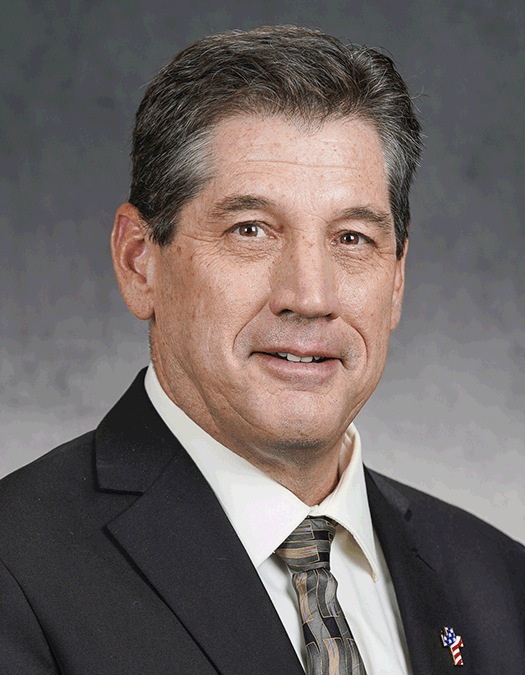
Maddy summaryThis bill designates a specific segment of Trunk Highway 58 in Zumbrota as the "Officer/Firefighter Gary L. Schroeder, Jr. Memorial Highway." It directly affects the public traveling that highway segment by renaming it in honor of a fallen public safety officer. The key provision requires the state transportation commissioner to adopt signage designating the highway and erect appropriate markers, as specified in Minnesota Statutes. This is a symbolic, non-policy change to commemorate an individual.

Sponsored bills
Maddy summaryThis bill proposes adding a new section to the Minnesota Constitution that explicitly states a preborn child has a right to life. It defines a preborn child as a living human fetus from fertilization until live birth and requires voter approval at the 2026 general election for the amendment to take effect in 2027. The text includes specific language ensuring that medical treatment to save a pregnant person's life or the removal of a nonviable or deceased fetus remains allowed.
Maddy summaryThis bill temporarily suspends the state motor fuels tax in Minnesota for a specific period in 2026, directly affecting drivers, fuel retailers, and businesses that purchase gasoline and diesel. Under the legislation, the tax rate is set to zero cents per gallon or per thousand cubic feet for all fuel types during the designated timeframe, which begins shortly after the bill is enacted and ends in early September 2026. To offset the lost revenue from this suspension, the state will transfer money from its general fund to the Department of Transportation to cover the costs that would have been collected from fuel taxes. The bill also allocates a one-time appropriation to the Department of Revenue to cover the administrative expenses required to implement this temporary tax pause.
Maddy summaryThis bill amends Minnesota statutes to update pension contribution rates and annuity calculation formulas for teachers in the state's retirement systems. It establishes specific employer contribution percentages for certain districts like Minneapolis and Duluth while adjusting the rates for other districts. Additionally, the legislation modifies how retirement annuities are computed based on years of service, distinguishing between different periods of employment and membership types. These changes directly affect teachers and school districts in Minnesota by altering the financial terms of their retirement benefits.
Maddy summaryHF 3295 amends Minnesota's Open Meeting Law (Minnesota Statutes 13D.065) to allow public bodies like city councils and school boards to broadcast meetings via social media. It requires advance notice of the broadcast and how to access it, and clarifies that social media comments during broadcasts are not government records unless the notice specifies otherwise. Public bodies that accept online comments as testimony must establish their own rules for handling them. This directly affects local government bodies holding public meetings in Minnesota.
Maddy summaryThis bill makes it a felony to force or coerce a pregnant minor under 18 into seeking or obtaining an abortion, defining coercion broadly to include threats, isolation, financial pressure, and exploiting vulnerabilities. It requires hospitals and other facilities to screen and report suspected cases of human trafficking involving minors. Additionally, the law adds wrongful death as a cause of action for deaths resulting from abortions and mandates the creation of specific rules by the state health commissioner.
Maddy summaryThis bill authorizes the state to issue up to $1.8 million in bonds to fund improvements for the National Service Park in Plainview. The funds will be used to construct, furnish, and equip the Military and Peace Corps Plazas within the park. Once the bonds are sold, the money will be given to the city of Plainview to carry out these construction projects. The legislation takes effect immediately upon final passage by the legislature.
Maddy summaryHF 482 establishes "Choose Life" special license plates for Minnesota motor vehicle owners. To obtain these plates, applicants must pay a $25 initial fee and $25 annual contribution to a dedicated "Choose Life account," in addition to standard registration fees. Funds collected are deposited into this account and distributed by Choose Life Minnesota, Inc., to non-profit agencies within each county that assist pregnant women making adoption plans - excluding any agencies involved in abortion services or charging fees for services. The bill also specifies plate design requirements (featuring the "Choose Life" logo and inscription) and limits administrative costs for the program to 15% of funds. The program becomes effective January 1, 2026.
Maddy summaryThis bill establishes the SAVE Minnesota Act, which requires voters to present a specific photo identification card to register to vote and to cast their ballots. To obtain this new voter identification card, applicants must provide proof of their U.S. citizenship and may receive certain vital records, such as birth certificates, without a fee. The legislation also creates a new voter identification card program, modifies existing driver's license requirements, and sets up a process for handling provisional ballots. Additionally, the bill includes funding provisions to support the administration of these new election procedures and establishes a children's trust fund.
Maddy summaryThis bill is a House resolution that formally impeaches Minnesota Governor Timothy J. Walz for alleged corrupt conduct in office. It directly affects the Governor by charging him with four specific articles of misconduct, including concealing fraud in state programs, obstructing oversight investigations, prioritizing political narratives over transparency, and failing to enforce laws protecting public funds. If adopted by the House, the resolution would immediately suspend the Governor's duties while the Senate conducts a trial to determine whether he should be removed from office. The bill also requires the Speaker of the House to serve formal notice of the charges to the Governor and directs the Chief Clerk to send copies of the resolution to relevant state officials.