

Maddy summaryThis bill establishes a temporary sales tax holiday for the entire month of July 2026 to commemorate the 250th anniversary of the United States. It directly affects Minnesota retailers and consumers by exempting the sale of most tangible personal property from state sales tax during this period. The exemption applies to all retail sales from July 1 through July 31, 2026, but excludes alcohol, taxable cannabis products, and motor vehicles. The bill takes effect the day after it is finalized and signed into law.
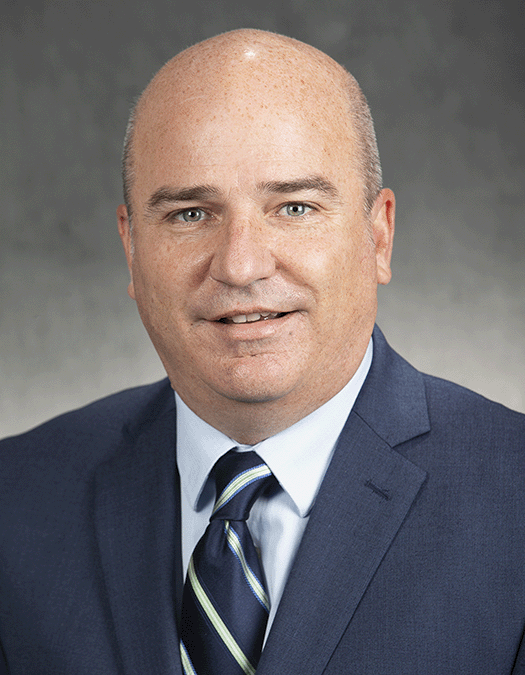
Rep. John Burkel
Sponsored bills
Maddy summaryHF 12 restricts participation on female-designated sports teams in Minnesota K-12 schools to students identified as female at birth, based on specific medical criteria. It requires students in disputes about sex to provide a physician's statement confirming their sex using three factors: reproductive anatomy, natural testosterone levels, and chromosome analysis. The bill directly affects public and private schools offering girls' sports teams and students seeking to join them. It amends Minnesota education law to take effect July 1, 2025.
Maddy summaryHF 2002 abolishes a prohibition that prevented the Minnesota Public Utilities Commission from issuing a certificate of need for new nuclear power plants. This change would allow the commission to approve applications for new nuclear plant construction, which was previously blocked by law. The bill amends Minnesota Statutes 2024, section 216B.243, subdivision 3b, by removing the language stating the commission "may not issue a certificate of need" for new nuclear facilities. The policy change directly affects nuclear energy developers seeking to build new plants in Minnesota and the commission's approval process.
Maddy summaryHF 2113 exempts small Minnesota employers with 50 or fewer employees from the state's paid leave requirement. This bill amends Minnesota Statutes 2024, section 268B.01, to explicitly exclude such employers from the paid leave mandate. Small businesses that currently meet the 50-employee threshold will no longer be required to provide paid leave under this law. Employers with 50 or fewer employees may still choose to opt into the paid leave program if they wish. The bill directly affects small business owners and their employees in Minnesota.
Maddy summaryThis bill removes the standard four-year statute of limitations for medical malpractice claims related to gender-affirming care received by minors in Minnesota. It defines gender-affirming care as medical or surgical interventions such as hormone therapy, puberty blockers, or gender reassignment surgery intended to affirm an individual's perceived gender identity that differs from their biological sex. The change allows patients or former patients to file lawsuits against healthcare providers for alleged errors or failures in such care without being restricted by the usual time limit. The amendment applies specifically to cases involving minor children and does not alter the statute of limitations for other types of medical malpractice claims.
Maddy summaryThis bill establishes a new taxpayer refund account in Minnesota to hold undesignated money returned to the state through restitution, fraud recovery, overpayment recovery, administrative fines, or other reimbursements. State agencies must transfer these recovered funds to the commissioner of management and budget within 60 days of receipt, and the funds must be used exclusively for issuing refunds to individual taxpayers who filed Minnesota income tax returns. The commissioner will distribute the accumulated funds as direct payments to eligible taxpayers once the account balance exceeds $300 million, with refunds issued within 120 days after the legislative session ends. The bill also requires the commissioner to create rules for administering the account and determining the refund distribution formula, with provisions taking effect on July 1, 2026.
Maddy summaryHF 3566 makes it a gross misdemeanor to intentionally place hard objects (like iron or steel) in growing crops with the intent to damage farm machinery used for harvesting, spraying, or planting. It also updates trespass laws to specifically protect agricultural land, making it a crime to enter locked or posted farmland without permission. The bill requires courts to order restitution for damaged equipment and defines "agricultural land" using existing law. This directly affects farmers (as property owners) and anyone entering fields without consent, imposing criminal penalties for intentional property damage or trespass.
Maddy summaryHF 3236 modifies Minnesota's requirements for groundwater appropriation permits. It requires applicants to submit detailed geologic data about well sites, specific pumpage rates, water quality assessments, and results from aquifer tests conducted at the requested pumping rate. The bill also clarifies that applicants bear all costs for aquifer tests and monitoring, and sets a 150-day deadline (or 120 days after test results) for permit decisions. This directly affects businesses, agricultural operations, and developers seeking groundwater permits by increasing application documentation and cost responsibilities.
Maddy summaryThis bill allows property owners in Minnesota to choose a different legal process for appealing damage assessments in watershed district and drainage authority projects. Instead of using the current administrative review process, affected property owners can elect to have their damage appeals handled through the state's standard eminent domain procedures under Chapter 117. The bill applies specifically to projects financed by watershed districts and drainage authorities, giving property owners the option to request an appraisal and negotiation process before potentially moving to a full court proceeding if an agreement cannot be reached. Property owners must file their appeal within 30 days of the damage determination order, and if they choose this new process, they cannot simultaneously pursue the traditional administrative appeal route.
Maddy summaryThis bill creates a new Hazard Mitigation Fund to provide grants to Minnesota local governments, including counties, cities, and school districts, for projects that reduce risks from emergencies like floods or storms. The program allows these eligible applicants to receive funding for planning activities, feasibility studies, and construction of mitigation projects that protect critical infrastructure and lower future costs. To qualify, applicants must demonstrate local commitment through official resolutions and match at least 25 percent of project costs using cash, donated materials, or volunteer labor. The bill also establishes an annual application process and permits funds to serve as the local share for federal disaster assistance programs.