

Maddy summaryHF 192 prevents local governments (cities, counties) from being required to pay for certain costs related to Minnesota's trunk highway projects. Specifically, it prohibits the state transportation commissioner from obligating local units to cover expenses incurred within the highway right-of-way that are directly caused by the project, such as utility relocations. The bill also appropriates funds from the general fund for fiscal years 2026-2027 to cover these non-trunk highway fund costs, available until June 2027. This applies to most projects starting after July 1, 2025, but excludes projects already in the state program before that date with 2025 construction. The law aims to clarify cost-sharing responsibilities between state and local entities for highway improvements.
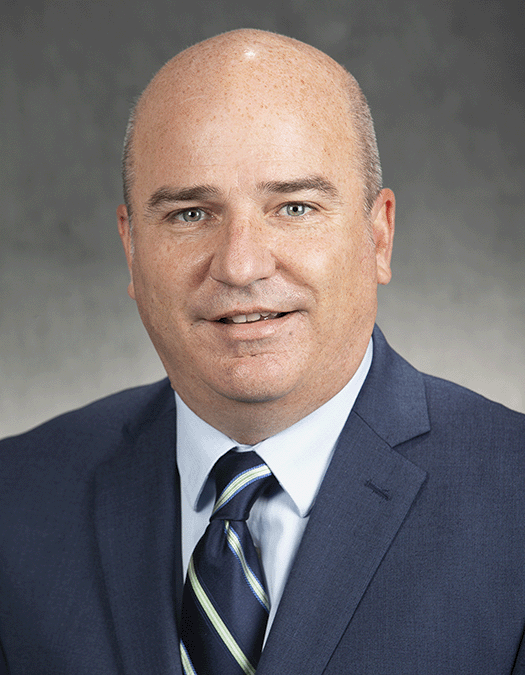
Rep. John Burkel
Sponsored bills
Maddy summaryHF 1371 exempts specific paper products from Minnesota's extended producer responsibility (EPR) program for solid waste management. It adds two new categories to the list of exempt materials: packaging for newspapers (including supplements) and packaging for magazines with circulation under 95,000 that focus on news and current events. This means publishers of these paper products will no longer be subject to the EPR program's requirements, such as funding waste management or meeting recycling targets. The bill directly affects newspaper and small-circulation magazine publishers in Minnesota.
Maddy summaryHF 1859 establishes a minimum one-mile setback requirement for wind energy conversion systems (wind turbines) from residences in Minnesota. The bill directly affects wind energy developers seeking permits for new installations near homes, requiring that no permit be granted for systems located within one mile of a residence. It amends Minnesota Statutes section 216I.05 to add this specific setback rule, applying to all new site permit applications after enactment. The law creates a clear, concrete distance requirement to address siting near residential properties.
Maddy summaryThis bill modifies Minnesota's renewable energy standards by expanding which hydroelectric projects count toward clean energy goals (including facilities over 100 megawatts if operating since 2023). It allows electric utilities to request delays in meeting renewable, solar, or carbon-free energy requirements if the commission determines it serves the public interest, considering factors like cost impacts and system reliability. The bill also expands sales tax exemptions for residential heating fuels and electricity, and prohibits demolition of fossil-fuel power plants under specific conditions. Additional provisions include supporting carbon capture technology and removing barriers to new nuclear power plants.
Maddy summaryHF 72 prohibits entities or organizations receiving state funding from making campaign expenditures or spending money on political activities. It directly affects nonprofits and other groups that receive state funds through direct appropriations, competitive grants, or other legislatively named funding programs. The law bans using any state-funded money for political purposes, including supporting candidates or ballot measures, effective July 1, 2025. This policy change aims to separate public funds from political campaign activities.
Maddy summaryHF 1523 exempts certain agricultural workers from Minnesota's Paid Leave Law. Specifically, it excludes workers employed by a farmer, family farm, or family farm corporation who either work for a farm with five or fewer total employees, or work on the farm for 28 days or fewer each year. This amendment to Minnesota Statutes 2024, section 268B.01, directly affects small-scale farm workers who meet these criteria. The bill clarifies that these workers are not covered by the state's paid leave requirements, while other agricultural workers remain subject to the law.
Maddy summaryHF 1745 appropriates $75,000 for fiscal year 2026 and $75,000 for fiscal year 2027 from the general fund to the Minnesota Turf Seed Council. The funds support research on improving turf and forage seed production, native plant breeding, and management practices like nutrient and pest control. The council must submit a report by January 15, 2027, detailing how the funds were used and research outcomes. This bill directly affects the Minnesota Turf Seed Council and benefits Minnesota agricultural producers focused on turf seed and native plant industries.
Maddy summaryHF 1702 allocates $100,000 for fiscal year 2026 and $100,000 for fiscal year 2027 from the state general fund to support mental health outreach and farm safety programs for Minnesota farmers, ranchers, and agricultural workers. The funding will cover services like 24-hour hotlines, stigma reduction efforts, and educational programs under existing law (Minnesota Statutes §17.1195). Unused funds from 2026 will carry over and remain available until June 30, 2027, per the bill’s provisions. This bill directly affects agricultural communities by expanding access to mental health and safety resources.
Maddy summaryHF 1231 prohibits Minnesota's environmental commissioner from creating rules that apply exclusively to construction and demolition landfills. The bill amends state law to block rules targeting facilities handling only construction debris (like wood, concrete, or shingles) or specific industrial waste from building materials. It directly affects the commissioner's rulemaking authority, requiring any new rules to apply broadly rather than focusing solely on these landfill types. This change ensures regulations for solid waste disposal facilities cannot be limited to a single waste stream.
Maddy summaryHF 1503 establishes a grant program for Minnesota poultry producers to install specific measures preventing avian influenza (bird flu) transmission from wild birds to domestic flocks. Eligible recipients must use funds to cover costs for approved methods like lasers, visual deterrents (e.g., air socks), or sound systems, while contributing 20% of the expenses (with a possible $2,000 reduction for labor costs). Recipients must document expenses, report annually on prevention effectiveness, and allow commissioner monitoring. The program is funded through state appropriations for fiscal years 2026-2027, targeting Minnesota-based poultry operations.