

Maddy summaryHF 482 establishes "Choose Life" special license plates for Minnesota motor vehicle owners. To obtain these plates, applicants must pay a $25 initial fee and $25 annual contribution to a dedicated "Choose Life account," in addition to standard registration fees. Funds collected are deposited into this account and distributed by Choose Life Minnesota, Inc., to non-profit agencies within each county that assist pregnant women making adoption plans - excluding any agencies involved in abortion services or charging fees for services. The bill also specifies plate design requirements (featuring the "Choose Life" logo and inscription) and limits administrative costs for the program to 15% of funds. The program becomes effective January 1, 2026.
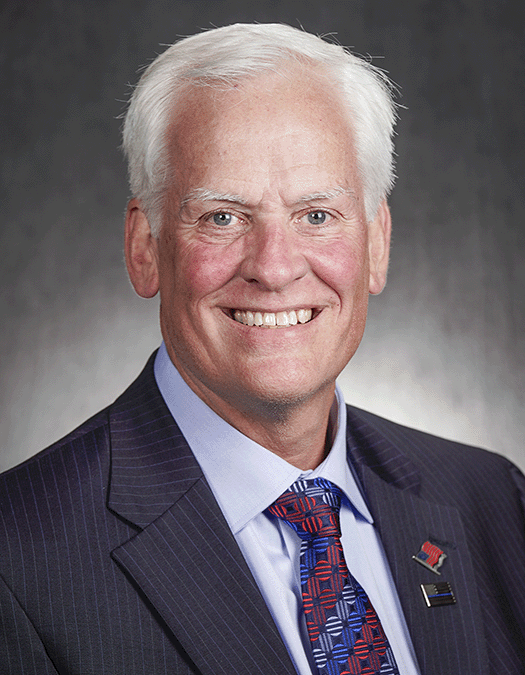
Rep. Tom Sexton
Sponsored bills
Maddy summaryHF 3802 amends Minnesota's energy certificate of need exemptions, removing the requirement for certain energy projects to seek state approval. The bill specifically exempts projects like wind/solar facilities (including repowering projects that don't exceed capacity limits), transmission line upgrades (e.g., converting to natural gas or increasing efficiency by ≤10%), and energy storage systems from the standard review process. It also clarifies exemptions for small transmission lines (≤1 mile) and upgrades using existing rights-of-way. These changes directly affect energy developers and utilities building or modifying infrastructure, streamlining approval for projects that align with existing state energy policies. The bill focuses on updating technical definitions and scope rather than creating new regulatory requirements.
Maddy summaryThis bill creates a new 100% tax on money obtained through fraud by individuals or organizations, regardless of whether they have already paid fines or restitution. It applies to those convicted by a court, those identified by the state revenue commissioner as having committed fraud, and anyone paid to help facilitate such fraudulent activities. The revenue collected from this tax must be used exclusively to provide relief for state income or property taxes. The law takes effect retroactively for fraud cases determined after December 31, 2019.
Maddy summaryThis bill directs the Minnesota School Safety Center to create and distribute evidence-based model safety plans for K-12 schools, requiring districts to adopt similar plans by May 2028. It establishes strict criteria for what counts as "evidence-based," mandating that safety strategies be backed by strong research or well-designed studies before they are implemented. The legislation also enables anonymous threat reporting systems in schools and requires the safety center to consult with licensed mental health professionals when developing these plans. Additionally, the bill modifies grant programs for school buildings and cybersecurity while increasing funding for safe schools initiatives.
Maddy summaryThis bill modifies Minnesota's African American Family Preservation and Child Welfare Disproportionality Act to strengthen protections for children of color in the child welfare system. It requires social services agencies to make "active efforts" rather than just "reasonable efforts" to keep African American and disproportionately represented children in their homes, reunify them with families, and involve families in all service decisions. The law mandates that agencies consider cultural and social values when providing services, ensures community members from communities of color serve as court advocates, and requires ombudspersons to monitor compliance with these new standards. Additionally, the bill expands placement options to include relatives and community members before removing children from their homes.
Maddy summaryThis bill amends Minnesota's gross receipts tax law to explicitly include hospitals and health care providers as taxable entities while excluding licensed chiropractors from the list of providers subject to the tax. The legislation defines "health care provider" to include various medical service providers such as doctors, dental professionals, and ambulance services, while listing specific exclusions like pharmacies, nursing homes, and home health agencies. A new provision adds licensed chiropractors to the list of excluded providers, clarifying that they will not be required to pay the gross receipts tax on their services. The changes will take effect for gross revenues received after December 31, 2026, and apply to the state's existing gross receipts tax framework.
Maddy summaryHF 3528 modifies Minnesota's Board of Barber Examiners by requiring one board member to represent a barber union (with at least two years of existence) and another to represent a barber professional organization. It reduces fees for barbers, including lowering the practical exam cost from $85 to $80 and adjusting other registration fees. The bill directly affects barbers seeking certification, barber schools, and barber shops by updating their registration requirements and removing outdated administrative rules. These changes streamline the licensing process while maintaining public safety standards for barber services.
Maddy summaryThis bill modifies how Minnesota calculates registration taxes for passenger cars and hearses by lowering the tax rate based on the vehicle's manufacturer's suggested retail price. It changes the tax calculation for new vehicles registered on or after November 16, 2020, and reduces the percentage of the vehicle's value taxed for each subsequent year of ownership. The legislation also establishes a process to transfer money from the state's general fund to the highway user tax distribution fund to cover any revenue shortfall caused by these tax reductions.
Maddy summaryThis bill creates a property tax exemption for specific electric generation facilities in Minnesota that produce between 40 and 50 megawatts of power. The exemption applies only to personal property like machinery at facilities that use natural gas as their primary fuel, are owned by municipal power agencies, and are located outside the metropolitan area. To qualify, facilities must be built between January 1, 2027, and January 1, 2030, be within 1,000 feet of an existing natural gas pipeline, address a resource gap identified in state energy planning, and receive approval from local city and county governments. The tax exemption would begin with property taxes payable in 2030 and does not extend to transmission lines, interconnections, or gas pipelines.
Maddy summaryThis bill modifies Minnesota's Paid Leave Law to expand the definition of "seasonal employee" from 150 days to 180 days within a 52-week period, specifically for workers in the hospitality industry. Under the new rules, employers must certify that an employee meets the extended duration limit and that the business meets specific revenue thresholds to classify someone as seasonal. The legislation also requires employers to notify the state within five business days if a seasonal employee no longer qualifies for that status. Employees classified as seasonal under these criteria would remain ineligible for paid leave benefits during weeks they are employed in that capacity.