

Maddy summaryHF 2390 appropriates $275,000 for fiscal year 2026 and $275,000 for fiscal year 2027 from the workforce development fund to provide a grant to Workforce Development, Inc., for the Southeast Minnesota Workforce Development Area #8. The grant funds career training, education, and wraparound support services (including childcare, transportation, and housing assistance) for individuals with employment barriers in Steele County, aiming to address local worker shortages and help families move out of poverty. Up to 5% of the funds may cover administrative costs, and the grant is available until June 30, 2027, with unspent funds from year one carrying over to year two. The commissioner must report annually by January 15 to legislative committees on how the funds were used, including administrative expenses.
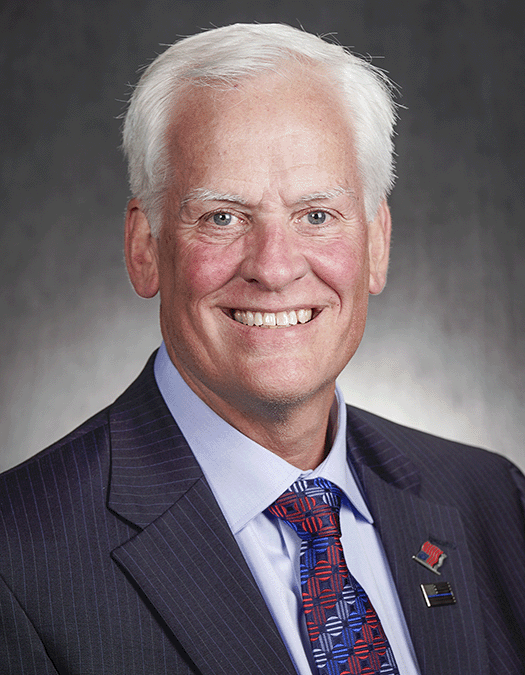
Rep. Tom Sexton
Sponsored bills
Maddy summaryHF 23 amends Minnesota Statutes section 181.932 to strengthen whistleblower protections for public employees. It expands the list of protected disclosures to include reporting gross mismanagement or waste of public funds (subsection 7), clarifies protections for health care quality concerns (subsection 4), and adds specific scenarios like reporting truthful scientific studies (subsection 5) or classified service communications about state services (subsection 6). These changes directly affect state and local government employees who report violations of law, safety risks, or financial misconduct. The bill modifies existing anti-retaliation language to explicitly cover these new disclosure types while maintaining that protected disclosures cannot override other legal data protections.
Maddy summaryHF 1169 directs Minnesota's Commissioner of Children, Youth, and Families to create a plan by January 2026 to reduce paperwork in child protection cases. The plan must involve counties, local agencies, Tribal governments, and include specific changes, an implementation timeline, and ongoing input procedures to benefit foster care providers, tribes, counties, and child placement agencies. The bill also provides funding to improve the Social Services Information System and appropriates money for these efforts. This focuses on streamlining administrative processes without changing child protection standards.
Maddy summaryHF 25 establishes a state grant program administered by Minnesota's Department of Health to fund nonprofit women's pregnancy centers and maternity homes. The program provides financial support for services like housing, medical care, parenting education, and mental health resources to help pregnant women and new mothers - particularly those facing homelessness or crisis - carry pregnancies to term and care for their children. Eligible organizations must be nonprofits offering free or low-cost services without promoting abortion, providing abortion care, or referring women to abortion providers. Grant funds cannot be used for abortion-related activities, and strict privacy rules require written consent before sharing personal information about clients. The bill appropriates state funds for this program while reducing other health-related appropriations.
Maddy summaryHF 1225 eliminates all-terrain vehicle (ATV) registration fees for Minnesota veterans with a 100% service-connected disability. It amends Minnesota Statutes to exempt these veterans from paying the standard $60 (public use) or $6 (private use) three-year registration fee, instead providing free registration. Veterans must provide proof of their 100% disability rating from the U.S. Department of Veterans Affairs or military retirement board. This change directly affects qualifying veterans who own ATVs, removing a financial burden tied to vehicle registration. The policy modifies existing fee structures under Minnesota Statutes § 84.922, subdivision 5.
Maddy summaryHF 1253 modifies Minnesota's absentee ballot procedures for certain voters. It shortens the timeline for mailing absentee ballots from 46 days to 28 days before elections (Minnesota Statutes 2024, § 203B.06, subd. 3) and moves the deadline for returning ballots from 8:00 p.m. to 3:00 p.m. on election day (§ 203B.08, subd. 1). The bill also prohibits correctional facilities from receiving absentee ballots, requiring county auditors to reject applications with correctional facility addresses (§ 203B.06, subd. 2). These changes directly affect absentee voters, election officials managing ballot distribution, and correctional facilities.
Maddy summaryHF 1261 increases penalties for tampering with motor vehicles and establishes a new offense for passengers who knowingly ride in a vehicle they reasonably should have known was taken without permission. The bill directly affects drivers who tamper with vehicles (e.g., breaking in or damaging them) and passengers who are aware a vehicle was stolen. Its key provision creates a separate crime for passengers who should have known a vehicle was taken, expanding accountability beyond just the driver. The bill amends Minnesota Statutes 609.546, effective August 1, 2025.
Maddy summaryHF 2069 creates new Minnesota license plates specifically for veterans of each U.S. military branch (Army, Navy, Air Force, Marines, Coast Guard, and Merchant Marine). Eligible veterans who meet existing criteria (including having discharge papers) can apply for a free plate featuring "VETERAN" and their branch's emblem. The plates must be the same size as standard plates for the vehicle type (e.g., motorcycle) and can be transferred to another vehicle owned by the same veteran for a $5 fee. This bill, effective January 1, 2026, expands Minnesota’s existing veterans' plate program by adding branch-specific designs.
Maddy summaryHF 1285 declares Minnesota a "mining-friendly state" by amending Minnesota Statutes section 93.001. The bill establishes a formal state policy supporting mineral exploration, development, production, and commercialization through long-term state support. This policy change directly affects the mining industry, state agencies responsible for mineral regulation, and communities near potential mining sites. It does not create new regulations or funding but sets a guiding principle for future state actions related to mineral development.
Maddy summaryHF 11 delays the implementation of Minnesota's Paid Leave Law from 2026 to 2027, affecting employers, employees, and state agencies responsible for administering the program. The bill amends multiple statute sections to adjust key dates, including the start of employer premium payments (now January 1, 2027) and administrative requirements like public outreach and annual reporting. This one-year delay provides additional time for businesses to prepare for the new paid leave program without changing the law's core requirements. The law's substance - such as premium rates and fund management - remains unchanged, only the rollout timeline is extended.