

Maddy summaryThis bill would allow Minnesota school resource officers who perform unpaid volunteer service to claim a subtraction from their individual income tax. The tax benefit is calculated by multiplying the number of volunteer hours by the hourly wage that would typically be paid to a school resource officer. To claim this subtraction, officers must provide documentation from their school showing the hours worked and the applicable hourly wage rate. The changes would take effect for tax years beginning after December 31, 2025.
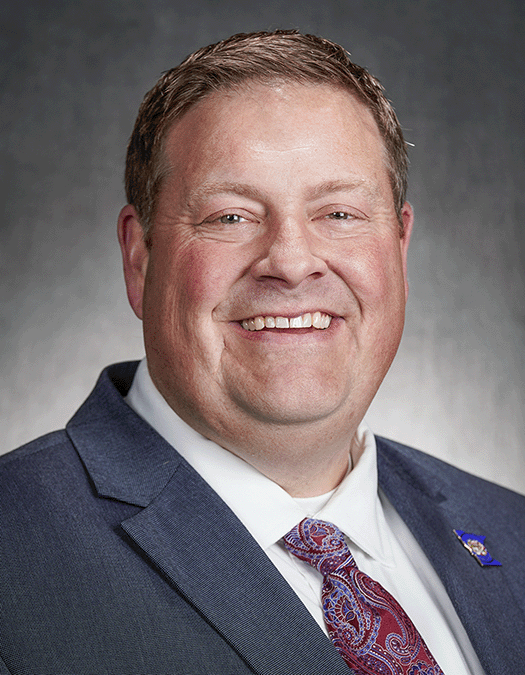
Rep. Keith Allen
Sponsored bills
Maddy summaryThis bill allocates state funding to the Minnesota health professional education loan forgiveness program specifically for physicians specializing in obstetrics and gynecology who practice in designated rural areas. The funds, appropriated for fiscal years 2027 and 2028, will be used to repay education loans for eligible OB/GYN physicians working in rural communities. If there are not enough qualified OB/GYN applicants to use all the allocated money, any unused funds will be carried over to the next biennium and distributed among other eligible medical professions. The legislation modifies existing state distribution rules to prioritize this specific specialty group in rural settings.
Maddy summaryThis bill establishes a new felony crime in Minnesota for providing material support or resources to designated foreign terrorist organizations or those engaged in terrorist activity. It directly affects individuals who might offer money, training, weapons, shelter, or other assistance to such groups, while explicitly excluding medical and religious materials from the definition. The law sets tiered penalties based on harm caused, ranging from up to ten years in prison for basic violations to up to forty years if the support results in death. The legislation will take effect on August 1, 2026, and applies only to crimes committed on or after that date.
Maddy summaryThis bill stops annual payments from the Monticello nuclear plant to a state renewable energy fund and modifies how distributed solar energy standards are handled. It extends a sales tax exemption on residential natural gas and electricity to apply year-round instead of seasonally. Additionally, the bill exempts electric and natural gas facilities from paying the state commercial-industrial property tax. These changes directly affect the Monticello nuclear plant operator, solar energy developers, residential energy consumers, and utility companies operating gas and electric infrastructure.
Maddy summaryHF 3748 appropriates $250 million from the general fund for grants to replace lead service lines in municipal water systems. This funding directly helps water utilities and homeowners affected by lead pipes, which pose health risks. The grants are administered by the Public Facilities Authority under Minnesota Statutes, section 446A.077, and are available until June 30, 2034. The bill provides one-time state funding to accelerate the replacement of hazardous lead pipes in drinking water infrastructure.
Maddy summaryThis bill updates Minnesota laws to strengthen consumer protections and disclosure requirements for virtual currency kiosks. It directly affects kiosk operators and customers who use these machines to buy or sell digital currencies. The legislation adds new definitions for blockchain analytics and tracing software, requires operators to maintain detailed transaction records for five years, and mandates live customer service availability during specific hours. Additionally, the bill requires kiosks to clearly display material risks such as the lack of government backing and significant value fluctuations before customers complete transactions.
Maddy summaryThis bill requires retail establishments to display specific disclosures on handheld electronic devices before consumers purchase games or other paid entertainment. The law mandates that users affirm they are at least 16 years old and ensures payment amounts are shown in large, prominent text. These requirements apply to businesses offering handheld devices with paid content in Minnesota. The bill aims to improve transparency for consumers using these devices.
Maddy summaryThis bill requires Minnesota's social studies standards to include information about the dangers and perils of communism and socialism, specifically during the 2030-2031 review and revision of state academic standards. The legislation mandates that the state commissioner incorporate details about estimated lives lost and negative outcomes associated with these ideologies into the updated curriculum. It directly affects Minnesota public school systems by setting a specific requirement for future social studies education content. The bill takes effect on July 1, 2026, and does not change current curriculum requirements but establishes a mandate for future revisions.
Maddy summaryThis bill modifies Minnesota's medical cannabis endorsement requirements, primarily affecting businesses that cultivate, process, or sell medical cannabis products. It updates rules for retail endorsements by requiring retailers to employ either a licensed pharmacist or a certified medical cannabis consultant to provide final authorization for patient product distribution. The legislation also clarifies that retail businesses must verify patient registry enrollment and confirm proper product selection through consultation with qualified medical professionals before dispensing cannabis. Additionally, the bill mandates that all medical cannabis products undergo safety, potency, and consistency testing at approved facilities before being distributed to patients. These changes aim to standardize oversight and ensure qualified professionals oversee the final approval of medical cannabis products for patients.
Maddy summaryHF 16 prohibits Minnesota cities, counties, or local governments from passing laws that block law enforcement from sharing immigration status information with federal authorities. It requires county attorneys to notify federal immigration agencies when someone without legal status is arrested for a violent crime. The bill overrides any local "noncooperation" policies that would restrict this information sharing or federal immigration enforcement. It applies to all local law enforcement and government entities in Minnesota, ensuring consistent cooperation with federal immigration enforcement on specific matters.