

Maddy summaryThis bill requires Minnesota gas stations to offer E-15 gasoline, a fuel blend containing 15% ethanol, starting in 2028 for new stations and 2030 for existing ones with compatible equipment. The Department of Agriculture will monitor E-15 supply and prices, while the Department of Revenue will verify sales data to determine eligibility for exemptions. Small businesses with annual sales under $300,000 and stations with older fuel tank infrastructure may request waivers from these requirements. The governor can temporarily adjust the rules if E-15 becomes unavailable or causes economic hardship, and the bill authorizes agencies to create rules for implementation.
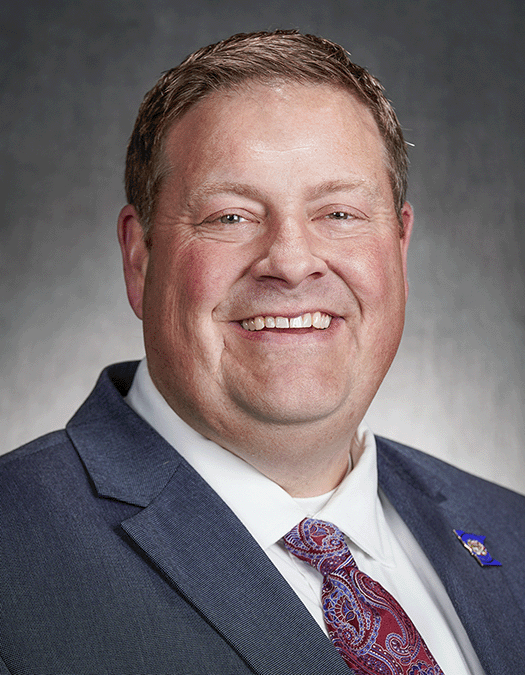
Rep. Keith Allen
Sponsored bills
Maddy summaryThis bill authorizes Minnesota to implement federal Workforce Pell Grants by creating a state-level approval process for eligible workforce training programs. It requires the Governor's Workforce Development Board to establish application procedures, coordinate with other workforce programs, and mandate that approved programs report data on completion rates, job placement, and earnings. The bill specifically targets programs that prepare students for high-skill, high-wage, or in-demand occupations, ensuring alignment with federal requirements while giving the state authority to manage the program.
Maddy summaryThis bill restricts the governor's authority when filling vacancies on the University of Minnesota Board of Regents by requiring the governor to appoint only candidates previously recommended by the joint legislative committee. It directly affects the state's higher education governance structure by limiting executive discretion in board appointments. The key provision adds a new requirement to Minnesota Statutes 2024, section 137.0246, specifying that if the legislature does not elect a candidate after the joint legislative committee makes a recommendation, the governor must choose from that specific list. This change ensures that board appointments follow the legislative committee's recommendations rather than allowing the governor to select candidates independently.
Maddy summaryThis bill establishes a new low-interest student loan program in Minnesota to help eligible students cover educational costs. The program provides loans with a maximum interest rate of three percent, with annual borrowing limits of $5,000 and a lifetime cap of $20,000 per student. Eligibility is restricted to Minnesota residents attending public or not-for-profit institutions in the state whose household income does not exceed 300 percent of the federal poverty guidelines. The state will fund the program with $17.5 million in fiscal years 2026 and 2027, and the commissioner of the Office of Higher Education will manage the loans and related administrative tasks.
Maddy summaryThis bill modifies how Minnesota calculates family responsibility amounts for state grant awards, directly affecting students and their families receiving financial aid. It establishes a new rule where any negative parental or student contribution is treated as zero rather than the previous threshold of negative $1,500, while also adjusting percentage calculations for dependent and independent students. The legislation applies to state grant awards beginning in the summer 2026 academic term and includes provisions for adjusting living expense allowances when grant funds exceed projected demand.
Maddy summaryHF 3436 requires drivers approaching a stopped school bus displaying flashing red lights to stop at least 20 feet away. The bill amends Minnesota Statutes section 169.444 to mandate this stop until the bus retracts its stop arm and turns off the red lights. It also adds a new provision requiring drivers to prepare to stop within 20 feet when a bus shows prewarning amber lights, signaling red lights are about to activate. This law directly affects all drivers operating vehicles near school buses in Minnesota, aiming to improve safety for children boarding or exiting buses. The bill takes effect the day after final enactment.
Maddy summaryHF 2081 removes income-based limits on deducting Social Security benefits from Minnesota state income tax. It eliminates the current phaseout thresholds and maximum deduction amounts (e.g., $5,840 for joint filers), allowing taxpayers to subtract the full amount of their Social Security benefits. This change applies to Minnesota residents receiving Social Security benefits who file state tax returns. The bill takes effect for taxable years beginning after December 31, 2024.
Maddy summaryThis bill requires vehicle manufacturers and dealers to notify the state commissioner within 10 days when a vehicle is returned to them within 30 days of being transferred to a buyer or lessee. The legislation mandates that the commissioner cancel the registration and issue a refund of any registration taxes paid by the original buyer or lessee for these returned vehicles. It applies specifically to vehicles that are permanently transferred back to the same manufacturer or dealer without the transferee retaining any right to use or possess the vehicle. This change affects vehicle dealers and manufacturers in Minnesota who handle returned vehicles, as well as consumers who paid registration fees on vehicles that were subsequently returned.
Maddy summaryThis bill creates a sales tax exemption for preowned motor vehicles in Minnesota, meaning buyers would not pay the standard sales tax when purchasing a used car. The legislation defines a preowned vehicle as any motor vehicle that has been previously sold, titled, registered, or transferred to someone else and operated before the current sale. The exemption applies to sales and purchases made after June 30, 2026, and would directly affect private individuals and businesses buying used vehicles in the state. The bill amends existing tax statutes to add this new exemption category alongside other existing tax exemptions for specific groups and vehicle types.
Maddy summaryThis bill lowers the minimum acreage requirement for special agricultural homesteads in Minnesota from 40 acres to 5 acres, making it easier for smaller landowners to qualify for property tax benefits. The legislation allows owners who possess a separate, noncontiguous parcel of at least 20 acres of agricultural land to classify their smaller homestead property as a special agricultural homestead, provided specific conditions regarding land value, location, and active farming are met. Key provisions include maintaining the homestead classification even if surrounding land use changes, as long as ownership and farming requirements remain satisfied, and expanding eligibility for certain families who actively farm the property. The bill also includes provisions for properties damaged by past natural disasters and clarifies rules for noncontiguous land included in homestead classifications.