

Maddy summaryHF 1522 modifies Minnesota's definition of "agricultural land" for property tax classification purposes. It specifies that agricultural land must consist of either contiguous acreage of 10+ acres used for farming last year, or land used for intensive livestock/poultry confinement (excluding grazing-only land). This change affects farmers and landowners who qualify for lower tax rates on agricultural property, ensuring only land meeting these criteria receives the reduced 0.5% or 1% classification rate. The bill clarifies how mixed-use parcels (like land with windbreaks or timber) are classified under existing tax categories.
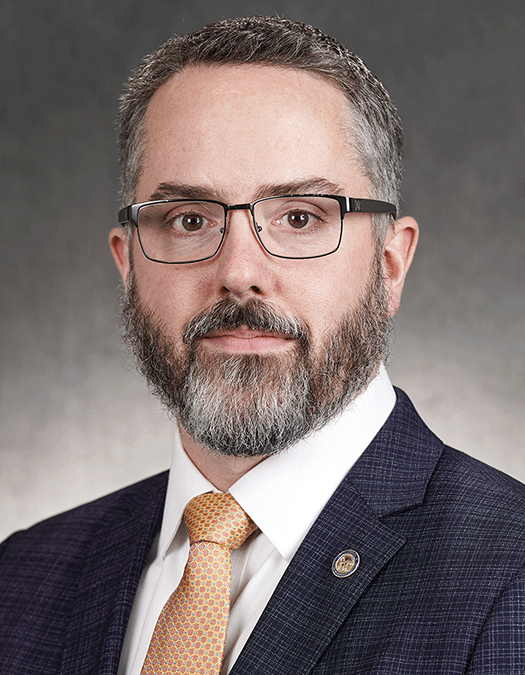
Rep. Luke Frederick
Sponsored bills
Maddy summaryHF 2187 removes a 48-hour admission requirement for crisis services at community-based program locations, giving service providers more flexibility in scheduling. The bill also makes technical changes to support the creation of the Direct Care and Treatment agency, which will manage certain human services programs. These changes directly affect community-based crisis service providers and the new agency’s operational structure. The bill does not alter eligibility criteria for services but streamlines administrative processes for providers and the agency.
Maddy summaryHF 1993 modifies Minnesota's requirements for substance use disorder (SUD) assessments and treatment provider qualifications. It specifies that comprehensive SUD assessments must be conducted face-to-face within five days (excluding the service initiation day) by qualified staff like alcohol and drug counselors, certain mental health professionals, or licensed nurses with addiction training. The bill also updates qualifications for treatment coordinators, requiring specific training, education, or certification, plus 2,000 hours of supervised experience working with SUD clients. Additionally, it mandates a study and report on limitations in SUD treatment practices. These changes directly affect SUD treatment providers and the clients receiving services under Minnesota's behavioral health system.
Maddy summaryHF 2037 establishes the Department of Direct Care and Treatment with a commissioner to oversee it, while repealing the existing Direct Care and Treatment Executive Board. This bill restructures the administrative framework for direct care services by creating a new departmental structure under state law. It amends multiple Minnesota Statutes related to agency operations, including definitions and governance for the new department, but does not create new programs or funding. The change primarily affects state agencies providing direct care services, streamlining oversight under the new commissioner.
Maddy summaryHF 2834 appropriates $2,000 from Minnesota's general fund in fiscal year 2026 to the Minnesota State Poultry Association. The funds are specifically for supporting youth poultry programs across the state, such as educational initiatives for young people involved in poultry activities. This is a one-time appropriation, meaning it does not repeat annually. Any unspent portion of the $2,000 remains available for use in fiscal year 2027, rather than expiring at year-end. The bill directly affects the Minnesota State Poultry Association (as the recipient) and Minnesota youth participating in poultry-related educational programs.
Maddy summaryHF 2586 extends cost-of-care exemptions for counties and clients during transfers for certain committed individuals in Minnesota. It specifically delays county payment responsibility for up to 30 days for people awaiting transfer to another state facility or program (expiring June 30, 2025), and maintains full exemption for those committed as mentally ill and dangerous to the public (expiring March 31, 2025). The bill also establishes a Priority Admission Review Panel, requires a Direct Care and Treatment admissions dashboard, and mandates a report on the program. These changes apply to individuals under civil commitment who are waiting for transfer to correction facilities or other state-operated treatment programs. The policy adjustments aim to streamline transitions while ensuring financial responsibility during interim periods.
Maddy summaryHF 2844 appropriates $102.99 million for the University of Minnesota's Higher Education Asset Preservation and Replacement (HEAPR) program, $102.99 million for Minnesota State Colleges and Universities' HEAPR program, $900,000 for library construction grants, and smaller sums for Minnesota State Academies (including student center and therapy pool predesign) and the Perpich Center for Arts Education. The bill authorizes spending bond proceeds and specific funds to acquire, improve, and better public land, buildings, and capital assets at state institutions, with strict requirements on project completion timelines and funding sources. It modifies existing programs like HEAPR and specifies that funds cannot replace routine operations or projects that could be financed through other means. This bill directly affects public universities, colleges, state schools, and cultural institutions by providing targeted capital improvement funding for facility upgrades.
Maddy summaryHF 2707 appropriates $11.125 million for each of fiscal years 2026 and 2027 from the general fund to support sexually exploited youth or youth at risk of sexual exploitation under Minnesota Statutes §256K.47. At least $9 million annually must fund street outreach, emergency shelter, regional navigators, and housing services for these youth. The bill directly affects vulnerable youth in Minnesota by providing dedicated funding for critical safe harbor resources and housing support. It establishes concrete funding mechanisms without altering existing statutes or creating new requirements.
Maddy summaryHF 107 modifies Minnesota's unemployment insurance rules for workers involved in labor disputes. It specifies that workers participating in or directly affected by a labor dispute can receive benefits until the end of the week the dispute was active, while those not involved are eligible until the dispute began. The bill clarifies that certain situations - like employer safety violations, lockouts, or being fired before a dispute starts - do not make applicants ineligible. This directly affects workers who stop working due to labor conflicts, ensuring they maintain eligibility under defined conditions. The changes amend Minnesota Statutes section 268.085, subdivision 13b.
Maddy summaryHF 2211 allocates $3.6 million from the general fund for each of fiscal years 2026 and 2027 to the Minnesota Commissioner of Health. This funding is specifically for grants to local and Tribal health departments to support substance misuse prevention, education, and recovery programs under Minnesota Statutes §144.197, subd. 4. The bill directly affects health departments that will receive these grants to expand community-based services. It does not create new requirements but provides dedicated funding for existing program frameworks focused on addressing substance misuse.