

Maddy summaryHF 3693 modifies Minnesota's 2025 Department of Agriculture budget by increasing the total appropriation from $56,052,000 to $56,552,000. Key changes include raising funding for dairy programs ($23,801,000 vs. $23,301,000), boosting the local food purchasing grant program to $1,200,000 in the second year (from $700,000), and adding $1,000,000 annually for county fairs. The bill adjusts specific line-item allocations within existing programs but does not create new initiatives or change eligibility rules. It directly affects how the Department of Agriculture allocates funds for current programs like dairy support, organic certification, and biofuel infrastructure.
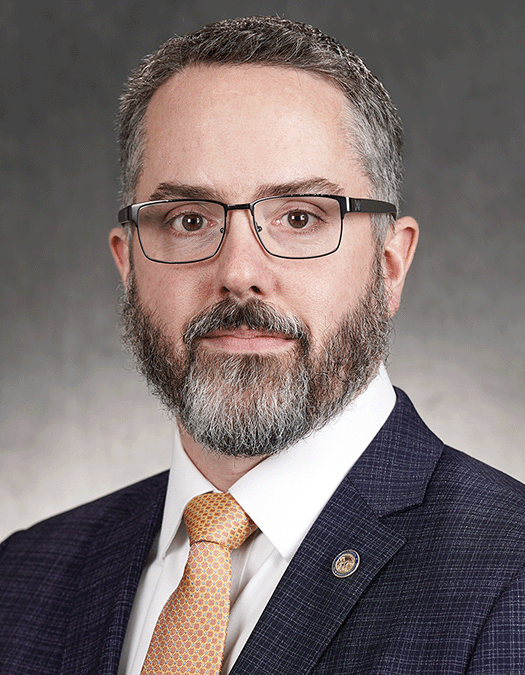
Rep. Luke Frederick
Sponsored bills
Maddy summaryHF 970 requires original equipment manufacturers (OEMs) of farm equipment to provide independent repair shops with necessary tools, parts, and documentation on fair and reasonable terms. It directly affects Minnesota farmers and independent repair providers by ensuring they can access repair resources without being forced to use manufacturer-approved services or pay excessive fees. Key provisions include prohibiting OEMs from imposing unreasonable restrictions (like requiring repair shops to become authorized dealers) or charging more for parts/tools than they offer to their own authorized providers. The bill amends Minnesota law to define terms like "authorized repair provider" and "fair and reasonable terms" to clarify these requirements. This applies specifically to digital electronic farm equipment, aiming to increase repair options and reduce costs for farmers.
Maddy summaryThis bill modifies reimbursement rates for high-intensity residential substance use disorder services in Minnesota, directly affecting providers of these services and the state's human services funding system. Starting January 1, 2026, the state will pay 83 percent of a previously modeled rate for high-intensity residential services, while low-intensity services and treatment coordination will remain at 100 percent of that modeled rate. Beginning January 1, 2027, adolescent treatment programs providing high-intensity residential services will receive an additional 30 percent increase on top of the standard high-intensity rate. The changes apply to services delivered under the state's substance use disorder treatment program and are based on rates established in a 2021 legislative report.
Maddy summaryThis bill allows elected officials in Minnesota to hold town hall meetings at public colleges and universities within their jurisdiction. It requires these institutions to provide free, available space and waive parking fees for attendees when officials request a meeting at least 30 days in advance. The law limits officials to three such meetings per year and specifies that institutions do not need to cancel existing reservations to accommodate these events. This provision applies to Minnesota State Colleges and Universities, with the University of Minnesota asked to comply voluntarily.
Maddy summaryHF 2216 protects residents of Minnesota assisted living facilities by prohibiting facilities from requiring a legal guardian as a condition for admission or continued residence. It requires facilities to get commissioner approval before raising fees by more than the Consumer Price Index, demanding detailed financial documentation including operational costs, balance sheets, and comparisons to similar facilities. The bill also prevents facilities from terminating or not renewing contracts based on certain grounds and updates arbitration rules for contract disputes. These changes directly affect assisted living facilities and their residents by increasing oversight of fees and residency terms.
Maddy summaryHF 1795 appropriates state funds for Minnesota's farm-to-school and early childhood care programs, directly supporting schools and child care providers serving children. The bill allocates specific funding for fiscal years 2026 and 2027 to purchase Minnesota-grown fruits, vegetables, meat, poultry, grain, and dairy for these settings, including reimbursements for equipment and food purchases. It also sets aside $150,000 annually for a statewide coordinator to assist farmers and institutions, and allows limited state funding (up to 7.5% of federal funds) to support federal program administration. Eligible entities must participate in federal nutrition programs like the National School Lunch Program.
Maddy summaryThis bill modifies data requirements and procedures for Minnesota's Direct Care and Treatment executive board, which oversees state-operated human services facilities. It establishes a new classification system for employees within the program and updates rules for patient consent and voluntary transfers. The legislation also clarifies how property damage claims are handled, sets specific procedures for challenging sex offender program data, and defines what information counts as private medical versus directory data. These changes aim to streamline administrative processes and clarify privacy protections for patients and staff.
Maddy summaryHF 3788 expands Minnesota's agriculture special license plates to include "farm trucks" alongside existing eligible vehicles like passenger cars, one-ton pickup trucks, motorcycles, and recreational vehicles. To qualify, applicants must pay standard registration fees, contribute $20 annually to the Minnesota Agriculture Account, and meet all other vehicle registration requirements. This bill directly affects Minnesota farmers who operate eligible farm trucks by providing them a new option for special license plates. The change modifies Minnesota Statutes section 168.1285 to explicitly list "farm truck" as an eligible vehicle class for these plates.
Maddy summaryThis bill requires hospitals in Minnesota to obtain approval from the Department of Health before making significant changes like closing parts of their facilities, moving services to other locations, or stopping specific care offerings such as operating rooms or pediatric overnight services. The law applies to acute care hospitals and aims to prevent abrupt service reductions that could impact patient care, except in cases of financial insolvency or natural disasters. Hospitals must follow a public interest review process similar to existing procedures for other hospital changes, and the Department of Health will enforce compliance using its regulatory authority. The measure takes effect immediately upon final passage and does not address financial outcomes or speculate on how hospitals will respond to these requirements.
Maddy summaryThis bill establishes a new legal right in Minnesota allowing individuals to sue if their name, likeness, or voice is used for commercial purposes without their permission. It defines likeness as any recognizable image of a person and voice as any sound that identifies a specific individual, covering both recorded and computer-generated versions. The law permits people to sell or license these rights and allows lawsuits to continue for up to 70 years after death if the person's identity was used commercially during that time. Courts can award damages for financial losses, profits made from the unauthorized use, and attorney fees, with triple damages available if the misuse was intentional. The bill includes exceptions for news reporting, criticism, satire, and other First Amendment-protected uses, ensuring free speech rights remain intact.