

Maddy summaryHF 7 modifies multiple public safety laws in Minnesota. It requires law enforcement agencies to make bail/bond information public and mandates county attorneys to publicly report reasons for dismissing charges. The bill establishes mandatory minimum sentences for certain sex trafficking offenses and requires individuals subject to stays in sexual conduct cases to register as predatory offenders. It also increases penalties for assaulting police officers, obstructing highway/airport traffic, and expands law enforcement's use of tracking devices on fleeing vehicles. These changes apply directly to law enforcement agencies, prosecutors, and individuals involved in criminal cases.
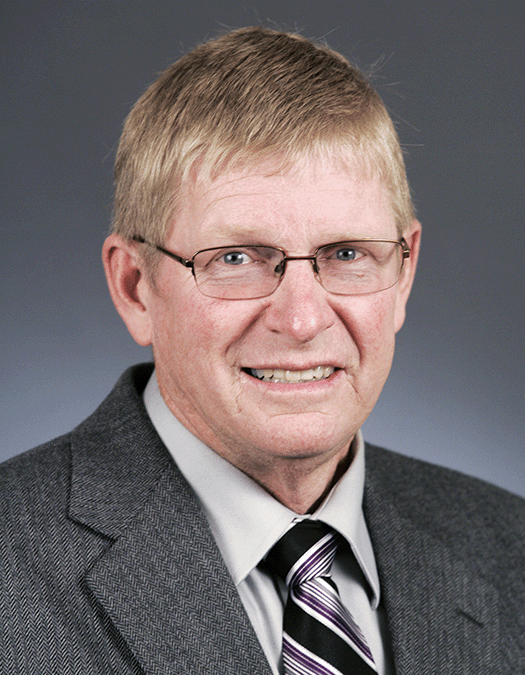
Rep. Paul Anderson
Sponsored bills
Maddy summaryThis bill allocates $450,000 from the environment and natural resources trust fund in fiscal year 2027 to support Minnesota farmers, aggregators, and processors involved in the oat industry. The funds will be distributed as grants to help these recipients invest in infrastructure or equipment for cultivating, harvesting, processing, storing, transporting, wholesaling, or distributing oats. The legislation aims to improve soil health and water quality by reducing erosion and nitrate leaching through these investments. The appropriation is exempt from certain income repayment requirements under Minnesota law.
Maddy summaryThis bill allocates $225,000 from the workforce development fund to support grants for secondary career and technical education programs offering meat cutting and butchery training. The funding can be used to purchase equipment, renovate facilities, and train faculty, with individual grants capped at $75,000 and up to 10% reserved for faculty development. Priority may be given to applicants collaborating with Minnesota State Colleges and Universities or local industry partners. The Department of Employment and Economic Development must submit a report by January 15, 2028, detailing awarded grants and unfunded requests to relevant legislative committees.
Maddy summaryHF 2553 repeals Minnesota Statutes section 216B.246, which granted existing electric transmission companies (called "incumbent owners") priority rights to build new transmission lines connected to their facilities under federal planning approvals. This affects public utilities, municipal power agencies, and other entities previously defined as "incumbent electric transmission owners" under the repealed law. The bill removes their automatic right to construct new lines without competitive bidding or review. The change eliminates a specific legal provision without adding new requirements or creating new processes.
Maddy summaryHF 21 would require a three-fifths supermajority vote in both the Minnesota House and Senate to extend a peacetime emergency declaration beyond 14 days. Currently, such extensions beyond 14 days could be approved by the Executive Council, but this bill would shift that authority to the legislature. The bill directly affects governors seeking to prolong emergency powers and the legislative process for reviewing those requests. It does not change the initial 14-day emergency declaration period or the governor's authority to declare emergencies under existing criteria. Note: This bill was introduced but not passed during the 2025 legislative session.
Maddy summaryHF 3172 provides rebates to resource recovery facilities and waste-to-energy facilities that separate materials from waste streams for recycling, composting, or reuse. Facilities must report annual tonnage of processed materials (e.g., recyclables, compostables, or ash) by February 1 each year, triggering rebates of $30 per ton for recycling/reuse and $20 per ton for ash utilization. The rebates are funded from existing solid waste tax revenues, with $30 million annually allocated for this purpose. The program begins July 1, 2025, and requires facilities to submit detailed reports to the state revenue commissioner.
Maddy summaryHF 3548 modifies Minnesota's farm down payment assistance program to help new farmers purchase land. It sets eligibility limits: applicants must earn under $250,000 annually from farming, have no prior land ownership, and commit to owning/farming the land for five years (with a 20% penalty for violations). Grants cover up to $20,000 for 2-75 acres or $40,000 for larger parcels, requiring $8,000 in matching funds. The program prioritizes specialty crop producers (like fruits, vegetables, or industrial hemp) and allocates $1.25 million annually for these grants, effective July 2026.
Maddy summaryHF 3474 appropriates $50,000 from Minnesota's general fund for the Agricultural Utilization Research Institute to cover legal costs. This one-time funding is available until June 30, 2029, and becomes effective the day after the bill is enacted. The bill directly affects the institute by providing specific financial support for legal expenses, not for general research activities. It is a procedural funding measure with no broader policy changes or new requirements for other entities.
Maddy summaryThis bill modifies Minnesota's grain indemnity account rules by adding a new requirement: funds cannot be transferred out of the account unless it holds more than $15 million. The account continues to pay valid farmer claims, premium refunds, administrative costs, legal fees, and trustee payments as before. The change specifically restricts fund transfers to prevent depletion when balances fall below $15 million. It directly affects the Minnesota Department of Agriculture, which manages the account for farmers and grain-related claims. The policy change is purely procedural, focusing on fund management without altering existing benefit eligibility or payment amounts.
Maddy summaryHF 1066 increases annual funding for soil and water conservation districts in Minnesota. It amends state law to raise the annual appropriation from $15 million (for 2023-2024) to $20 million starting in 2025, paid from the general fund to the commissioner of revenue. This funding directly supports local soil and water conservation districts that provide technical assistance and cost-share programs for landowners. The bill takes effect for payments made in 2025 and subsequent years.