

Maddy summaryThis bill creates a pilot program in Minnesota to help farmers implement rotational grazing systems, which involve dividing pastures into smaller sections and rotating livestock to reduce soil damage and protect water sources. The program will provide grants to Minnesota farmers for establishing perennial forages or purchasing infrastructure like fencing and watering systems, with each farmer required to contribute a 50% match through cash, materials, or services. Grants are limited to $25,000 per farmer and must be reimbursed after the farmer completes the project and provides proof of implementation. The commissioner of agriculture must submit a report by January 2028 detailing the program's results, including how many grants were awarded and their geographic distribution. The bill appropriates $2 million from the environment and natural resources trust fund to support this pilot program in fiscal year 2027.
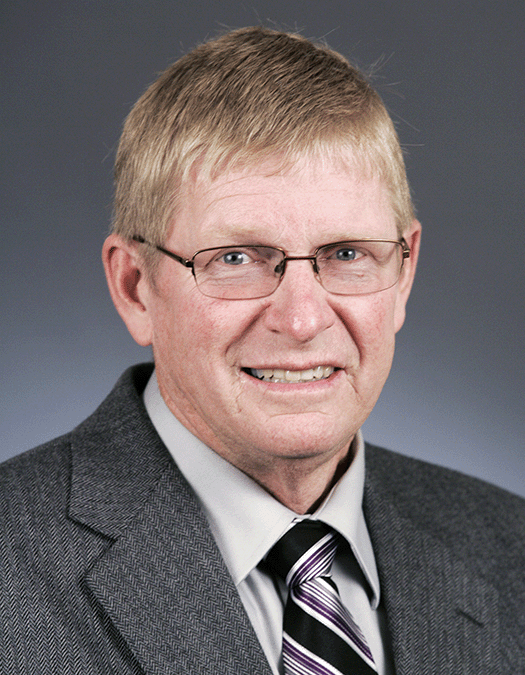
Rep. Paul Anderson
Sponsored bills
Maddy summaryHF 13 would amend Minnesota Statutes section 609.06 to eliminate the requirement that individuals must attempt to retreat before using reasonable force in self-defense or defense of others. The bill specifically removes the "duty to retreat" provision, allowing people to use force without first trying to avoid confrontation if they reasonably believe it is necessary. This change would directly affect Minnesotans using force to defend themselves or others in situations where they perceive an immediate threat. The bill was introduced but not passed, as it was laid on the table during the 2025 legislative session.
Maddy summaryHF 85 modifies Minnesota's requirements for mortuary science internships. It establishes a minimum 2,080-hour internship period (within three years) under direct supervision of a licensed practitioner, requiring interns to complete 25 case reports in embalming, funeral arrangements, and services. The bill also allows up to 520 hours to be waived for students completing clinical training through the University of Minnesota or approved programs. These changes directly affect mortuary science students seeking licensure and licensed practitioners serving as supervisors.
Maddy summaryHF 84 modifies Minnesota's requirements for mortuary science professionals licensed in other states to practice in Minnesota. It adds new documentation requirements, including proof of completing at least 25 funeral arrangements, 25 embalming cases, and 3 years of practice in another jurisdiction (or equivalent education documentation), along with specific continuing education records. The bill directly affects out-of-state mortuary science license holders seeking to work in Minnesota. These changes ensure applicants meet Minnesota's standards before receiving a reciprocal license. The bill does not alter Minnesota's own licensing rules for in-state applicants.
Maddy summaryThis bill creates a new crime called disruption of worship services in Minnesota, targeting individuals who enter religious buildings with the intent to disrupt scheduled services by committing a crime. The law defines a religious establishment as a building used for worship that is clearly marked with a sign or other identifier. First-time offenders face gross misdemeanor charges, while repeat offenders could be charged with a felony punishable by up to five years in prison or a fine of $10,000 or both. The provisions take effect on August 1, 2026, and apply only to crimes committed on or after that date.
Maddy summaryThis bill authorizes the issuance of up to $9 million in state bonds to fund an expansion of the wastewater industrial pretreatment facility in Paynesville, Minnesota. The funds will be used to redesign, construct, and upgrade the facility to increase its treatment capacity and improve its systems. The money comes from the bond proceeds fund and is directed through the Public Facilities Authority to the city. The legislation takes effect immediately upon final passage by the legislature.
Maddy summaryThis bill creates a new program in Minnesota that offers financial incentives to retail gas stations for selling specific biofuel blends containing 11 to 15 percent ethanol. Starting in 2028, eligible stations that have not previously sold these biofuels and have not received other state biofuel grants can receive up to five cents per gallon in payments, with a total annual cap of $50,000 per station. The program is funded by a one-time $5 million appropriation from the state's general fund and requires stations to submit monthly sales reports and verify their volumes with state records. The commissioner of agriculture will administer the program and has the authority to create rules for its implementation.
Maddy summaryThis bill allocates funds and authorizes the issuance of state bonds to support Minnesota's water infrastructure funding program, primarily benefiting eligible municipalities. It specifically designates $9 million for the city of Paynesville to upgrade its wastewater industrial pretreatment facility, increasing treatment capacity and modernizing systems. The legislation authorizes the sale of state bonds to generate the necessary funding, with the commissioner of management and budget responsible for executing the bond sale according to existing state laws. The bill takes effect the day after final enactment, providing immediate authorization for these financial commitments.
Maddy summaryHF 3562 modifies Minnesota's motor vehicle registration tax for passenger cars and hearses. It reduces the tax rate from 1.54-1.575% to 1.25-1.285% of a vehicle's manufacturer's suggested retail price (MSRP), depending on whether the vehicle was first registered in Minnesota before or on/after November 16, 2020. The tax amount decreases each year based on the vehicle's age (e.g., 100% of MSRP in year one, dropping to 10% in year ten), then becomes a flat $20 annually after the 10th year. This bill directly affects Minnesota vehicle owners paying registration fees for passenger cars and hearses, effective for registrations starting January 1, 2027.
Maddy summaryThis bill clarifies milk options available in Minnesota schools participating in the federal National School Lunch Program. It requires schools to offer a variety of fluid milk (including flavored, organic, and nonorganic whole, reduced-fat, low-fat, and fat-free options) and nutritionally equivalent non-dairy beverages. The bill also mandates that schools provide lactose-reduced milk, lactase-fortified milk, or milk with added acidophilus for students with lactose intolerance upon a parent's written request. These changes apply directly to public and nonpublic schools receiving school lunch funding or participating in the breakfast program.