

Maddy summaryHF 1845 expands Minnesota's definition of "veteran" to include two specific groups: (1) Hmong veterans naturalized under the federal Hmong Veterans' Naturalization Act of 2000, and (2) individuals who served honorably with secret guerrilla units or irregular forces operating from Laos in support of U.S. forces between February 28, 1961, and May 14, 1975. The bill amends Minnesota Statutes section 197.447 to add these categories to the existing definition, ensuring these veterans qualify for state benefits. It also creates an advisory task force of veterans, experts, and community members to help determine eligibility under the new definition. This change directly affects Hmong veterans and Laotian-based veterans who previously may not have met Minnesota's veteran criteria.
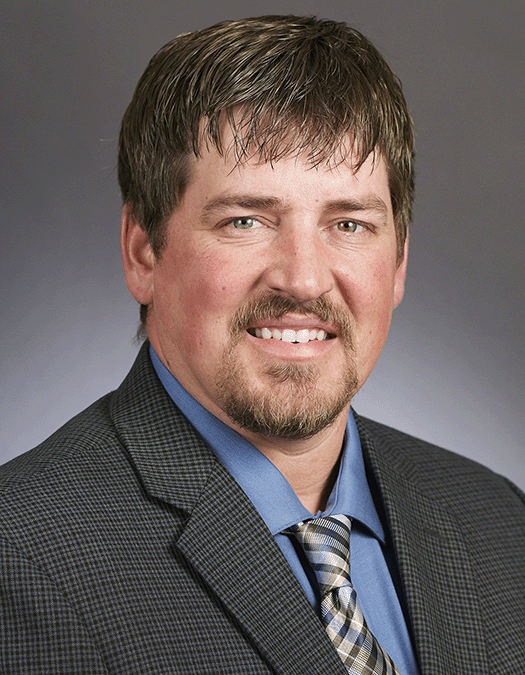
Rep. Nathan Nelson
Sponsored bills
Maddy summaryHF 2220 prohibits Minnesota state agencies from charging parking fees to state employees at facilities owned or operated by the state. It directly affects all state employees who park on state property, whether working or with manager approval for personal use. The bill amends Minnesota Statutes (sections 16B.04 and 16B.58) to require free parking, removing all fees, fines, or penalties for eligible employees. This change applies to all state parking lots managed under the Department of Administration, ensuring employees receive a free parking permit.
Maddy summaryHF 2254 adds a $400 "baby bonus" to Minnesota's existing child credit for each qualifying child born during the tax year. This directly affects Minnesota taxpayers with newborn children, increasing their state income tax credit. The bill modifies the child credit calculation by adding the $400 per newborn (without reducing the minimum credit amount) and allows for potential advance payments. It takes effect for tax years beginning after December 31, 2024.
Maddy summaryHF 1676 modifies Minnesota's rules for farmed deer (Cervidae) to strengthen chronic wasting disease (CWD) management. It requires annual herd inventory verification by veterinarians, 14-day reporting of deer movements, and mandatory CWD testing for deer over six months that die or are slaughtered. If CWD is detected, owners must depopulate herds within 30 days, maintain fencing for ten years, post biohazard signs, and disclose CWD history to future property buyers. The bill directly affects deer farmers and landowners in CWD-affected areas, adding specific reporting, testing, and long-term land-use restrictions. These changes aim to prevent CWD spread through stricter monitoring and response protocols.
Maddy summaryHF 11 delays the implementation of Minnesota's Paid Leave Law from 2026 to 2027, affecting employers, employees, and state agencies responsible for administering the program. The bill amends multiple statute sections to adjust key dates, including the start of employer premium payments (now January 1, 2027) and administrative requirements like public outreach and annual reporting. This one-year delay provides additional time for businesses to prepare for the new paid leave program without changing the law's core requirements. The law's substance - such as premium rates and fund management - remains unchanged, only the rollout timeline is extended.
Maddy summaryHF 1057 modifies Minnesota's definition of "employee" for earned sick and safe time benefits. It explicitly excludes certain workers, including independent contractors, specific emergency service personnel (like volunteer firefighters and ambulance attendants), elected officials, and farm workers under limited conditions. Farm workers are excluded if employed by a small farm (5 or fewer employees) or if their work totals 28 days or less per year. This change directly affects these excluded groups by determining who qualifies for the state's sick and safe time protections.
Maddy summaryHF 1063 modifies Minnesota's financial reporting requirements for licensed grain buyers. It mandates that grain buyers submit annual financial statements - including a balance sheet, income statement, and cash flow statement - prepared by an independent accountant. The required review level depends on annual grain purchases: buyers handling $7.5 million or more must undergo a review or audit, while those handling $20 million or more must have a full audit with an opinion statement. Small buyers purchasing under $1 million annually and paying with cash or certified checks are exempt from these reporting rules.
Maddy summaryHF 770 appropriates $30 million from state bond proceeds to fund specific agricultural loan programs administered by Minnesota's Rural Finance Authority. It directly affects Minnesota farmers by financing beginning farmer loans, seller-sponsored loans, agricultural improvement loans, and livestock expansion loans under Minnesota Statutes, chapter 41B. The bill authorizes the state to issue up to $50.05 million in bonds, with debt service repaid by the Authority, and prioritizes funding first for beginning farmers, then seller-sponsored loans, and finally agricultural improvement loans.
Maddy summaryHF 2009 provides $240,000 in fiscal year 2026 and $240,000 in fiscal year 2027 from the general fund to the Office of the Foster Youth Ombudsperson. This funding directly supports foster youth in Minnesota by enabling the hiring of additional full-time staff. The key provision allows the Ombudsperson's office to conduct expanded outreach to foster youth. The bill focuses solely on authorizing these specific appropriations for staffing, with no other policy changes.
Maddy summaryHF 1463 appropriates $25 million annually (fiscal years 2026-2027) from the general fund for Minnesota town roads and $10 million annually for town bridges. The funds will be distributed under existing rules in Minnesota Statutes section 162.081 to support local road and bridge maintenance programs. This bill directly affects Minnesota's town road and bridge systems by providing dedicated state funding for upkeep. It does not create new policies or alter current distribution methods, only allocating existing budget resources.