

Maddy summaryHF 2947 exempts electrical, electronic, or mechanical parts in upholstered furniture and textile furnishings from Minnesota's PFAS prohibitions until January 1, 2032. This directly affects furniture manufacturers and retailers who use these components in products sold in Minnesota. The bill amends Minnesota Statutes section 116.943 to create this temporary exemption, allowing continued use of such parts while broader PFAS restrictions apply to other products. The exemption does not change other PFAS restrictions in Minnesota law.
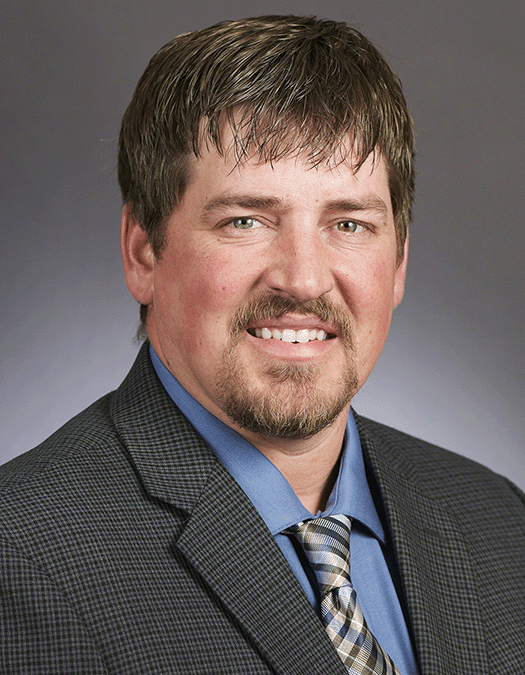
Rep. Nathan Nelson
Sponsored bills
Maddy summaryHF 2387 amends Minnesota Statutes § 124D.118 to establish a program allowing schools to provide free half-pint milk to students who do not participate in the full school lunch program. This directly affects public and nonpublic schools in Minnesota, enabling students to receive milk without needing to take a complete lunch, thereby reducing food waste from uneaten meals. The bill authorizes state reimbursement of 20 cents per milk serving for kindergarten students and up to 50 cents (or USDA rate) for lunch milk, with funding appropriated for fiscal years 2026 and 2027. Schools must follow commissioner-established guidelines to participate, focusing on daily milk access as a nutritional supplement.
Maddy summaryHF 363 establishes a $5 per acre property tax credit for agricultural land certified under Minnesota's agricultural water quality program in specific counties (Dodge, Fillmore, Goodhue, Houston, Mower, Olmsted, Wabasha, and Winona). This credit directly affects farmers who have land certified by the Department of Agriculture under the water quality program in those counties. The credit reduces property taxes payable to local governments, with the state reimbursing counties and school districts through annual appropriations from the general fund. Payments for the credit will begin for property taxes due in 2026.
Maddy summaryHF 2898 clarifies who qualifies as a "restricted pesticide handler" in Minnesota and modifies related licensing rules. The bill adds a specific definition for "handler" as someone meeting federal requirements (40 CFR § 171.201) who performs preapplication tasks like mixing and loading restricted pesticides under a licensed applicator’s supervision. It updates Minnesota Statutes sections 18B.01 and 18B.30 to explicitly state that handlers - not full applicators - may conduct these specific tasks when supervised. This change aligns state rules with federal standards and clarifies responsibilities for pesticide handling activities.
Maddy summaryHF 2918 provides one-time funding for the Minnesota Department of Natural Resources to create a statewide water availability atlas using existing data and develop a siting methodology for large water users. The atlas will map water availability across Minnesota, while the methodology will help state agencies, local governments, and economic development authorities determine suitable locations for water-intensive projects. The department must complete these tools and submit a report by January 15, 2028. This bill directly affects state and local entities involved in water resource planning and economic development.
Maddy summaryHF 1522 modifies Minnesota's definition of "agricultural land" for property tax classification purposes. It specifies that agricultural land must consist of either contiguous acreage of 10+ acres used for farming last year, or land used for intensive livestock/poultry confinement (excluding grazing-only land). This change affects farmers and landowners who qualify for lower tax rates on agricultural property, ensuring only land meeting these criteria receives the reduced 0.5% or 1% classification rate. The bill clarifies how mixed-use parcels (like land with windbreaks or timber) are classified under existing tax categories.
Maddy summaryHF 1964 appropriates $9.6 million from state bonds to renovate paved state trails established under Minnesota law. The funds, sourced through bonds sold by the state, will be managed by the commissioner of natural resources for trail projects prioritized under existing statutes. This bill directly affects Minnesota's state trail system and the agencies responsible for maintaining it. The legislation creates a specific funding mechanism to support infrastructure improvements on designated paved trails.
Maddy summaryHF 2548 creates the Outdoor School for All grant program to fund immersive, multiday outdoor educational experiences for Minnesota students in grades 4-8. The program provides grants to accredited overnight outdoor schools and nonprofit learning centers meeting specific criteria, including research-based curricula, integration with school standards, skill development (like leadership and critical thinking), and accessibility for underserved students. It appropriates $2.5 million for fiscal years 2026 and 2027 from the general fund. The bill directly affects public school students and providers offering equitable outdoor education, aiming to address declining outdoor engagement and access disparities.
Maddy summaryHF 2683 establishes Minnesota's Biofertilizer Innovation and Efficiency Program to help farmers reduce nitrogen-based fertilizer use and improve water quality. The program provides annual per-acre payments of at least $5 to eligible Minnesota farmers who verify a 15% reduction or 30 pounds per acre less in commercial nitrogen fertilizer use through qualifying biofertilizers (like nitrogen-fixing products or soil amendments) in their crop plans. Farmers must operate at least 40 acres in Minnesota and submit documented crop nutrient management plans. The bill appropriates $1.5 million for the program in fiscal year 2026, with the Agriculture Commissioner required to review and adjust payment rates annually based on inflation and new technologies.
Maddy summaryHF 2667 amends Minnesota law to clarify the definition of a "handler" for restricted pesticides and adjusts license requirements. It defines a "handler" as someone meeting federal standards who mixes or loads restricted pesticides under a licensed applicator's supervision. The bill modifies section 18B.30 to state that handlers may perform preapplication activities (like mixing/loading) without their own license, but only under a licensed applicator's direct supervision. This directly affects pesticide handlers and applicators by streamlining compliance for routine mixing and loading tasks.