

Maddy summaryHF 347 expands Minnesota's individual income tax deduction for military retirement pay. The bill adds three specific provisions allowing taxpayers to subtract military retirement income from taxable income: (1) certain military pensions under federal law, (2) federal employee retirement pensions multiplied by military service ratio, and (3) civil service retirement pensions multiplied by military service ratio. It also prohibits taxpayers claiming another specific credit (section 290.0677) from using this deduction. The change applies to tax years beginning after December 31, 2024, directly benefiting Minnesota residents receiving qualifying military retirement pay.
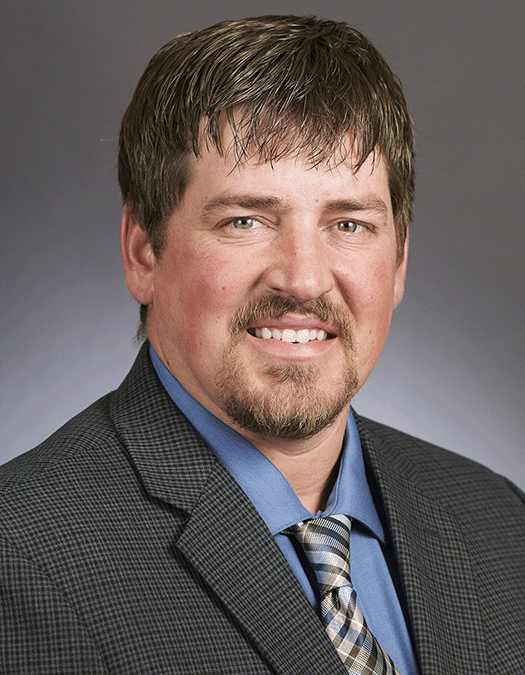
Rep. Nathan Nelson
Sponsored bills
Maddy summaryHF 451 eliminates the dedicated funding source for pollinator habitat work by repealing the statutory requirement to appropriate money to the "pollinator account" (previously established under Minnesota Statutes 103B.101, subd. 19). It also repeals the "Lawns to Legumes" grant program (Minnesota Statutes 103B.104), which provided financial assistance to homeowners and communities for planting native, pollinator-friendly vegetation. These changes end two specific programs administered by the Board of Water and Soil Resources that supported habitat restoration for declining pollinators like the rusty patched bumble bee. The bill takes effect July 1, 2025.
Maddy summaryHF 343 provides state funding to extend the Shorewood Park Sanitary Sewer District sewer system to 20 homes on Rush Lake and build a new sewage treatment facility in Chisago County. The bill appropriates money from state bonds to cover planning, design, and construction costs for both projects, with the condition that nonstate funding must first be secured. This directly affects Chisago County residents in the Shorewood Park area who will gain access to improved sewer services. The funding is provided through state bonds authorized under Minnesota law, subject to budget approval.
Maddy summaryHF 469 requires anyone 16 years or older to carry a valid state trail bicycle pass when riding a bicycle on Minnesota state trails where bicycle use is permitted. The bill establishes an annual pass for $25 and a daily pass for $5, with fees collected by the Department of Natural Resources and deposited into a dedicated trail maintenance account. Passes must be presented for inspection by conservation officers, and the revenue funds repairs and maintenance of state trails open to bicycle use. This applies directly to cyclists using designated state trails across Minnesota.
Maddy summaryHF 345 establishes a legal right for patients or residents in Minnesota healthcare facilities to have one chosen support person present during care. It requires licensed providers (like hospitals, nursing homes, and assisted living facilities) to allow this without restrictions, except for clinically necessary reasons, and to provide written policies explaining any limitations. Key provisions include ensuring minors' support persons aren't restricted by visitation hours, accommodating family during end-of-life care, and requiring virtual options if in-person visits aren't possible. Violations carry a $500 daily civil penalty. The bill directly affects patients/residents, their chosen support persons, and all licensed healthcare facilities in Minnesota.
Maddy summaryHF 346 requires health insurance companies in Minnesota to reimburse advanced practice nurses and physician assistants at the same rate as physicians for the same covered services. This applies to enrollees choosing these providers for covered care, directly affecting health plan companies and these specific healthcare professionals. The law, effective January 1, 2025, mandates equal reimbursement rates for identical services regardless of provider type. It targets a specific equity gap in provider payment without altering coverage rules or service definitions. This is a direct policy change to standardize payment rates under Minnesota Statutes, chapter 62Q.
Maddy summaryThis bill appropriates $7 million from state bond proceeds to fund specific upgrades to Pine City's wastewater treatment infrastructure. The funds will cover repairs to pond riprap, aeration systems, outfall lines, and installation of a new pond liner for the city's wastewater system. The state will issue bonds to cover the cost, following standard Minnesota bond procedures. This directly affects Pine City residents by improving their local wastewater treatment facility. The bill provides concrete funding for defined infrastructure repairs, with no additional policy changes beyond the specified project scope.
Maddy summaryThis bill modifies Minnesota's definition of sustainable aviation fuel under state law. It specifies that qualifying fuel must be derived from biomass, gaseous carbon oxides from biomass or direct air capture, or green hydrogen - excluding palm fatty acid distillates - and must achieve at least a 50% reduction in life cycle greenhouse gas emissions compared to petroleum-based fuels. The requirement uses either the Argonne National Laboratory's GREET model or the International Civil Aviation Organization's methodology for verification. This directly affects Minnesota taxpayers engaged in producing or blending sustainable aviation fuel. The change ensures state compliance with specific environmental standards for eligible fuel.
Maddy summaryHF 4071 modifies the state appropriation for farm down payment assistance grants by adjusting funding levels for various agricultural organizations and programs. The bill specifically changes the budget amounts for entities such as county agricultural societies, the Minnesota Turf Seed Council, GreenSeam, Second Harvest Heartland, and the Emerging Farmers Office. These changes include increasing or decreasing specific dollar amounts allocated for activities like food bank support, local food promotion, agricultural research, and assistance to emerging farmers. The legislation also updates reporting requirements for some recipients to ensure transparency on how the funds are used and the outcomes achieved.
Maddy summaryThis bill requires businesses in Minnesota to accept United States currency, including Federal Reserve notes, as payment for goods and services. The rule applies to in-person transactions and allows sellers with multiple locations to comply by accepting cash at just one of their sites. However, banks, credit unions, and businesses that require security deposits or credit card numbers for potential damages are exempt from this requirement. Sellers who refuse cash payments face a civil penalty of up to $250 for each transaction or attempted transaction. The law will take effect on January 1, 2025.