

Maddy summaryHF 1448 allows surviving spouses to use their deceased spouse's unused federal estate tax exemption when calculating Minnesota estate taxes. The bill requires personal representatives of a decedent's estate to elect this "portability" option on Minnesota estate tax returns (or file a return if not otherwise required), making the election irrevocable. It directly affects married couples where one spouse dies before using their full federal estate tax exemption, potentially reducing estate taxes for the surviving spouse. The key change is streamlining access to this federal exemption for Minnesota estates of decedents dying after December 31, 2024.
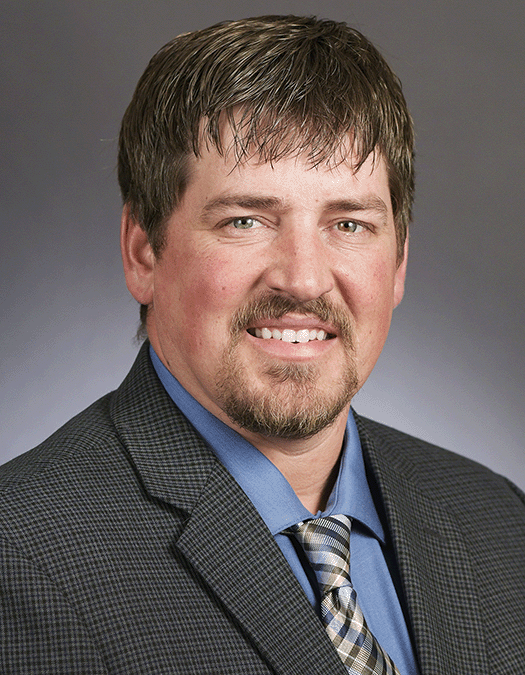
Rep. Nathan Nelson
Sponsored bills
Maddy summaryHF 1424 modifies foster care rules for relatives in Minnesota. It expands the definition of "related" caregivers to include important friends with significant relationships to the child or family, requiring these relatives to obtain foster care licenses (unless they're parents or legal guardians). The bill also mandates that all foster care providers - both related and unrelated - complete annual training on preventing sudden infant death and abusive head trauma for children under five. Additionally, it updates background check procedures for domestic partners of relative caregivers and modifies the Minnesota Family Investment Program (MFIP) funding structure. These changes aim to strengthen safety standards while providing clearer pathways for relatives and trusted community members to care for children in foster care.
Maddy summaryHF 1464 appropriates $1.2 million from the general fund in fiscal year 2026 to the Pollution Control Agency for a grant to Rice County, specifically to address water quality concerns at French Lake. Rice County may use these funds for water quality testing, infrastructure improvements, services, training, and maintenance related to the lake. The bill also extends the availability of an existing grant for the same French Lake project through June 30, 2027, under prior law. This legislation directly affects Rice County and French Lake residents by providing dedicated funding for water quality management.
Maddy summaryHF 649 requires Minnesota's wildlife commissioner to establish an annual open season for wolf hunting after wolves are removed from federal endangered species protections. The bill mandates that the commissioner consult with the agriculture commissioner and USDA before setting season rules, considering data on wolf conflicts with livestock and pets. Season rules must align with Minnesota's existing wolf management plan and include public comment opportunities. This directly affects state wildlife management decisions, hunters, and livestock owners by creating a required annual process for wolf population control.
Maddy summaryHF 1331 requires the commissioner of natural resources to conduct an annual statewide survey to estimate Minnesota's wolf population. The survey must cover the entire state - not just historic wolf habitats - and be completed each year. This amendment to Minnesota Statutes section 97B.646 (wolf management) adds this requirement to the existing framework, which already includes a wolf management plan and quarterly mortality reporting. The bill directly affects state wildlife management practices under the Department of Natural Resources.
Maddy summaryHF 776 appropriates $1.5 million for fiscal year 2026 and $1.5 million for fiscal year 2027 from the general fund to support Minnesota's Family Assets for Independence program. The funding is directed to the commissioner of children, youth, and families to implement the initiative under section 142F.20. This bill provides ongoing financial support for the program but does not change eligibility or program structure. It directly affects the state's administration of the Family Assets for Independence initiative.
Maddy summaryThis bill appropriates $4,518,000 for fiscal year 2026 and an additional $4,518,000 for fiscal year 2027 from the state general fund to the Agricultural Utilization Research Institute. It directly provides funding for the Institute to carry out its existing duties under Minnesota Statutes, chapter 116V, which focus on agricultural research and utilization. The bill makes no new policy changes but ensures continued financial support for the Institute's current operations.
Maddy summaryHF 114 appropriates $500,000 for fiscal year 2026 and $500,000 for fiscal year 2027 from the arts and cultural heritage fund to provide grants to all 95 Minnesota county agricultural societies. The funds must be distributed equally to each county fair to enhance arts access, education, and the preservation of Minnesota's agricultural, historical, and cultural heritage. This grant program operates in addition to existing funding under Minnesota Statutes section 38.02. The commissioner of agriculture will develop grant criteria and seek public input to guide funding for projects supporting these goals.
Maddy summaryHF 1008 modifies Minnesota's definition of "public waters" to clarify that inclusion in the public waters inventory is not the sole factor determining public waters status, effective July 1, 2027. The bill eliminates an annual $1 million appropriation from the general fund that had funded updating the public waters inventory map through fiscal year 2032. This change removes dedicated funding for maintaining the inventory map, which previously tracked waters designated as public under state law. The bill impacts the Minnesota Department of Natural Resources, local governments, and landowners who rely on the inventory for water management and land use decisions.
Maddy summaryHF 636 removes the requirement for a permit to carry a firearm in public places for eligible Minnesotans, while creating an optional permit system. The bill amends Minnesota Statutes 624.714 to state that anyone not prohibited by state or federal law (and at least 21 years old) may carry a firearm without a permit in public places - defined as government-owned property or private property open to the public, excluding homes, businesses, gun shops, and hunting areas. An optional permit, which requires proof of pistol safety training and background checks for disqualifying offenses, remains available for those who choose it. This change directly affects eligible residents who currently need permits to carry firearms in public, eliminating that barrier while preserving the option for a permit.