

Maddy summaryHF 1342 amends Minnesota child care licensing law to exempt unrelated individuals providing nonresidential care to two separate families (where each family is internally related) from needing a state license. This change adds a specific exemption to existing rules that already cover related caregivers. The bill directly affects informal caregivers - such as neighbors or friends - providing structured care for two distinct families without formal licensing. It does not alter requirements for care provided to unrelated individuals or for residential settings. The policy change simplifies licensing for this specific scenario under current statutory language.
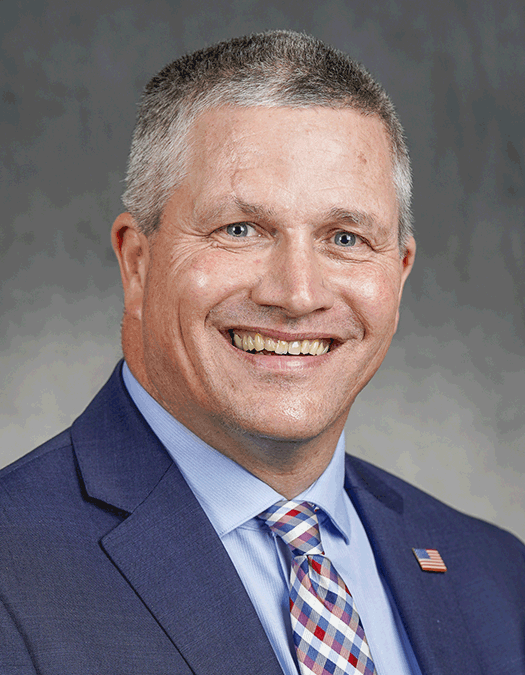
Rep. Jeff Dotseth
Sponsored bills
Maddy summaryHF 837 requires Minnesota's commissioner of commerce to apply to the federal government by December 31, 2026, for a waiver continuation under federal law (42 U.S.C. § 18052). This waiver is needed to keep Minnesota's premium security health insurance plan operating after 2027, as its future depends on federal approval. The bill also directs a one-time transfer of $413 million from the state general fund to the premium security plan account in fiscal year 2026. This funding supports the state's health insurance program for qualifying residents. The bill directly affects Minnesota's health insurance program and state budget management.
Maddy summaryHF 2420 establishes the Commission on Government Efficiency and Ethics to investigate allegations of fraud in state-funded programs and undisclosed legislative conflicts of interest. The commission will maintain an anonymous hotline and website for reporting, offer up to $5,000 rewards for reports leading to convictions or expulsions, and conduct investigations or forensic audits of state agencies. It requires public officials and entities handling public funds to cooperate with investigations and must report credible fraud evidence to law enforcement or legislative committees. The commission also submits annual reports with recommendations to prevent fraud and conflicts of interest. This bill directly affects state program administrators, legislators, and any individuals reporting misconduct.
Maddy summaryThis bill recognizes Minnesota's historic state flag (described as a blue flag with a central emblem featuring 19 stars, the word "MINNESOTA," and scenes from the Great Seal) and grants all Minnesotans the right to display it. It requires the lieutenant governor to set standards for its display on state property, mandating it be shown during specified holidays and on Capitol grounds during legislative sessions. The bill also allows the historic flag to be displayed on other public property for ceremonial purposes, while requiring it to be placed beneath the official state flag when both are displayed together. It directly affects all Minnesotans who display the flag and government entities managing public property.
Maddy summaryHF 2014 modifies notice requirements for conventional mortgage loans in Minnesota. It requires lenders to provide borrowers with a complete copy of loan documents at signing or soon after, and to send detailed written foreclosure notices that include the default type, required cure steps, a 30-day deadline to fix the issue, and information about reinstatement rights. The bill applies to lenders and borrowers in Minnesota, but compliance is optional for loans dated between August 1, 2024, and July 31, 2025 (with retroactive effect starting July 31, 2024). This changes how lenders must communicate default and foreclosure processes, but does not alter loan terms or interest rates.
Maddy summaryHF 2447 establishes a dedicated account for financial assurance funds collected from gas development permits. It requires the commissioner of natural resources to deposit these funds into an account managed by the State Board of Investment, with earnings credited back to the account. The funds can only be used for financial assurance purposes related to specific gas permits under chapters 93 and 103I of Minnesota Statutes. This bill directly affects gas development permit applicants and the commissioner's office, creating a new mechanism for handling and investing these required funds.
Maddy summaryHF 2383 removes specific restrictions on ticket resellers and online ticket marketplaces in Minnesota. The bill amends Minnesota Statutes section 325F.676 by eliminating prohibitions against: selling multiple copies of the same ticket, using others to wait in line for reselling, and advertising tickets before public availability without permission. This change directly affects businesses that resell tickets for events, allowing them greater flexibility in how they market and sell tickets. The bill focuses solely on removing these existing rules, with no new requirements added.
Maddy summaryHF 26, titled the "Never Again Act," shifts emergency declaration authority from the governor to the Minnesota legislature. It repeals the governor's power to declare emergencies and establish a new process requiring legislative approval for emergency declarations and extensions. The bill also prohibits the governor from issuing emergency orders with the "full force and effect of law" and explicitly protects citizens' rights, including free speech, religious freedom, assembly, travel, gun rights, and the ability to operate businesses. These changes amend multiple sections of Minnesota Statutes to clarify that only the legislature may enact emergency measures with legal force during crises.
Maddy summaryHF 23 amends Minnesota Statutes section 181.932 to strengthen whistleblower protections for public employees. It expands the list of protected disclosures to include reporting gross mismanagement or waste of public funds (subsection 7), clarifies protections for health care quality concerns (subsection 4), and adds specific scenarios like reporting truthful scientific studies (subsection 5) or classified service communications about state services (subsection 6). These changes directly affect state and local government employees who report violations of law, safety risks, or financial misconduct. The bill modifies existing anti-retaliation language to explicitly cover these new disclosure types while maintaining that protected disclosures cannot override other legal data protections.
Maddy summaryHF 1845 expands Minnesota's definition of "veteran" to include two specific groups: (1) Hmong veterans naturalized under the federal Hmong Veterans' Naturalization Act of 2000, and (2) individuals who served honorably with secret guerrilla units or irregular forces operating from Laos in support of U.S. forces between February 28, 1961, and May 14, 1975. The bill amends Minnesota Statutes section 197.447 to add these categories to the existing definition, ensuring these veterans qualify for state benefits. It also creates an advisory task force of veterans, experts, and community members to help determine eligibility under the new definition. This change directly affects Hmong veterans and Laotian-based veterans who previously may not have met Minnesota's veteran criteria.