

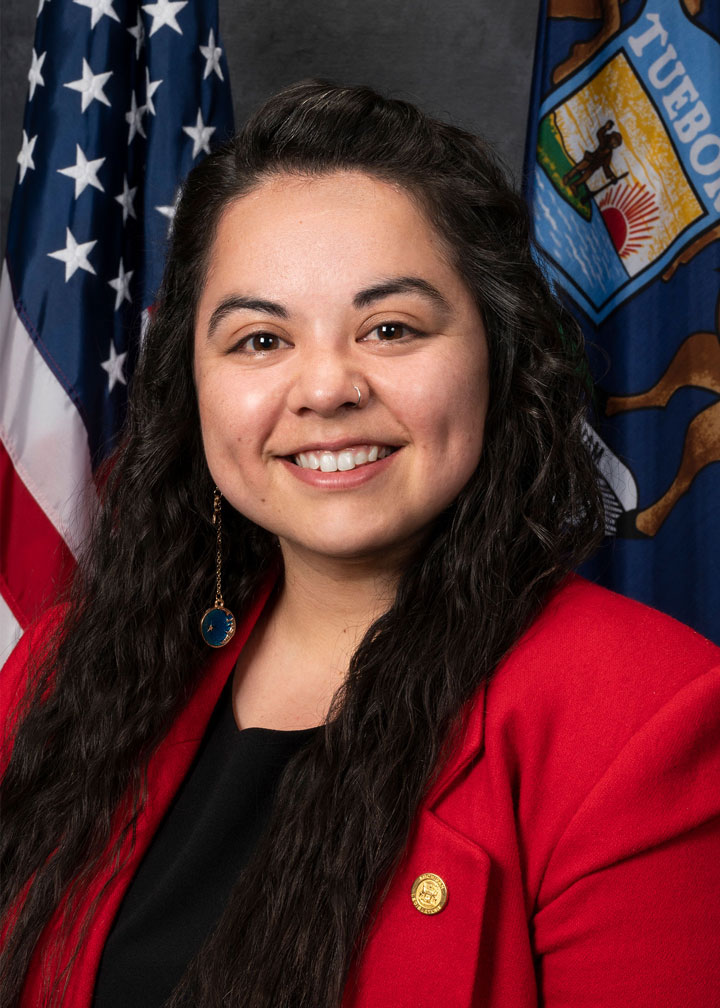
Photo of Mary Cavanagh
D Michigan Senate · District 6 On the 2026 ballot

Sen. Mary Cavanagh

Compare
Total votes
2,432
all sessions
Attendance
99%
24 missed
Lower than 82% of chamber peers
With party
95%
of cast votes
Higher than 86% of chamber peers
Bipartisan score
2%
crosses aisle rarely
Lower than 90% of chamber peers
Sponsored
1,233
bills & resolutions
Higher than 84% of chamber peers
Committees
5
assignments
1,233 bills and resolutions

Sponsored bills

Total
1,233
Primary
132
Co-sponsor
1,101
This page
1,233
matching current filters
Primary SB 694
Passed · Michigan Senate · Lead sponsor
Children: child care; definitions in the child care organizations act; revise. Amends secs. 1 & 9 of 1973 PA 116 (MCL 722.111 & 722.119) & repeals sec. 17a of 1973 PA 116 (MCL 722.127a). TIE BAR WITH: SB 0692'24

Maddy summaryThis bill updates the definitions within Michigan's Child Care Organizations Act to clarify who and what falls under state regulation. It specifically revises the criteria for "child care staff members" and "child care organizations" to include a broader range of workers and facilities, such as therapeutic group homes and certain camps. The legislation also removes a previous provision that excluded licensed camps from the act's definition of a child care organization. These changes ensure that the law's terminology accurately reflects the variety of settings and personnel involved in caring for minors.

Passed Dec 3, 2024 0 co-sponsors
Co-sponsor SB 692
Passed · Michigan Senate · Co-sponsor
Children: child care; licensing and regulation of camps; provide for. Creates new act.

Maddy summaryThis bill establishes the Camp Licensing Act to create a new regulatory framework for camps in Michigan that provide care and supervision to more than four campers for five or more days in a two-week period. It requires these organizations, including day, residential, and travel camps, to obtain state licenses and adhere to specific safety standards overseen by the Department of Licensing and Regulatory Affairs. A key provision mandates that staff and administrators undergo criminal history checks, disqualifying individuals with certain convictions related to violence, abuse, or sexual misconduct from working at these facilities. The legislation also sets up a dedicated fund to support licensing operations and includes provisions for liability immunity for licensed camps while prohibiting specific conduct regarding the reporting of incidents.

Passed Dec 3, 2024 1 co-sponsor
Co-sponsor SB 693
Passed · Michigan Senate · Co-sponsor
Criminal procedure: sentencing guidelines; sentencing guidelines for certain violations of the camp licensing act; provide for. Amends sec. 15g, ch. XVII of 1927 PA 175 (MCL 777.15g). TIE BAR WITH: SB 0692'24

Maddy summaryThis bill updates sentencing guidelines in Michigan for specific crimes related to child care and foster care licensing, such as failing to report criminal charges or submitting false reports. It directly affects licensed child care organizations, employees, foster family homes, and group homes by clarifying the maximum penalties for these offenses. The legislation sets a two-year maximum sentence for failure to report arraignment issues and a variable maximum for false reports that trigger high-risk investigations. This change only takes effect on September 1, 2025, and will not become law unless a companion bill, Senate Bill 692, is also enacted.

Passed Dec 3, 2024 1 co-sponsor
Co-sponsor SB 872
Passed · Michigan Senate · Co-sponsor
Children: foster care; conditions on the use of certain benefits for a child in foster care; provide. Amends 1994 PA 203 (MCL 722.951 - 722.960) by adding sec. 8f.

Maddy summaryThis bill requires Michigan's Department of Health and Human Services to screen children entering foster care for eligibility for state and federal benefits within 90 days and to apply for those benefits if it serves the child's best interests. Starting in October 2026, the state generally cannot use a child's earned income or benefits to pay for their foster care, though exceptions exist for special needs services or conserving funds for future needs. The department must act as a responsible manager of these funds, providing regular accounting to the child and their guardian ad litem, and offering financial literacy training to older youth. Additionally, the law mandates that any assets or income the child owns be transferred to them when they leave the system or turn 18.

Passed Dec 3, 2024 1 co-sponsor
Primary SB 1153
In committee · Michigan Senate · Lead sponsor
Highways: other; reference to prevailing wage and fringe benefits; update. Amends sec. 10a of 1951 PA 51 (MCL 247.660a).

Maddy summarySB 1153 updates the formula used to calculate financial transfers between the state and local governments when roads change jurisdiction. The bill requires the state transportation department to annually determine the mileage of roads transferred to or from state, county, city, or village control. It establishes that funding transfers will be based on the average revenue worth per mile of the road type involved, with specific rules for how miles are counted in cities with populations of 25,000 or more. This legislation directly affects the state transportation department, counties, cities, and villages by adjusting how funds are allocated during road jurisdictional changes.

In committee Nov 26, 2024 0 co-sponsors
Primary SB 1156
In committee · Michigan Senate · Lead sponsor
Labor: fair employment practices; fair and open competition in government contracts act; modify. Amends title & secs. 5, 7, 9 & 13 of 2011 PA 98 (MCL 408.875 et seq.); adds sec. 5a & repeals secs. 2 & 8 of 2011 PA 98 (MCL 408.872 & 408.878).

Maddy summarySB 1156 amends Michigan's Fair and Open Competition in Governmental Construction Act to strengthen rules against requiring contractors to adhere to specific labor agreements in public projects. The bill prohibits government entities from including terms in contracts, grants, or tax incentives that force bidders or contractors to join or avoid collective bargaining organizations, ensuring decisions are based on merit rather than labor status. It also declares any such prohibited terms in bid documents as automatically invalid and allows exemptions only for projects facing imminent threats to public health or safety. By repealing previous sections, the legislation aims to clarify and expand protections for businesses participating in government construction and related funding programs.

In committee Nov 26, 2024 0 co-sponsors
Primary SB 1154
In committee · Michigan Senate · Lead sponsor
Housing: other; Michigan fair chance access to housing act; create. Creates new act. TIE BAR WITH: SB 1155'24

Maddy summaryThis bill, known as the Michigan Fair Chance Access to Housing Act, establishes new rules for landlords regarding how they can use criminal history when screening rental applicants. It generally prohibits landlords from asking about criminal records on applications, advertising that they deny tenants based on such records, or making decisions solely on an applicant's criminal history before issuing a conditional offer to rent. However, the law allows landlords to consider specific serious offenses, such as convictions for arson, human trafficking, certain sexual crimes, and felonies committed within the last three years, provided they conduct an individualized assessment that considers mitigating factors like rehabilitation and employment. The legislation also requires landlords to clearly disclose their screening policies to applicants and gives those applicants the opportunity to provide evidence of inaccuracies or rehabilitation before a conditional offer is withdrawn.

In committee Nov 26, 2024 0 co-sponsors
Co-sponsor SB 1155
In committee · Michigan Senate · Co-sponsor
Consumer protection: unfair trade practices; unfair trade practices relating to landlords and tenants; establish. Amends secs. 3 & 4 of 1976 PA 331 (MCL 445.903 & 445.904). TIE BAR WITH: SB 1154'24

Maddy summarySB 1155 amends Michigan's Consumer Protection Act to explicitly prohibit landlords and tenants from engaging in unfair, deceptive, or unconscionable trade practices. The bill expands existing definitions of unlawful behavior to include specific actions such as making false claims about property conditions, misrepresenting the need for repairs, or using deceptive tactics regarding lease terms and fees. By clarifying these prohibited acts, the legislation aims to provide clearer standards for what constitutes unfair trade practices in residential housing transactions. This update directly affects both property owners and renters by reinforcing legal protections against misleading representations and abusive sales tactics.

In committee Nov 26, 2024 1 co-sponsor
Co-sponsor SB 1120
In committee · Michigan Senate · Co-sponsor
Courts: other; utilization of the Stored Communications Act; allow. Amends sec. 1 of 1966 PA 189 (MCL 780.651).

Maddy summaryThis bill updates Michigan's search warrant laws to allow judges and magistrates to issue warrants using electronic methods, such as computer networks or fax, rather than requiring in-person interactions. It permits affidavits and warrants to be transmitted digitally and enables judges to sign these documents from any location within the state. The legislation also clarifies that digital copies of these documents serve as official originals and establishes a timeline for when search warrant affidavits become public records, with exceptions for ongoing investigations. These changes directly affect law enforcement agencies, courts, and judges by modernizing the procedures for obtaining and executing search warrants.

In committee Nov 14, 2024 1 co-sponsor
Co-sponsor SB 1122
In committee · Michigan Senate · Co-sponsor
Environmental protection: pollution prevention; coal tar sealant or other high PAH sealant for pavement; prohibit use and sale. Amends 1994 PA 451 (MCL 324.101 - 324.90106) by adding pt. 149.

Maddy summaryThis bill prohibits the sale and application of coal tar sealants and other high-polluting pavement sealants within Michigan to reduce environmental contamination. It defines these restricted products by their chemical composition and sets up a system where sellers must keep records of any exemptions for up to three years. The law allows the state director to grant written exceptions for specific research or technology development purposes and establishes a $5,000 fine for violations.

In committee Nov 14, 2024 1 co-sponsor
Showing 331 to 340 of 1,233 bills
Previous 1 … 33 34 35 … 124 Next