

Maddy summaryThis Senate Resolution (SR 70) formally recognizes September 15-October 15, 2025, as Hispanic Heritage Month in Michigan. It does not create new laws or affect any individuals or groups; instead, it serves as a ceremonial designation by the Michigan Senate to honor the cultural, historical, and societal contributions of Hispanic and Latino Americans to the United States and Michigan. The resolution aligns with the established national observance period and acknowledges Michigan’s Hispanic-American community.
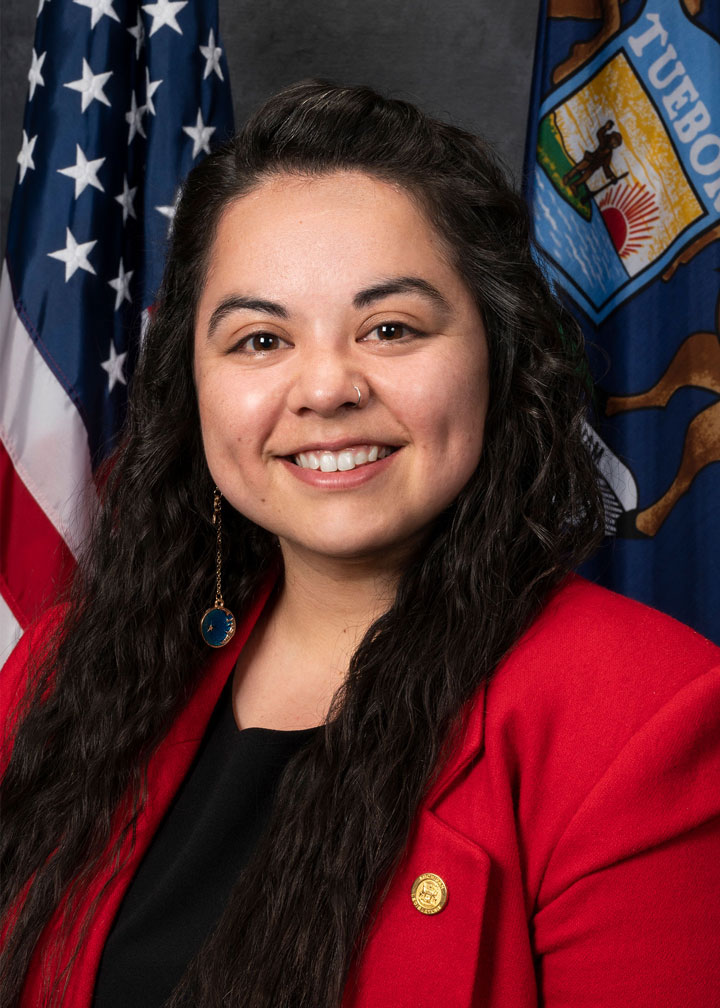
Sen. Mary Cavanagh
Sponsored bills
Maddy summarySB 533 makes it illegal to intentionally spread false information about elections with the goal of stopping people from voting. It imposes civil fines of up to $1,000 per violation on individuals who falsely claim details about election timing, voter eligibility rules, voting penalties, or registration status. Employers (including local governments) who knowingly hire someone violating this law face fines up to $10,000, though local governments are presumed not to have prior knowledge of such violations. The law directly targets misinformation meant to obstruct voting rights, not accidental errors or general political speech.
Maddy summaryThis resolution symbolically designates September 2025 as Suicide Prevention Month to raise awareness about suicide prevention efforts. It cites CDC data showing suicide is the second leading cause of death among people aged 10-34 and emphasizes the importance of mental health resources and reducing stigma. The resolution encourages public engagement with suicide prevention and references the 988 suicide hotline as a key resource. As a ceremonial resolution, it does not create new laws or funding but aims to promote community awareness during that month.
Maddy summarySB 336 modifies Michigan's search warrant procedures by requiring law enforcement officers to announce their identity and purpose before entering a property, then wait a reasonable time for admittance before forcing entry. It allows exceptions to this rule only in specific situations: imminent danger, evidence destruction risk, or if announcing would compromise an investigation. Officers seeking exceptions must include details about occupants (including disabilities) and animals in their warrant application. The bill directly affects police executing warrants and residents of homes or buildings being searched, aiming to balance officer safety with property occupant rights. The proposed changes are not yet law.
Maddy summarySB 334 requires all Michigan law enforcement officers to complete mandatory training on responding to mental health crises. It amends Michigan's Mental Health Law (MCL 28.601-28.615) by adding new sections that establish this training requirement. The bill directly affects every law enforcement officer in the state, mandating specific protocols for de-escalating situations involving mental health challenges. This policy change shifts training standards from voluntary to required under state law.
Maddy summarySB 333 requires all Michigan law enforcement agencies to adopt and regularly update use-of-force policies by six months after the law takes effect. These policies must mandate that officers only use objectively reasonable force, prohibit continuous throat restraint as deadly force, and prioritize de-escalation techniques before resorting to physical or deadly force. Agencies must also publicly post their policies online or at physical locations and continuously review them to align with legal standards. The bill directly affects every law enforcement agency in Michigan, setting clear, enforceable standards for officer conduct during encounters.
Maddy summarySB 522 amends Michigan law to explicitly include human trafficking violations as a grounds for terminating parental rights. The bill adds human trafficking to the list of abusive conduct under existing subsection (k), which allows courts to terminate rights when a parent's actions (including abuse) create a reasonable likelihood of future harm to the child. This change directly affects parents who commit human trafficking against their children, providing courts with a specific legal basis to pursue termination in such cases. The amendment does not alter other existing grounds for termination but clarifies that human trafficking violations qualify as grounds under the same standard as other forms of abuse.
Maddy summarySB 523 amends Michigan's Child Protection Law to explicitly include human trafficking violations as a qualifying form of abuse that allows the state Department of Health and Human Services to seek court intervention for children. The bill adds human trafficking (as defined in Michigan law) to the list of serious harms - alongside physical abuse, sexual assault, and neglect - that trigger the department's duty to petition a court for authority over a juvenile. This change directly affects parents, guardians, or adults living in a child's home who commit human trafficking or place a child at risk through such activity. The key mechanism expands the grounds for state action, ensuring human trafficking is treated with the same seriousness as other severe child abuse under existing legal standards.
Maddy summarySB 519 requires Michigan's Public Service Commission to create rules enabling community solar programs. It mandates that at least 30% of electricity from each facility must serve low-income households or organizations, ensures subscribers can transfer their solar credits when moving within the same utility area, and prevents utilities from changing a customer's rate class for joining solar programs. The bill also establishes bill credit rates based on utility rates (excluding distribution costs) to ensure all customer groups can access community solar. These rules directly affect electric providers, low-income households, and all Michigan residents who may subscribe to community solar facilities.
Maddy summarySB 518 establishes a framework for community solar facilities in Michigan, allowing multiple subscribers to share electricity generated from a single solar installation. The bill requires facilities to have at least 3 subscribers, limit capacity to 5 megawatts, and ensure 60% of capacity is subscribed by small users (40 kW or less). It defines "bill credits" that subscribers receive to offset their electricity bills based on their proportional share of the solar facility’s output. This directly affects residential and small business subscribers - particularly low-income households meeting HUD or poverty line criteria - and electric providers managing these programs.