

Maddy summarySenate Bill 218 establishes a process for courts to reinstate parental rights that were previously terminated. This can occur if adoption or guardianship is no longer the child's permanency goal, at least three years have passed since termination, and the child is at least 14 years old (or a younger sibling of such a child). Petitions can be filed by state agencies or the child's legal representative. The court will evaluate factors like the parent's fitness, the child's preference, and safety risks, potentially ordering a trial period of up to 180 days. If found by clear and convincing evidence to be in the child's best interests, parental rights can be permanently reinstated.
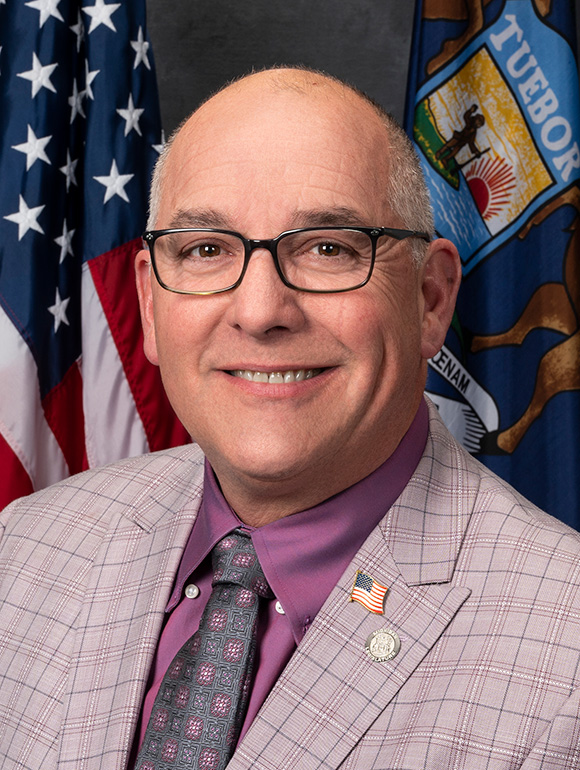
Sen. Joe Bellino
Sponsored bills
Maddy summarySenate Bill 211 proposes to create a "purple star school program" within Michigan's revised school code to support students from military families. By January 1, 2026, the Department of Education would establish a program allowing public schools to apply for this designation. To qualify, schools must designate a staff military liaison, provide an online resource page for military families, offer a student-led transition program, and provide staff professional development on military-connected issues. Additionally, qualifying schools must implement at least one initiative, such as a resolution of support, monthly recognition, or a partnership with the armed forces.
Maddy summarySenate Bill 206 encourages Michigan public schools to provide instruction on organ, eye, and tissue donation. By January 1, 2026, the state's Department of Education may develop a model presentation on this topic, including information about the Michigan organ donor registry. Beginning in the 2026-2027 school year, school boards are encouraged to provide this presentation to students before they complete 9th grade. Parents or legal guardians can request to excuse their child from attending the presentation without penalty.
Maddy summarySenate Bill 210 amends Michigan's penal code to prohibit the operation of unmanned aircraft (drones) near various critical infrastructure and public safety facilities. It makes it illegal to knowingly and intentionally use a drone in a way that interferes with the operations of facilities such as fire stations, hospitals, correctional facilities, dams, nuclear reactors, and government-owned buildings. The bill also prohibits flying or hovering a drone over facilities that are listed on the Federal Aviation Administration's fixed site registry. Violations are classified as a felony, carrying potential penalties of imprisonment or fines, though commercial operators are exempt if they comply with federal aviation regulations.
Maddy summaryThis is a ceremonial resolution (not a law) introduced by Senator Chang designating March 2025 as Social Work Month. It recognizes the contributions of social workers in Michigan and across the U.S., highlighting their roles in mental health care, child welfare, advocacy for vulnerable populations, and community support. The resolution calls on citizens to join the National Association of Social Workers in celebrating this month. It does not create new policies or affect specific groups through legislative action.
Maddy summarySB 189 allows out-of-state teachers with at least three years of successful teaching experience in their home state or country to obtain Michigan teaching certificates or endorsements without retaking required exams or completing Michigan's reading certification requirements. It directly affects educators moving to Michigan from other jurisdictions who provide documentation of their teaching history. The bill maintains existing requirements for Michigan-certified teachers (including reading coursework) but waives exam and reading credit hurdles for qualifying out-of-state applicants. The legislation does not change Michigan's standard certification rules for new teachers or alter the reading competency standards for existing educators.
Maddy summarySB 150 modifies Michigan's requirement for competitive bidding on road construction projects. It raises the cost threshold for cities/villages with over 500,000 residents from $100,000 to $100,000 (no change for them) and increases the threshold for other local road agencies from $100,000 to $250,000 per project, while adding an annual $800,000 total spending cap per agency. Projects like traffic signal upgrades and road resurfacing remain exempt from bidding rules. This change reduces the number of projects requiring public bidding for smaller local governments handling road work.
Maddy summarySB 151 reduces Michigan's individual income tax rate from 4.25% to 3.9%, effective January 1, 2025. This change applies to all individual taxpayers filing Michigan income tax returns under the current tax code. The bill amends Section 51 of the 1967 Income Tax Act to establish this new rate for tax years beginning on or after January 1, 2025. It does not alter other provisions of the tax code, such as school aid fund deposits or agricultural preservation fund allocations.
Maddy summarySB 88 requires liquor retailers to pay administrative fees to wholesalers when payments are bounced due to insufficient funds. It directly affects liquor retailers who make dishonored payments and wholesalers who collect these fees. The bill establishes a progressive fee structure: $50 for the first bounced payment, increasing to $250 for the fifth or subsequent bounced payments within a 12-month period. Wholesalers must charge these fees for each bounced payment, with higher fees applying for repeated offenses within the same 12-month window. This changes the existing law by adding specific fee amounts and requiring wholesalers to enforce them.
Maddy summarySB 87 amends Michigan's liquor control code to require the Liquor Control Commission to suspend a liquor retailer's license for 14 days if the retailer has six or more payments to a wholesaler dishonored by a bank (due to insufficient funds) on different dates within 12 consecutive months. This directly affects licensed liquor retailers who repeatedly fail to cover payments to wholesalers. The key provision establishes a clear, automatic suspension trigger based on the frequency of bounced payments. The bill creates a specific enforcement mechanism to address payment issues between retailers and wholesalers under the existing code.