

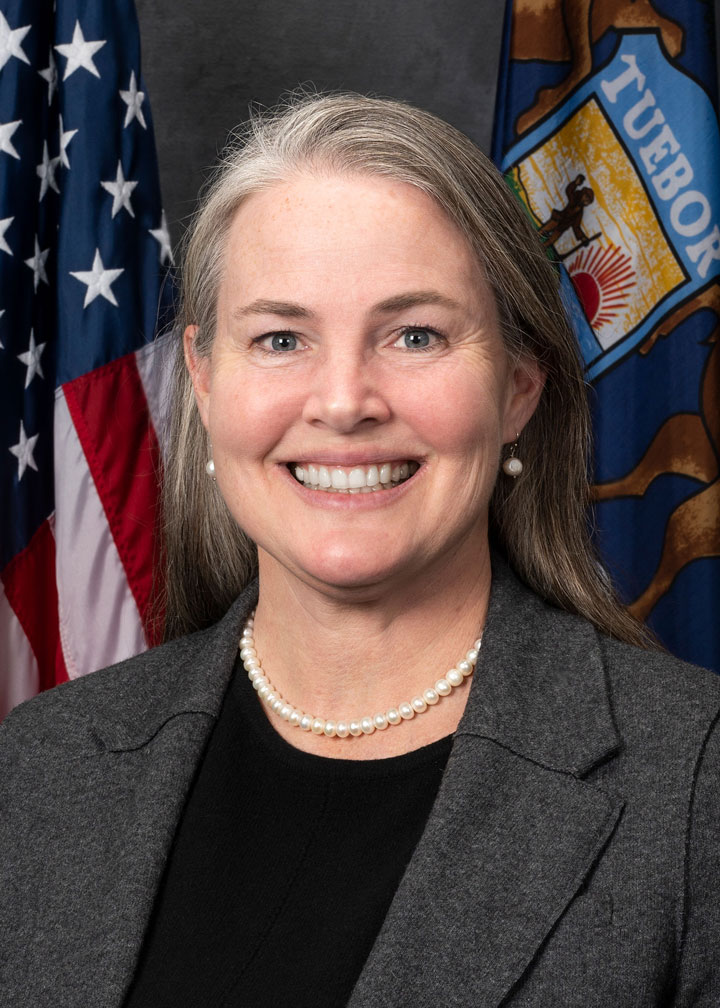
Photo of Sue Shink
D Michigan Senate · District 14 On the 2026 ballot

Sen. Sue Shink

Compare
Total votes
1,308
all sessions
Attendance
100%
1 missed
Higher than 80% of chamber peers
With party
99%
of cast votes
Near the chamber average
Bipartisan score
1%
crosses aisle rarely
Near the chamber average
Sponsored
752
bills & resolutions
Higher than 92% of chamber peers
Committees
7
assignments
752 bills and resolutions

Sponsored bills

Total
752
Primary
91
Co-sponsor
661
This page
752
matching current filters
Co-sponsor SB 1091
In committee · Michigan Senate · Co-sponsor
Courts: funding; trial court funding; provide for. Amends sec. 907 of 1949 PA 300 (MCL 257.907) & repeals sec. 908 of 1949 PA 300 (MCL 257.908). TIE BAR WITH: SB 1089'26

Maddy summaryThis bill amends the Michigan Vehicle Code to clarify how civil traffic infractions are handled in court, specifically preventing them from being treated as lesser included offenses of criminal charges. It establishes specific fine ranges for various violations, such as speeding and equipment failures, while also setting a maximum cost limit of $100 for court expenses. The legislation allows judges to order treatment or education programs for offenders and requires courts to publish schedules of fines that must account for indigent defendants. Additionally, it mandates that courts waive fines and costs if a driver repairs defective safety equipment before their court date.

In committee Jul 2, 2026 1 co-sponsor
Primary SB 762
In committee · Michigan Senate · Lead sponsor
Energy: other; energy and water usage report requirements for data centers; provide for. Amends sec. 5a of 1939 PA 3 (MCL 460.5a).

Maddy summarySB 762 requires Michigan's Public Service Commission to publish annual reports starting July 1, 2027, detailing water and energy usage by data centers. Specifically, it mandates that public water supplies submit each data center's annual water usage by June 1, and the commission must report total energy usage (in gigawatts per year) for each data center. This directly affects data centers (facilities housing centralized data storage and processing equipment) and public water supplies across Michigan. The bill creates no new regulations but establishes a reporting mechanism for transparency on resource consumption.

In committee Jul 1, 2026 0 co-sponsors
Co-sponsor SB 763
In committee · Michigan Senate · Co-sponsor
Water supply: conservation; limits on water withdrawals under part 327 of the natural resources and environmental protection act; amend. Amends 1994 PA 451 (MCL 324.101 - 324.90106) by adding sec. 32707a.

Maddy summarySB 763 prevents water users with permits under Michigan's water withdrawal rules from charging the public for costs related to infrastructure upgrades needed when they increase their water withdrawal capacity. It applies specifically to permit holders who seek to exceed their previously reported withdrawal limits and require new infrastructure (like pipes or treatment systems) to accommodate the increase. The bill ensures these infrastructure costs remain the responsibility of the permit holder, not the public, when expanding water use. This policy change directly affects commercial, industrial, or municipal water users holding permits under Section 32723 of Michigan's Natural Resources and Environmental Protection Act.

In committee Jul 1, 2026 1 co-sponsor
Primary SB 1075
In committee · Michigan Senate · Lead sponsor
Food: other; sale of eggs by consignment through licensed retail food establishments; provide for. Amends sec. 7114 of 2000 PA 92 (MCL 289.7114).

Maddy summarySB 1075 amends Michigan's food law to allow licensed retail food establishments to sell shell eggs through a consignment arrangement, provided the eggs come from producers with fewer than 3,000 hens and are sold directly to the store. Under this new provision, the eggs must be kept separate from other inventory, labeled with the specific farm name and contact details, and sold only in clean containers that do not feature third-party brand names. The bill also clarifies that these consignment eggs cannot be sold online or by mail order and must be packaged with a label stating they were not inspected by the state department. This legislation primarily affects small-scale egg producers and licensed grocery stores or markets that wish to offer farm-fresh eggs without going through a traditional distributor.

In committee Jun 30, 2026 0 co-sponsors
Co-sponsor SCR 13
Passed · Michigan Senate · Co-sponsor
A concurrent resolution of tribute offered as a memorial for R. Robert Geake, former member of the Senate and House of Representatives.

Maddy summaryThis bill is a memorial resolution honoring the life and public service of R. Robert Geake, a former Michigan legislator who served in both the House of Representatives and the Senate. The text details his extensive career, including his legislative work on committees focused on education, mental health, and children's welfare, as well as his later roles as an investigator and chair of the Office of the Children's Ombudsman and the Legislative Retirement System Board. The resolution formally expresses the Legislature's tribute to his dedication and instructs that copies of the document be sent to his family.

Passed Jun 25, 2026 1 co-sponsor
Co-sponsor SB 1043
Passed · Michigan Senate · Co-sponsor
Trade: business practices; excessively increased pricing for energy products and services during a market disruption; prohibit. Creates new act. TIE BAR WITH: SB 1041'26, SB 1042'26

Maddy summaryThis bill, known as the Energy Pricing Protection Act, prohibits businesses from charging excessively high prices for gasoline, propane, and home heating oil during market disruptions. It defines a market disruption as events like natural disasters, strikes, or emergencies and sets a 20% price increase threshold as the limit for what is considered unjustified, unless sellers can prove higher costs or prior discounts caused the rise. The law applies to anyone selling these essential energy products but excludes utilities regulated by state or federal commissions. Enforcement is handled by state and local prosecutors, who can issue written demands for documents and testimony and file court actions against violators, with investigative details kept confidential until a formal charge is made.

Passed Jun 25, 2026 1 co-sponsor
Co-sponsor SB 1041
Passed · Michigan Senate · Co-sponsor
Housing: public accommodations; excessively increased pricing in hotel and lodging industry during a declared state of emergency; prohibit. Creates new act. TIE BAR WITH: SB 1042'26, SB 1043'26

Maddy summaryThis bill creates the Hotel and Lodging Pricing Protection Act to stop businesses from raising room rates by more than 20% during a declared state of emergency unless they can prove the increase is due to higher costs or pre-existing contracts. The law applies to hotels, bed and breakfasts, campgrounds, and short-term rentals like Airbnb, but excludes large resort-managed units. It allows prosecutors to investigate violations by issuing legal demands for documents and testimony, with courts empowered to enforce compliance if the investigation is deemed proper.

Passed Jun 25, 2026 1 co-sponsor
Co-sponsor SB 1042
Passed · Michigan Senate · Co-sponsor
Trade: business practices; excessively increased pricing for certain goods and services during a declared state of emergency; prohibit. Creates new act. TIE BAR WITH: SB 1041'26, SB 1043'26

Maddy summaryThis bill establishes the Commodities and Emergency Services and Supplies Pricing Protection Act to stop businesses from raising prices unfairly during a declared state of emergency. It specifically targets sales of building materials, food, emergency supplies, medical items, and general goods, defining an illegal price hike as an increase of more than 20% compared to pre-emergency rates unless the seller can prove higher costs. The law prohibits charging or offering these items at excessively high prices and grants prosecutors the power to investigate violations by demanding documents and testimony from suspected violators.

Passed Jun 25, 2026 1 co-sponsor
Co-sponsor SB 1077
In committee · Michigan Senate · Co-sponsor
Labor: fair employment practices; use of electronic monitoring or automated decisions tools by an employer; prohibit except for certain purposes. Creates new act.

Maddy summaryThis bill, known as the Responsible Artificial Intelligence Security for Employees Act, restricts how employers in Michigan can use automated decision-making tools and electronic monitoring systems for their workforce. It generally prohibits using these technologies for employment decisions like hiring or firing, except when screening large volumes of applications based on specific job criteria. Employers are only allowed to monitor employees for specific purposes such as ensuring job function completion, monitoring production quality, or protecting health and safety, and they must obtain written consent from every employee before using such tools. The legislation also mandates that employers provide clear notice of monitoring, maintain accurate data, allow employees to correct their records, and conduct impact assessments to ensure these tools do not negatively affect individuals based on protected characteristics.

In committee Jun 24, 2026 1 co-sponsor
Primary SB 1076
In committee · Michigan Senate · Lead sponsor
Energy: gas and oil; certain standards under the motor fuels quality act; update. Amends secs. 2, 3, 4, 4a, 5, 6, 7, 10a & 10d of 1984 PA 44 (MCL 290.642 et seq.); adds secs. 4b, 7a & 7b & repeals sec. 5a of 1984 PA 44 (MCL 290.645a).

Maddy summarySB 1076 updates the Michigan Motor Fuels Quality Act by modernizing the definitions of various fuel types and industry terms used in the law. The bill clarifies the meanings of substances like ethanol, biodiesel, and hydrogen fuel, while also refining definitions for industry roles such as blenders, distributors, and operators. Additionally, it adds new sections to the statute to address emerging fuel technologies and repeals an outdated provision. These changes directly affect fuel suppliers, retailers, and regulators by ensuring the legal framework accurately reflects current fuel standards and practices.

In committee Jun 24, 2026 0 co-sponsors
Showing 21 to 30 of 752 bills
Previous 1 2 3 4 76 Next