

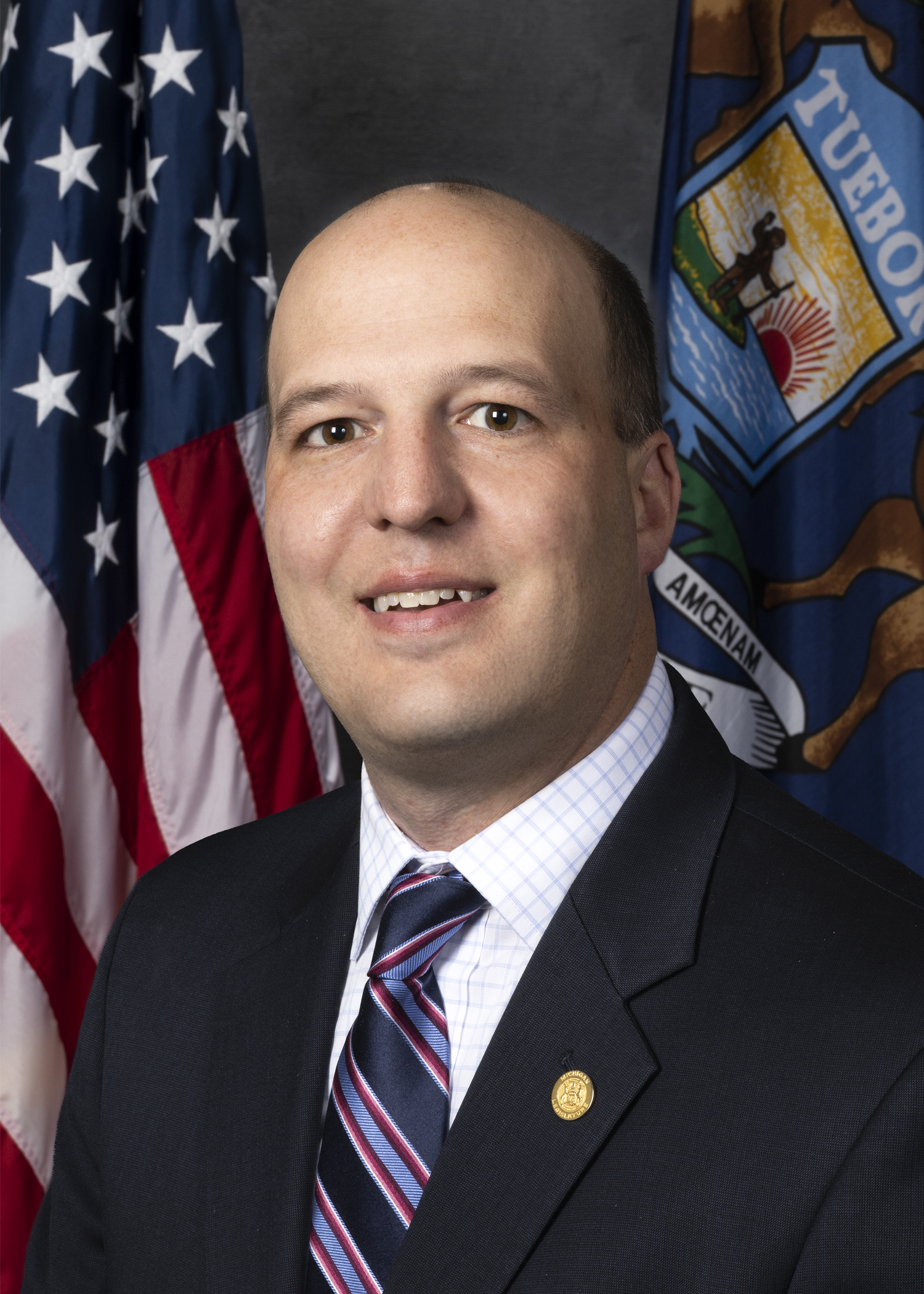
Photo of Kevin Hertel
D Michigan Senate · District 12 On the 2026 ballot

Sen. Kevin Hertel

Compare
Total votes
5,327
all sessions
Attendance
100%
23 missed
Higher than 90% of chamber peers
With party
96%
of cast votes
Higher than 81% of chamber peers
Bipartisan score
2%
crosses aisle rarely
Lower than 85% of chamber peers
Sponsored
1,526
bills & resolutions
Near the chamber average
Committees
6
assignments
1,526 bills and resolutions

Sponsored bills

Total
1,526
Primary
142
Co-sponsor
1,384
This page
1,526
matching current filters
Co-sponsor SB 514
In committee · Michigan Senate · Co-sponsor
Corporate income tax: credits; distributor credit for returnable containers; provide for. Amends 1967 PA 281 (MCL 206.1 - 206.847) by adding secs. 279 & 679. TIE BAR WITH: SB 512'25

Maddy summarySB 514 creates a corporate income tax credit for beverage distributors who charge deposits on returnable containers. It allows eligible distributors to claim a $0.005 credit per container sold starting in 2026, with annual adjustments based on the U.S. Consumer Price Index beginning in 2027. Distributors must attach a specific report to their tax return to claim the credit, and any unused credit amount is refundable. The bill directly affects beverage distributors who originate container deposits and depends on the passage of companion bill SB 512 to take effect.

In committee Sep 3, 2025 1 co-sponsor
Co-sponsor SB 399
Passed · Michigan Senate · Co-sponsor
Controlled substances: drug paraphernalia; definition of drug paraphernalia; modify. Amends sec. 7451 of 1978 PA 368 (MCL 333.7451).

Maddy summarySB 399 amends Michigan's definition of "drug paraphernalia" in the Public Health Code to explicitly exclude certain testing products, like fentanyl test strips, from being classified as paraphernalia. The bill states that tools used to detect harmful chemicals in controlled substances - such as strips for testing fentanyl - do not count as drug paraphernalia under state law. This change directly affects individuals using these testing products for safety, including people who use or distribute them to prevent overdoses. The amendment aims to remove legal barriers for harm-reduction tools without altering other provisions about paraphernalia.

Passed Jul 1, 2025 1 co-sponsor
Primary SB 397
Passed · Michigan Senate · Lead sponsor
Human services: medical services; exemption of certain prescription drugs from the medical assistance prior authorization process; provide for. Amends sec. 109h of 1939 PA 280 (MCL 400.109h).

Maddy summarySB 397 removes the prior authorization requirement for specific prescription drugs under Michigan's medical assistance program (Medicaid). This directly affects Medicaid beneficiaries and healthcare providers by allowing immediate coverage for designated drugs without waiting for insurer approval. The bill amends state law to automatically cover these medications, eliminating a step that previously delayed access. It applies only to drugs explicitly named in the legislation, streamlining treatment for covered conditions.

Passed Jul 1, 2025 0 co-sponsors
Primary SB 400
Passed · Michigan Senate · Lead sponsor
Insurance: health insurers; prior authorization for certain opioid use disorder and alcohol use disorder medications; prohibit. Amends 1956 PA 218 (MCL 500.100 - 500.8302) by adding sec. 3406ww.

Maddy summarySB 400 prohibits Michigan health insurers from requiring prior authorization for medications treating opioid use disorder or alcohol use disorder. This directly affects health insurance companies and patients seeking these specific treatments, removing a common administrative barrier. The bill amends Michigan’s Insurance Code to explicitly ban prior authorization requirements for these medications, using the existing definition of "prior authorization" from Section 2212e. The law ensures faster access to evidence-based treatment without insurer delays.

Passed Jul 1, 2025 0 co-sponsors
Co-sponsor SB 402
Passed · Michigan Senate · Co-sponsor
Human services: medical services; coverage for street medicine services; require. Amends sec. 109 of 1939 PA 280 (MCL 400.109).

Maddy summarySB 402 requires health insurance plans to cover street medicine services, which provide medical care directly to homeless individuals in non-clinical settings like streets or shelters. The bill amends state law (MCL 400.109) to mandate this coverage, directly affecting homeless residents and healthcare providers offering street-based care. This policy change ensures that street medicine services can be billed through insurance, improving access to healthcare for vulnerable populations who might otherwise avoid traditional clinics. The requirement applies to all health insurers covered under the amended statute.

Passed Jul 1, 2025 1 co-sponsor
Co-sponsor SB 401
Passed · Michigan Senate · Co-sponsor
Health: pharmaceuticals; co-prescribing of naloxone with opioid drugs; require. Amends sec. 17744b of 1978 PA 368 (MCL 333.17744b).

Maddy summarySB 401 requires doctors to co-prescribe naloxone - a medication that reverses opioid overdoses - whenever they prescribe opioid painkillers. This directly affects healthcare providers who prescribe opioids and their patients, mandating that naloxone be provided at the same time as the opioid prescription. The bill amends existing law to make this co-prescribing a standard requirement, not an option. It aims to reduce opioid overdose deaths by ensuring patients have immediate access to naloxone when prescribed opioids. The bill passed the legislature with strong support on July 1, 2025.

Passed Jul 1, 2025 1 co-sponsor
Co-sponsor SB 404
Passed · Michigan Senate · Co-sponsor
Controlled substances: other; opioid antagonist policy; require schools to implement in certain circumstances. Amends sec. 1178 of 1976 PA 451 (MCL 380.1178) & adds sec. 1179c. TIE BAR WITH: SB 405'25

Maddy summarySB 404 requires public schools in Michigan to ensure at least one staff member at each school is trained to administer naloxone (an opioid overdose reversal medication) if the state health department provides it at no cost. Schools must develop policies requiring staff to notify parents when naloxone is used and call 9-1-1 for suspected opioid overdoses. The bill directly affects public school districts, intermediate districts, and public school academies by mandating training and response protocols for opioid-related emergencies. It specifies naloxone must be FDA-approved and defines "opioid-related overdose" to include symptoms like respiratory depression or unconsciousness needing medical help.

Passed Jul 1, 2025 1 co-sponsor
Co-sponsor SB 405
Passed · Michigan Senate · Co-sponsor
Controlled substances: other; definition of governmental agency under the administration of opioid antagonist act; modify. Amends sec. 101 of 2019 PA 39 (MCL 15.671). TIE BAR WITH: SB 404'25

Maddy summarySB 405 amends Michigan's "Administration of Opioid Antagonists Act" by revising the definition of "governmental agency" to explicitly exclude school district boards, public school academies, and licensed healthcare providers (under Public Health Code Part 209). This change means these entities will no longer be subject to the act's requirements regarding opioid antagonist access and training. The bill directly affects school districts, public school academies, and licensed healthcare facilities by removing them from the scope of the law. The amendment clarifies which organizations must comply with the act's provisions, focusing on state and local government entities rather than schools or healthcare providers. This is a technical definitional update with no new requirements or funding changes.

Passed Jul 1, 2025 1 co-sponsor
Co-sponsor SB 403
Passed · Michigan Senate · Co-sponsor
Health occupations: pharmacists; dispensing certain addiction medications without undue delay; require. Amends 1978 PA 368 (MCL 333.1101 - 333.25211) by adding sec. 7333c.

Maddy summarySB 403 requires Michigan pharmacists to dispense certain medications used to treat addiction without unnecessary delay. This directly affects pharmacists who handle these medications and patients seeking treatment for substance use disorders. The bill amends Michigan's Pharmacy Act (MCL 333.1101 et seq.) by adding a new provision that eliminates administrative barriers causing delays in providing these critical medications. It establishes a clear requirement for prompt dispensing while maintaining pharmacists' existing professional responsibilities.

Passed Jul 1, 2025 1 co-sponsor
Co-sponsor SB 319
Passed · Michigan Senate · Co-sponsor
Labor: collective bargaining; minimum staffing levels within a bargaining unit; make a mandatory subject of bargaining for certain public employees. Amends secs. 11 & 15 of 1947 PA 336 (MCL 423.211 & 423.215).

Maddy summarySB 319 amends Michigan's public employee collective bargaining law to require that minimum staffing levels within a bargaining unit become a mandatory topic for negotiation between public employers and employee representatives. This applies specifically to public employees covered under 1969 PA 312 (which includes most state and local government workers like teachers, nurses, and first responders), making staffing levels a required subject of bargaining alongside wages and hours. The bill includes a limited exception: if a public employer faces reduced state funding or property tax revenue, it may choose whether to negotiate staffing levels, but must otherwise include them in bargaining. The change directly affects public sector workplaces where employee bargaining units exist, ensuring staffing levels cannot be unilaterally set by employers without negotiation.

Passed Jun 26, 2025 1 co-sponsor
Showing 101 to 110 of 1,526 bills
Previous 1 … 10 11 12 … 153 Next