

Maddy summaryThis resolution (HR 181) declares October 2025 as Polish American Heritage Month in Michigan. It recognizes the significant contributions of Michigan's large Polish American community - nearly 8% of the state's population (784,200 people) - to the state's history, culture, and society, encouraging all citizens to honor their heritage during that month. As a symbolic gesture, it does not create new laws or affect specific groups through policy mechanisms.
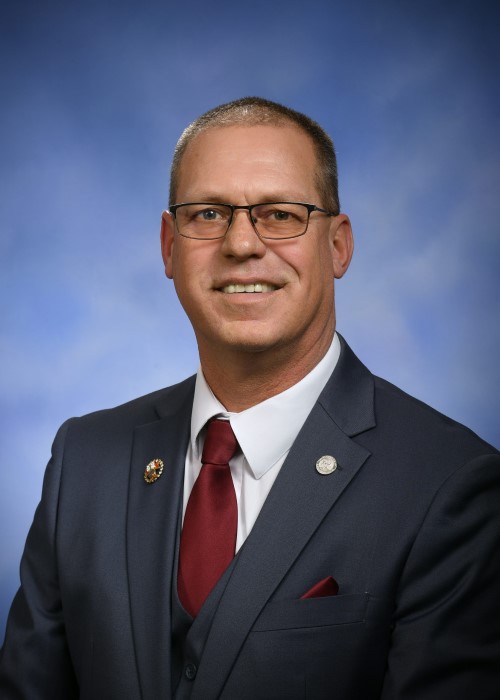
Rep. Greg Alexander
Sponsored bills
Maddy summaryThis is a ceremonial resolution, not a law with policy changes. It declares October 2025 as "Pastor Appreciation Month" in Michigan to recognize pastors' contributions to their congregations and communities. The resolution expresses support for pastors' work through "wise counsel" and spiritual leadership, based on religious references in the text. It has no legal effect or direct impact on any specific group beyond symbolic recognition.
Maddy summaryHB 4834 is a procedural bill that revises Michigan's 1945 Aeronautics Code (MCL 259.2 et seq.) by amending 21 existing sections and adding a new Section 89c while repealing Section 36. It updates the legal language and structure of the code without creating new policy or directly affecting specific individuals or entities. The bill focuses on administrative and technical corrections to the state's aviation regulatory framework. As a code revision, it primarily impacts state agencies and aviation-related entities governed by this statute. The bill is currently in committee referral stage after its first reading and committee review.
Maddy summaryHB 4835 amends Michigan's law enforcement standards act to update the legal definition of "law enforcement officer." It specifically adds airport law enforcement officers (appointed by public airport authorities) and clarifies that certain other roles - like public safety officers at community colleges and conservation officers - also qualify under this definition. The bill directly affects these officers, ensuring they fall under the Michigan Commission on Law Enforcement Standards' requirements for training and certification. This is a definitional update, not a policy change, and affects who must meet the state's law enforcement standards.
Maddy summaryHB 5075 requires individuals alleging accessibility violations under Michigan's Persons with Disabilities Civil Rights Act to provide written notice to facility owners or managers before filing a lawsuit. The notice must detail specific violations and give the owner 15 business days to respond, either by committing to fix issues within 120 days, challenging the claim, or proving prior corrections. This applies to violations of accessibility laws covering public accommodations, buildings, and transportation. The bill aims to give owners a chance to resolve issues before litigation, while still allowing lawsuits if owners fail to respond or comply within the specified timeframe. It directly affects disabled individuals seeking enforcement and facility owners subject to accessibility laws.
Maddy summaryHB 5056 requires Michigan's state construction code to adopt specific international codes, including the International Residential Code and International Energy Conservation Code, as the baseline for building safety and energy standards. It eliminates the current advisory committee and creates a new 19-member advisory committee with representatives from architects, contractors, fire services, building officials, energy efficiency specialists, disability advocates, and low-income housing groups. The committee must review updates to these international codes, evaluate proposed changes based on public health, safety, economic impact, and technical feasibility, and submit recommendations to the state director within 45 days. This bill directly affects construction professionals, building inspectors, and developers who must comply with the updated code requirements. The new process ensures public input through accessible meetings and transparent voting on code revisions.
Maddy summaryHB 5057 requires Michigan's housing director to convene a meeting with a commission within 90 days of the bill's effective date. The commission must develop recommendations for modifying housing codes to allow triplexes, quadplexes, 5-plexes, or 6-plexes in residential areas, specifically considering water supply, fire department response times, and public safety. These recommendations would guide the director in updating rules or codes by January 1, 2027, if needed. The bill does not immediately permit multi-unit housing but establishes a process for future rule changes to potentially expand housing options in residential zones.
Maddy summaryHB 4107 requires Michigan schools to include specific health education content for students in grades 7-12. It mandates instruction in cardiopulmonary resuscitation (CPR), automated external defibrillator (AED) use, and first aid response kits (including tourniquets and bleeding control supplies) as part of the health curriculum. Schools may use trained personnel like Red Cross instructors, EMTs, or properly trained teachers to deliver this instruction, with hands-on practice encouraged but not required for all students. The bill exempts 100% online schools from requiring hands-on CPR practice.
Maddy summaryHB 4160 prevents Michigan state agencies from creating rules stricter than federal standards, unless they prove a "clear and convincing need" for stricter rules. It directly affects all state agencies that create regulations, requiring them to justify any rule exceeding federal benchmarks. The bill mandates that agencies must either cite specific state law authorizing stricter rules or provide detailed justification for exceptional circumstances. This applies whether federal rules exist or not, though it excludes special education rules from this restriction. The law aims to align state regulations with federal standards unless compelling state-specific reasons exist.
Maddy summaryHB 5060 requires bars, nightclubs, and other alcohol-serving establishments to hire bouncers only after they complete mandatory training on preventing positional asphyxiation - a dangerous restraint technique that can restrict breathing. The bill mandates that owners verify this training before employing anyone whose duties might involve physically restraining patrons. The Michigan Commission on Law Enforcement Standards will develop specific training rules, and violations could trigger penalties under Michigan's liquor control laws. The bill's effective date depends on another related bill (HB 5061) also being enacted.