

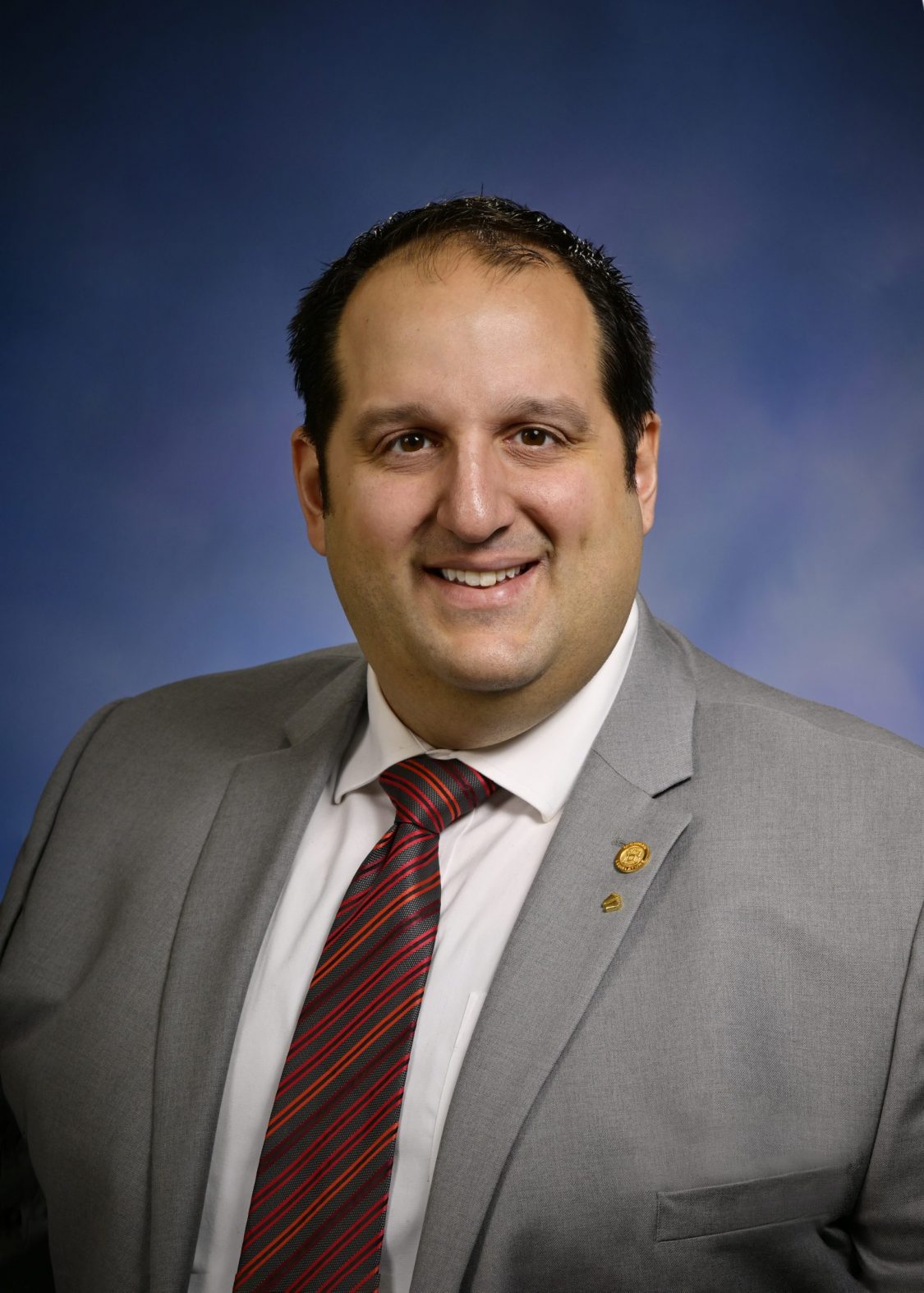
Photo of Joe Aragona
R Michigan House · District 60 On the 2026 ballot

Rep. Joe Aragona

Compare
Total votes
1,761
all sessions
Attendance
99%
13 missed
Higher than 83% of chamber peers
With party
93%
of cast votes
Higher than 94% of chamber peers
Bipartisan score
3%
crosses aisle rarely
Lower than 95% of chamber peers
Sponsored
584
bills & resolutions
Near the chamber average
Committees
4
assignments
584 bills and resolutions

Sponsored bills

Total
584
Primary
80
Co-sponsor
504
This page
584
matching current filters
Co-sponsor HB 4418
Passed · Michigan House · Co-sponsor
Probate: other; designation of a patient surrogate for health care decisions; allow. Amends 1998 PA 386 (MCL 700.1101 - 700.8206) by adding pt. 6 to art. V & repeals sec. 66h of 1939 PA 280 (MCL 400.66h). TIE BAR WITH: HB 4419'25

Maddy summaryHB 4418 updates Michigan's probate law to clarify how patients can designate a healthcare surrogate when they cannot make decisions themselves. It adds a new process for formally naming a surrogate (replacing the previous method) and removes an outdated section from older law. This directly affects patients without existing advance directives and their families by providing a clearer, more modern way to appoint someone to make medical decisions for them.

Passed Jan 29, 2026 1 co-sponsor
Co-sponsor HB 4419
Passed · Michigan House · Co-sponsor
Probate: other; designation of a patient surrogate for health care decisions; allow. Amends 1998 PA 386 (MCL 700.1101 - 700.8206) by adding secs. 5605 & 5606. TIE BAR WITH: HB 4418'25

Maddy summaryHB 4419 adds legal protections to Michigan's health care decision-making framework. It shields health care providers and facilities from liability when following decisions made by a legally designated patient surrogate or advocate, as long as they act in good faith. The bill also protects surrogates and advocates from liability for good-faith health care decisions they make. Providers who intentionally violate these rules face minimum damages of $1,000, while those who falsify or tamper with a patient's health care directive designation face minimum damages of $2,500. This directly affects patients with advance directives, their designated surrogates, and medical providers.

Passed Jan 29, 2026 1 co-sponsor
Primary HB 5469
In committee · Michigan House · Lead sponsor
Consumer protection: other; virtual currency kiosk protections; provide for. Creates new act.

Maddy summaryHB 5469, the "Virtual Currency Kiosk Consumer Protection Act," requires businesses operating physical digital currency exchange kiosks in Michigan to clearly disclose key risks to customers before any transaction. It mandates that operators explain that virtual currency is not legal tender, lacks government backing, is subject to regulatory changes, transactions are irreversible, and ledger recording times may differ from initiation. The bill directly affects kiosk operators and their customers, focusing on transparency about digital currency risks rather than regulating the currency itself. It does not cover gaming platform currencies or loyalty rewards programs.

In committee Jan 27, 2026 0 co-sponsors
Co-sponsor HB 5470
In committee · Michigan House · Co-sponsor
Financial institutions: money transmitters; money transmitter license; subject virtual currency kiosk to. Amends sec. 3 of 2006 PA 250 (MCL 487.1003). TIE BAR WITH: HB 5469'26

Maddy summaryHB 5470 amends Michigan's Money Transmission Services Act to require virtual currency kiosks to obtain a money transmitter license. The bill explicitly defines "money transmission services" to include owning, operating, advertising, or facilitating virtual currency kiosks - devices that allow users to buy, sell, or exchange virtual currencies like Bitcoin. This change subjects these kiosks to the same licensing, reporting, and regulatory requirements as traditional money transmitters (e.g., check-cashing services). It directly affects businesses operating virtual currency kiosks in Michigan, bringing them under the state's existing financial services oversight framework.

In committee Jan 27, 2026 1 co-sponsor
Co-sponsor HB 4980
Passed · Michigan House · Co-sponsor
Weapons: licensing; license to carry a concealed pistol; modify requirement to file in county of residence. Amends secs. 5b & 5l of 1927 PA 372 (MCL 28.425b & 28.425l).

Maddy summaryHB 4980 amends Michigan's concealed pistol licensing law to allow applicants to file their license applications with *any* county clerk in the state where they reside, rather than requiring filing only in their county of residence. This change directly affects Michigan residents seeking concealed carry permits, simplifying the initial application process. The bill modifies Section 5b of the state's firearms licensing act (MCL 28.425b) to remove the residency county restriction, while maintaining all other requirements like fingerprinting, background checks, fees ($100), and training documentation. It does not alter eligibility criteria, fees, or processing timelines - only the location where applications must be submitted. The bill is pending in the Judiciary Committee as introduced on September 18, 2025.

Passed Jan 27, 2026 1 co-sponsor
Co-sponsor HB 5459
In committee · Michigan House · Co-sponsor
Sales tax: collections; collection of sales tax on utility bills; prohibit. Amends sec. 4n of 1933 PA 167 (MCL 205.54n).

Maddy summaryHB 5459 clarifies how utility companies collect the 2% additional sales tax on residential electricity, gas, and heating fuels in Michigan. It directly affects utility companies serving residential customers, requiring them to calculate the tax based on specific rules depending on their customer size. Companies with 100,000+ Michigan customers must prorate the tax starting from May 1, 1994, based on days after April 30, 1994. Smaller companies (under 100,000 customers) can either use this proration method or apply the tax starting with the first bill after April 30, 1994. The bill amends existing tax collection rules to provide clear, practical guidelines for utilities.

In committee Jan 22, 2026 1 co-sponsor
Co-sponsor HB 5460
In committee · Michigan House · Co-sponsor
State management: purchasing; state procurement of electric motor vehicles made with forced labor; prohibit. Amends secs. 213 & 215 of 1984 PA 431 (MCL 18.1213 & 18.1215).

Maddy summaryHB 5460 prohibits Michigan state agencies from purchasing electric motor vehicles or components unless manufacturers provide a sworn declaration confirming no forced labor or oppressive child labor was used in their production, mining, or sourcing. This applies directly to all state agencies acquiring such vehicles, requiring verification of supply chain labor practices before contracts are signed. The bill defines "forced labor" broadly to include coercion, threats, abuse of legal processes, and child labor exploitation. It amends existing procurement laws to enforce this requirement, with no exceptions for state agencies under the transportation department's jurisdiction.

In committee Jan 22, 2026 1 co-sponsor
Co-sponsor HR 235
Passed · Michigan House · Co-sponsor
A resolution to declare January 18-24, 2026, as Sanctity of Human Life Week in the state of Michigan.

Maddy summaryThis resolution declares January 18-24, 2026, as "Sanctity of Human Life Week" in Michigan. It encourages citizens to reflect on the value of human life, support women and families, and strengthen a "culture of life" through symbolic recognition. The bill does not create new laws, alter policies, or directly affect any specific group or program. It is a ceremonial declaration with no binding requirements or funding mechanisms.

Passed Jan 22, 2026 1 co-sponsor
Co-sponsor HB 5466
In committee · Michigan House · Co-sponsor
Health: other; authority to limit patient visitation in certain health care facilities; restrict in emergency orders and under certain circumstances. Amends secs. 2253, 2453 & 5145 of 1978 PA 368 (MCL 333.2253 et seq.).

Maddy summaryHB 5466 amends Michigan's Public Health Code to limit emergency orders restricting patient visitation in healthcare facilities to a maximum of 30 days after an epidemic declaration. It specifically requires that after this 30-day period, healthcare facilities must allow "LINDA" (loved individuals need dedicated attention) visitation for patients with cognitive impairments, including family members, patient advocates, or designated attorneys-in-fact. The bill establishes safety measures like prescreening or visit duration limits for these visitors while ensuring facilities maintain safe operations. This directly affects hospitals, assisted living facilities, and physician offices during public health emergencies.

In committee Jan 22, 2026 1 co-sponsor
Co-sponsor HB 4692
Passed · Michigan House · Co-sponsor
Occupations: cosmetologists; branch facilities for a school of cosmetology; provide for. Amends 1980 PA 299 (MCL 339.101 - 339.2677) by adding sec. 1205b. TIE BAR WITH: HB 4693'25

Maddy summaryHB 4692 creates a new license for "secondary school facilities" that provide cosmetology training in separate classroom settings, directly affecting cosmetology schools and their associated training locations. These facilities must not offer public services or contain equipment like hair-drying chairs, must be staffed by licensed instructors with 3+ years' experience, and require detailed floor plans and department inspections. License holders must display their license and instructor credentials visibly, and the license becomes void if ownership changes or the location shifts, requiring a new application. The bill also mandates the department to create implementing rules within 18 months of enactment.

Passed Jan 21, 2026 1 co-sponsor
Showing 171 to 180 of 584 bills
Previous 1 … 17 18 19 … 59 Next