

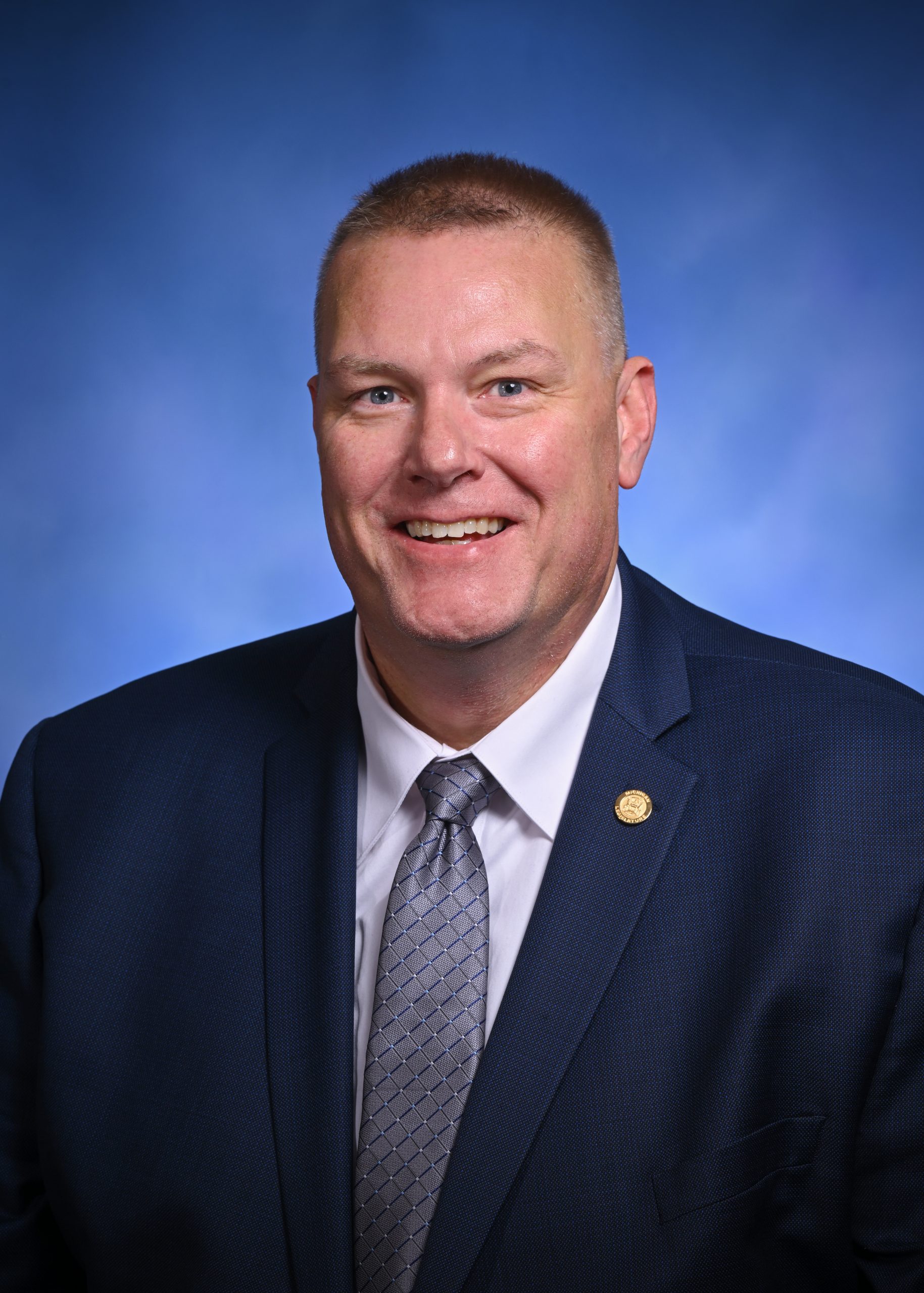
Maddy summaryHB 4712 creates a new program through which the Michigan Department of Military and Veterans Affairs will reimburse eligible Michigan National Guard members for premiums paid toward Tricare Reserve Select or Tricare Dental coverage. The program allows the department to award grants to qualifying members who apply using a department-provided form, covering premiums for these specific health plans. It directly affects Guard members who are not on active duty and lack other employer or private health insurance. The bill establishes the framework for administering these reimbursements but does not specify funding amounts or application deadlines.
Rep. Ron Robinson
Sponsored bills
Maddy summaryHB 4681 allows eligible disabled veterans with an honorable U.S. military discharge to request special vehicle registration plates or a "DV" adhesive tab for their service/conflict plates at no application fee. To qualify, veterans must prove a VA disability rating of at least 50% (for partial disability) or 100% (for total disability), including receiving disability retirement pay. Totally disabled veterans would be exempt from registration taxes, and their plates could be renewed without re-proving disability or paying fees. Surviving spouses of qualifying veterans may also use and renew these plates after the veteran’s death. The bill also permits a free wheelchair symbol tab to be attached to these special plates.
Maddy summaryHB 4682 modifies Michigan's property tax exemption for surviving spouses of veterans. It expands eligibility to include surviving spouses who qualify for dependency and indemnity compensation (under 38 USC 1310-1318) because their veteran spouse died from a service-connected disability. The exemption applies to homestead property owned by these surviving spouses, reducing their property tax burden. This change directly affects surviving spouses of veterans who meet specific U.S. Department of Veterans Affairs eligibility criteria.
Maddy summaryHB 4680 would make it a misdemeanor to refuse to remove a face covering when law enforcement requests it, if the person was wearing the mask to conceal their identity while threatening others, intimidating a group, or violating a state law or local ordinance. Currently, wearing a mask to hide identity during a crime is already a misdemeanor, but this bill adds officers' authority to stop and ask for removal in those specific situations. Refusing such a request would carry a penalty of up to one year in jail or a $2,500 fine. The bill directly affects individuals wearing face coverings in contexts involving potential threats, group intimidation, or ongoing law violations.
Maddy summaryHB 4516 amends Michigan's unemployment benefits law to clarify when workers lose eligibility for benefits due to leaving jobs. It shifts the burden of proof to claimants to prove they left work "involuntarily" for employer-related reasons, rather than assuming voluntary departure. The bill adds specific exceptions where benefits aren't charged to employers, including for domestic violence victims, military spouses relocating due to service, and part-time workers switching employers. These changes directly affect unemployed workers applying for benefits who left their jobs, ensuring clearer standards for disqualification and employer accountability.
Maddy summaryHB 4367 creates Michigan's "Purple Star School Program" to support military-connected students in public schools. It requires schools to designate a military liaison, maintain an easily accessible website with relocation and support resources, implement transition programs for military-connected students, provide staff training, and offer at least one community initiative like monthly recognition or military partnerships. The program applies to all public schools serving military-connected pupils, defined as students whose families include active/reserve military members or those who lost a service member in action. Schools must meet all these requirements to earn the "Purple Star" designation by 2026. The law aims to improve support systems for military-connected students through concrete, school-level actions.
Maddy summaryThis resolution officially designates June 27, 2025, as National PTSD Awareness Day in Michigan. It encourages Michigan residents to learn about PTSD, reduce stigma, and support those affected - including veterans, first responders, and trauma survivors - while aligning with the existing U.S. Senate observance honoring Staff Sergeant Joe Biel. The bill has no new funding or legal requirements; it is a symbolic gesture to promote awareness and compassion.
Maddy summaryHB 4655 prohibits Michigan state departments or licensing boards from requiring implicit bias training as a condition for health professional licensure or license renewal. The bill directly affects licensed healthcare workers (like nurses, doctors, and therapists) who would otherwise need to complete such training to obtain or maintain their licenses. It achieves this by amending Michigan's Public Health Code to add Section 16149, which bans the enforcement of rules mandating this training, and by rescinding a related section of the Michigan Administrative Code (MCL 338.7004). The bill removes a potential requirement for healthcare professionals seeking initial licensure or renewal.
Maddy summaryHB 4589 would create special vehicle registration plates for Michigan residents who served in Operation Inherent Resolve (the U.S. military operation in Iraq/Syria starting June 15, 2014). Eligible applicants - current or former members of the U.S. Armed Forces Reserve or active duty during this operation - could apply for plates displaying "Operation Inherent Resolve" beneath the registration numbers, without paying a service fee for application or renewal. The plates would expire on the vehicle owner’s birthday, and disabled veterans applying under this bill would also receive a disability tab. This bill does not impose new taxes or fees beyond standard registration taxes and applies only to qualifying military service members.
Maddy summaryThis resolution urges the U.S. military to expand medical waivers for recruits with food allergies, including peanuts, under existing Department of Defense guidelines. It specifically targets current disqualifying rules (DODI 6130.03) that exclude applicants with certain allergies, while noting the Air Force already allows waivers for non-anaphylactic cases. The resolution highlights that such changes would allow more eligible applicants - like the estimated 140,000 Michigan adults with peanut allergies - to serve without restricting career options. As a procedural resolution, it does not change policy but formally requests the Department of Defense to broaden waiver availability.