

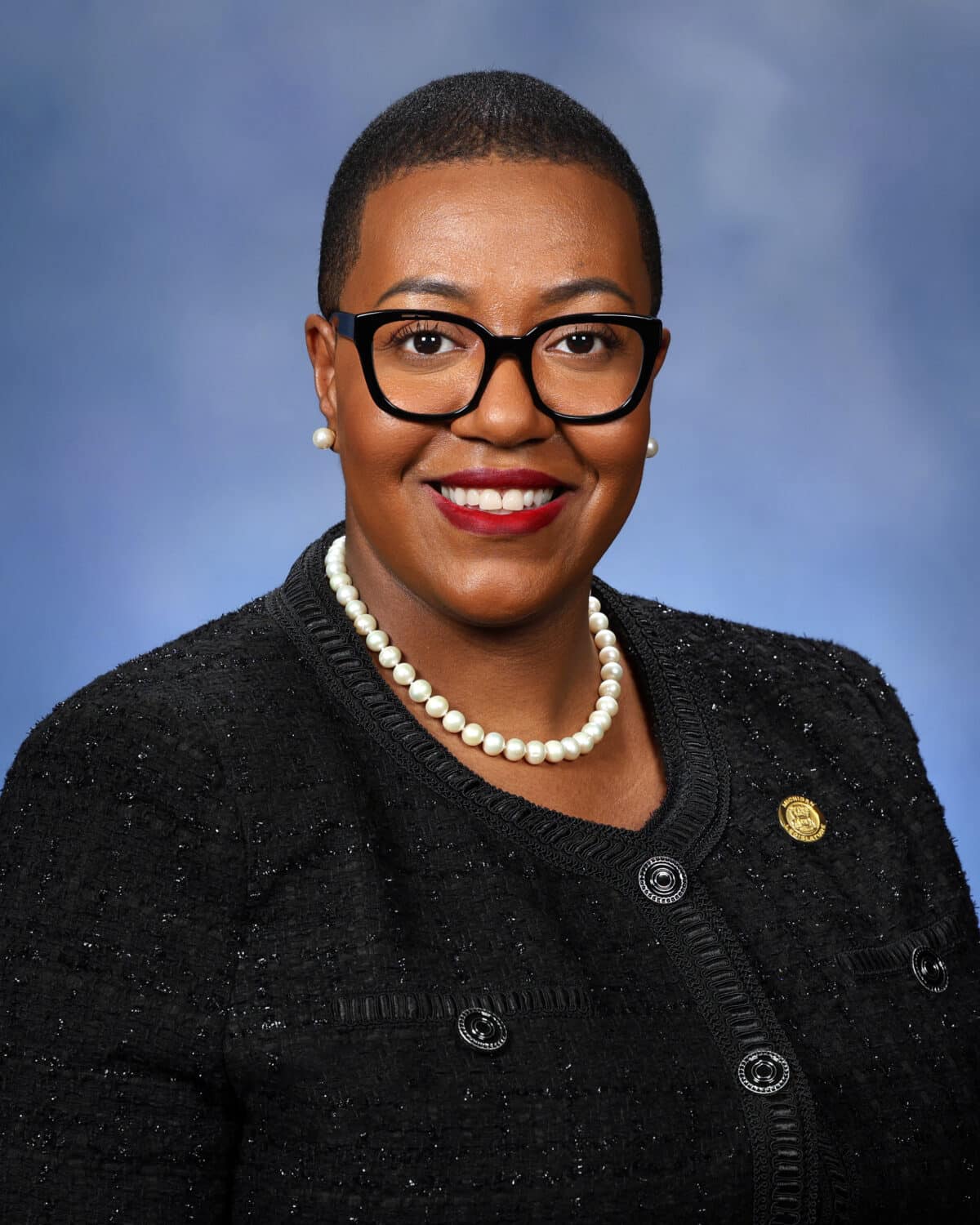
Photo of Morgan Foreman
D Michigan House · District 33 On the 2026 ballot

Rep. Morgan Foreman

Compare
Total votes
652
all sessions
Attendance
89%
80 missed
Lower than 88% of chamber peers
With party
91%
of cast votes
Lower than 78% of chamber peers
Bipartisan score
5%
crosses aisle rarely
Higher than 77% of chamber peers
Sponsored
393
bills & resolutions
Near the chamber average
Committees
2
assignments
393 bills and resolutions

Sponsored bills

Total
393
Primary
20
Co-sponsor
373
This page
393
matching current filters
Co-sponsor HB 6146
In committee · Michigan House · Co-sponsor
State finance: budgets; distribution of the countercyclical budget and economic stabilization fund; make subject to section 8 of the motor fuel tax act. Amends sec. 352 of 1984 PA 431 (MCL 18.1352). TIE BAR WITH: HB 6147'26

Maddy summaryThis bill proposes changes to how Michigan manages its economic stabilization fund by adjusting the rules for transferring money into and out of the fund based on state revenue growth rates. It requires that if revenue growth exceeds 2 percent, the excess amount must be moved into the stabilization fund, while limiting withdrawals to 25 percent of the fund balance when revenue growth is negative. Additionally, the bill subjects the fund to specific provisions of the motor fuel tax act, ensuring that any transfers are consistent with existing tax laws. The legislation is tied to a companion bill and will not take effect unless both are passed by the legislature.

In committee Jul 1, 2026 1 co-sponsor
Co-sponsor HB 6147
In committee · Michigan House · Co-sponsor
Transportation: motor fuel tax; gas tax holiday; provide for. Amends secs. 8 & 152 of 2000 PA 403 (MCL 207.1008 & 207.1152). TIE BAR WITH: HB 6146'26

Maddy summaryThis bill amends the Michigan Motor Fuel Tax Act to establish a temporary gas tax holiday that activates if the statewide average price of gasoline reaches $5.00 per gallon before the end of 2026. Under this provision, the tax rate would drop to zero cents per gallon for a three-month period, with the lost revenue automatically transferred from a state stabilization fund to the Michigan Transportation Fund. The legislation also updates the general tax rate structure to include annual adjustments based on inflation or a fixed 5% increase, whichever is lower, while maintaining specific rates for fuel held in storage as of the end of 2025. Additionally, the bill clarifies reporting requirements for fuel suppliers and terminals to ensure accurate tracking of blended products and tax liabilities.

In committee Jul 1, 2026 1 co-sponsor
Co-sponsor HB 6145
In committee · Michigan House · Co-sponsor
Education: school districts; capital outlay funds; allow school districts and intermediate school districts to use. Amends sec. 242 of 1984 PA 431 (MCL 18.1242)

Maddy summaryHB 6145 requires school districts and intermediate school districts in Michigan to develop and submit five-year capital outlay plans for facility improvements, including new construction and renovations. These plans must be submitted electronically by November each year and will be evaluated based on factors such as safety needs, occupancy rates, sustainability, and projected operating costs. The bill allows districts to opt into this process, which involves a review by the Department of Treasury and the Joint Committee on Oversight Services before any funding is authorized for final design and construction. By establishing these specific criteria and timelines, the legislation aims to bring greater transparency and oversight to how public school districts plan and request funds for building projects.

In committee Jul 1, 2026 1 co-sponsor
Co-sponsor HJR Y
In committee · Michigan House · Co-sponsor
Legislature: other; certain transparency requirements and penalties for failure to present school aid appropriation bills by July 1; provide for. Amends secs. 12, 26 & 31, art. IV & sec. 11, art. IX & adds sec. 55 to art. IV of the state constitution.

Maddy summaryThis proposed constitutional amendment requires Michigan's legislature to pass the annual school aid budget bill by July 1 each year. To ensure transparency and accountability, the bill must be publicly available on the legislature's website for at least seven days before a vote, and any amendments must be posted for 24 hours. If the deadline is missed, the salaries of the governor, the Senate majority leader, and the House speaker will be withheld until the bill is enacted.

In committee Jul 1, 2026 1 co-sponsor
Co-sponsor HB 6144
In committee · Michigan House · Co-sponsor
Education: financing; interest-free loans to school districts and intermediate schools districts from the state's surplus funds; allow under certain circumstances. Amends 1855 PA 105 (MCL 21.141 - 21.147) by adding sec. 2g.

Maddy summaryThis bill allows the state treasurer to provide interest-free loans to school districts and intermediate school districts if the state budget is not passed by October 1. Under the new rules, a district can borrow an amount equal to what it received from the school aid fund in the previous year for a period of up to one year. The state treasurer retains the authority to set additional terms for these loans, which are intended to help districts manage cash flow during budget delays.

In committee Jul 1, 2026 1 co-sponsor
Co-sponsor HB 6131
In committee · Michigan House · Co-sponsor
Public utilities: rates; disclosure of uses of increased revenue; require to be provided with rate increase requests. Amends sec. 6a of 1939 PA 3 (MCL 460.6a).

Maddy summaryHB 6131 amends state law to clarify the process public utilities must follow when requesting rate increases, ensuring they provide the Public Service Commission with specific evidence supporting their financial projections. The bill mandates that utilities coordinate with commission staff to avoid overlapping filings and requires the commission to notify interested parties and hold hearings before approving any changes that raise costs for customers. It also establishes strict timelines for the commission to review applications and grants utilities the ability to implement temporary rate increases while awaiting a final decision, provided they refund any excess amounts collected with interest if the final order is lower. Additionally, the legislation maintains existing protections against automatic fuel cost adjustments without proper notice and hearing, reinforcing the requirement for transparency in utility rate-making.

In committee Jun 30, 2026 1 co-sponsor
Co-sponsor HB 6139
In committee · Michigan House · Co-sponsor
Construction: permits; acoustic engineering report for data center; require to receive building permit. Amends 1972 PA 230 (MCL 125.1501 - 125.1531) by adding sec. 10a. TIE BAR WITH: HB 6135'26, HB 6140'26, HB 6141'26, HB 6137'26, HB 6138'26, HB 6142'26

Maddy summaryThis bill requires anyone applying for a building permit for a data center in Michigan to submit a detailed acoustic engineering report. The report must include measurements of current noise levels, projections of construction and operational noise, and a comparison of these levels against local rules or national standards. An enforcing agency cannot issue the permit until this report is provided and shared with the Michigan Public Service Commission and the local government. The law only takes effect if several other related bills are also passed.

In committee Jun 30, 2026 1 co-sponsor
Co-sponsor HB 6136
In committee · Michigan House · Co-sponsor
Businesses: other; Michigan zoning enabling act; make subject to the data center community benefit agreement act. Amends sec. 205 of 2006 PA 110 (MCL 125.3205). TIE BAR WITH: HB 6137'26

Maddy summaryThis bill amends Michigan's zoning enabling act to explicitly include the Data Center Community Benefit Agreement Act as a law that local zoning ordinances must follow. By adding this requirement to the list of existing state laws, the measure ensures that municipalities cannot create zoning rules that conflict with community benefit agreements for data center projects. The legislation also clarifies that local governments cannot regulate oil and gas drilling operations and establishes specific criteria for evaluating mining activities based on factors like safety, traffic, and public interest. Additionally, it protects renewable energy projects approved after January 1, 2021, from having their special land use approvals revoked once substantial construction or financial investment has begun.

In committee Jun 30, 2026 1 co-sponsor
Co-sponsor HB 6141
In committee · Michigan House · Co-sponsor
Public utilities: electric utilities; project labor agreements; require for certain data center contracts. Amends 1939 PA 3 (MCL 460.1 - 460.11) by adding sec. 10kk. TIE BAR WITH: HB 6135'26, HB 6140'26, HB 6137'26, HB 6138'26, HB 6142'26, HB 6139'26

Maddy summaryThis bill requires electric utilities in Michigan to include project labor agreements or collective bargaining agreements for all construction and maintenance work on qualified data centers. A project labor agreement is a pre-hire contract that sets standard employment terms, prevents strikes, and ensures labor-management cooperation for specific construction projects. The measure applies to facilities designed to house data center equipment for storing and processing information. The legislation will only take effect if several related bills are also passed into law.

In committee Jun 30, 2026 1 co-sponsor
Co-sponsor HB 6137
In committee · Michigan House · Co-sponsor
Businesses: other; community benefit agreements; require certain data centers to be subject to. Creates new act. TIE BAR WITH: HB 6135'26, HB 6136'26, HB 6140'26, HB 6141'26, HB 6138'26, HB 6142'26, HB 6139'26

Maddy summaryThis bill requires data centers in Michigan to sign legally binding community benefit agreements before they can begin construction or operation. To get approval, data center owners must negotiate deals with local governments and utility providers that address issues like hiring local workers, managing water usage, and funding community projects. The law mandates that these agreements cover at least half of five specific topics, including infrastructure costs and home efficiency improvements, and they must be approved by both the local government and the state public service commission. Without these signed agreements, local authorities cannot issue necessary permits, and the state commission cannot approve the facility's connection to the power grid. This legislation applies to any facility designed to house equipment for storing and processing data within the state.

In committee Jun 30, 2026 1 co-sponsor
Showing 21 to 30 of 393 bills
Previous 1 2 3 4 40 Next