

Maddy summaryHB 4175 modifies Michigan's high school diploma requirements by adding specific course credits students must complete. It requires all students graduating after 2023 to complete a half-credit personal finance course (fulfilling part of math, arts, or language requirements), while maintaining existing requirements for 4 math credits (including algebra I, geometry, and algebra II), 3 social science credits (including U.S. history and geography), 1 health/PE credit, and 1 arts credit. The bill also mandates two credits in a language other than English (including American Sign Language) for all students by graduation, with schools encouraged to offer language courses in early grades. These changes directly affect Michigan high school students and school districts responsible for implementing diploma standards.
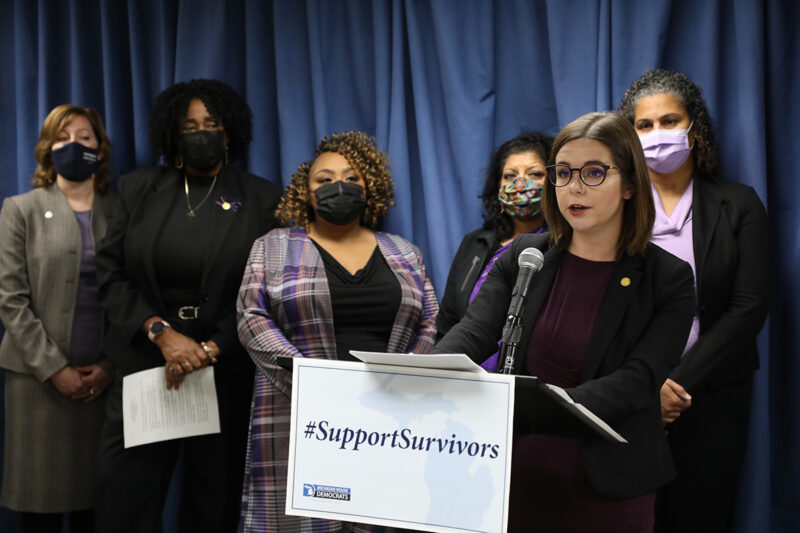
Rep. Laurie Pohutsky
Sponsored bills
Maddy summaryHB 4174 modifies Michigan's juvenile justice code to establish a presumption that self-incriminating statements made by juveniles during police interrogations are admissible in court if obtained through deceptive practices (e.g., false promises of leniency or misleading statements about evidence). The bill directly affects juveniles under 18 facing delinquency proceedings and law enforcement officers who may use deceptive tactics during interrogations. Keyly, it amends the Probate Code to add Section 17e, shifting the standard so such statements are presumed admissible unless the court finds the deception was "unreasonably coercive." This changes current practice by making it harder to exclude statements obtained through deception, impacting how juvenile confessions are handled in court.
Maddy summaryThis proposed constitutional amendment (HJR F) would remove gender-specific language from two Michigan constitutional provisions. It would repeal Article I, Section 25 - which defined marriage as "the union of one man and one woman" - and amend Article X, Section 1 to make property rights language gender-neutral. If approved, it would eliminate the constitutional ban on same-sex marriage and update outdated references to gender in property law. The amendment would require voter approval at the next general election. (Note: The bill is currently in committee referral, with no further action taken as of March 2025.)
Maddy summaryThis House Resolution (HR 34) urges the federal government to consider the economic impacts of tariffs on trade with Canada and Mexico. It directly affects Michigan businesses, particularly in agriculture (where Canada is the top export market), manufacturing, and auto production, which rely on stable North American supply chains. The resolution reaffirms support for the U.S.-Mexico-Canada Agreement (USMCA) and highlights Michigan’s $3 billion annual agricultural exports and $55 billion in annual trade with Ontario. As a non-binding resolution, it does not create new laws but formally advocates for fair trade negotiations to protect Michigan’s economy.
Maddy summaryHB 4134 amends Michigan's sentencing guidelines to establish specific penalties for crimes that prevent access to healthcare facilities, such as blocking entrances to clinics. It directly affects individuals convicted of obstructing access to medical care, including abortion providers or other healthcare services. The bill modifies existing sentencing guidelines (MCL 777.13n) to create new, higher sentencing ranges for these offenses. This change would apply to cases where someone intentionally interferes with lawful access to a healthcare facility. The bill is currently in committee review after its February 2025 introduction.
Maddy summaryHB 4133, the "Access to Health Facilities Act," prohibits physical obstruction, intimidation, or violence targeting individuals accessing or providing reproductive health services at licensed health facilities, including abortion care. It criminalizes actions like blocking entrances, threatening patients, or damaging property at these facilities, with penalties ranging from misdemeanors (up to 1 year jail, $10,000 fine) to felonies (up to life in prison for causing death). The law also allows civil lawsuits for $5,000 per violation and civil fines up to $25,000 for violators. It explicitly protects First Amendment-protected protests but does not affect local abortion regulations or existing protest laws.
Maddy summaryThis resolution designates February 24-March 2, 2025, as "Eating Disorders Awareness Week" in Michigan. It aims to raise public awareness about eating disorders - serious mental health conditions affecting people of all ages, backgrounds, and genders - and combat associated stigma. The resolution does not create new laws or funding; it is a symbolic declaration to encourage community conversations and early intervention. All Michigan residents are the general audience for this observance, which aligns with national efforts to highlight the need for support and understanding.
Maddy summaryHB 4075 amends Michigan's minimum wage law to gradually increase the hourly wage for most workers. It sets specific rates starting at $10.00 in 2019, rising to $20.00 by 2030, with annual adjustments for inflation beginning in 2022. The inflation adjustment uses the Consumer Price Index (CPI-W) and takes effect January 1 each year, unless unemployment exceeds 8.5% in the prior year. This bill directly affects low-wage workers and employers across Michigan who must comply with the updated wage schedule.
Maddy summaryThis bill creates a new research and development tax credit for Michigan businesses starting in 2025, allowing eligible companies to reduce their corporate income tax based on qualifying R&D expenses. The credit rate varies by company size, offering up to 10% for larger employers with 250 or more employees and up to 15% for smaller businesses with fewer than 250 workers, with separate maximum limits of $2 million and $250,000 respectively. Companies that collaborate with in-state research universities can claim an additional 5% credit on their R&D expenses, capped at $200,000, provided they submit written agreements to the state department. To manage the total cost, the bill sets a statewide spending cap of $100 million per year, which triggers a pro-rating system to distribute credits evenly if total claims exceed this limit.
Maddy summaryHB 4020 creates a temporary commission to update African-American history curriculum for Michigan K-12 schools. The commission, appointed by the governor and including university representatives, NAACP, and museum staff, must review current standards within 365 days and recommend age-appropriate instruction covering Reconstruction, the Civil Rights Era, and African-American contributions to U.S. development. Starting in the 2026-2027 school year, Michigan school districts must provide this instruction, and state assessments will include related questions. The bill mandates curriculum updates to the state board within two years of the commission's recommendations. This directly affects all public K-12 schools in Michigan and their required social studies curriculum.