

Maddy summaryHB 4758 requires Michigan Works agencies to create teams providing job transition services to two groups: individuals who lost federal jobs involuntarily between January 2025 and January 2027 (dislocated federal employees), and veterans. The bill mandates these teams to analyze job matches with public employers, assess transferable skills, and refer individuals to both public and private employers needing staff. It also requires assistance with filing for unemployment benefits under Michigan’s existing employment security system. The law applies specifically to Michigan Works agencies and public employers like state/local governments, schools, and community colleges. This bill creates a new coordination framework but does not establish new benefits or funding.
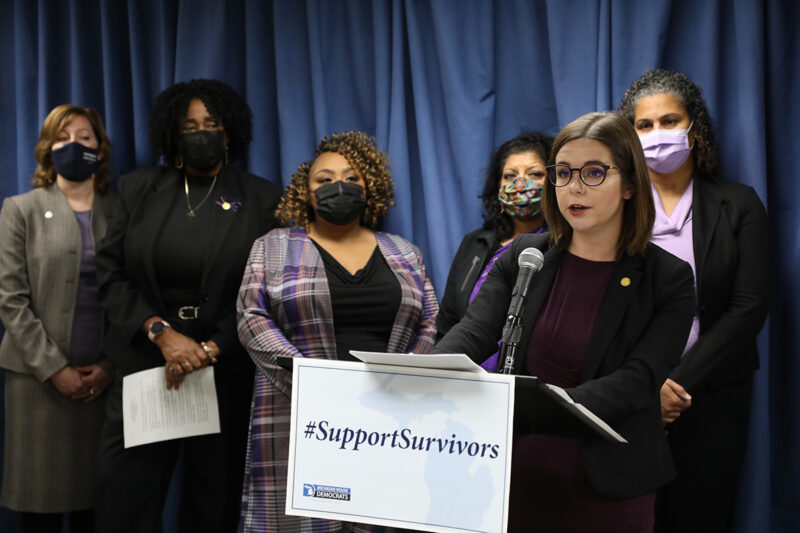
Rep. Laurie Pohutsky
Sponsored bills
Maddy summaryHB 4760 requires Michigan law enforcement officers to wear visible identification (showing their name or badge number and agency) and not wear masks or disguises during public interactions while performing duties. Exceptions allow masks for health protection (e.g., airborne diseases), safety from toxins, or physical protection during high-risk incidents like shootouts. The law applies to all state and federal officers in Michigan during public engagements, with violations punishable as misdemeanors (up to 90 days in jail or $1,000 fine). It does not affect covert operations or officers wearing protective gear for legitimate safety reasons.
Maddy summaryHB 4759 encourages public employers (like state agencies, cities, schools, and community colleges) to use an expedited hiring process for dislocated federal employees who are referred through the state's reemployment services program. The bill requires public employers receiving such referrals to prioritize these candidates, though it does not mandate hiring. Key provisions include defining "public employer" broadly and specifying that this process must follow existing constitutional hiring rules for state positions. It does not override other laws but depends on another bill (HB 4758) being enacted first. The measure directly affects dislocated federal workers seeking new jobs and public employers hiring for open positions.
Maddy summaryHB 4741 modifies Michigan's property tax law by ending certain programs that reduced delinquent tax payments or prevented foreclosure. It adds a $175 fee for properties forfeited to county treasurers due to unpaid taxes (after 12+ months delinquent), changes interest calculations for residential properties under foreclosure avoidance agreements, and updates redemption rules. Homeowners with delinquent taxes, particularly those in residential properties covered by existing tax foreclosure avoidance agreements, will be directly affected by these changes. The bill sunsets specific programs that previously offered payment reductions, requiring property owners to pay full delinquent amounts plus fees to avoid losing their homes.
Maddy summaryHB 4675 requires Michigan's education department to develop and share a list of optional cursive handwriting instruction programs for public schools by June 2027. Starting in the 2026-2027 or 2027-2028 school year, school districts and public school academies are encouraged - but not required - to incorporate one of these model programs into their curriculum. The bill aims to support schools in meeting existing credit requirements under Michigan’s merit standards by offering cursive instruction as a voluntary option. It directly affects Michigan public schools by providing resources for optional handwriting education, without mandating changes to current standards.
Maddy summaryHR 138 is a symbolic resolution introduced by Michigan House representatives to declare June 2025 as Lesbian, Gay, Bisexual, Transgender, and Queer Pride Month in the state. It does not create new laws or policies but formally recognizes the historical significance of LGBTQ+ rights movements, including the Stonewall Riots and key legal victories like Obergefell and Bostock. The resolution aims to affirm Michigan's support for LGBTQ+ communities and their contributions to the state's cultural and economic vitality. This declaration directly affects all Michiganders by officially honoring Pride Month through state-level recognition.
Maddy summaryHB 4669 requires Michigan correctional facilities to allow unannounced, immediate inspections by state legislators upon request. It directly affects all correctional facilities under the Department of Corrections and state legislators (senators and representatives). The key provision mandates that facility staff must grant legislators access to inspect any premises without prior notice. This bill enhances legislative oversight by providing direct, on-the-ground access to correctional facilities for lawmakers.
Maddy summaryThis resolution urges Congress, the President, and the Health and Human Services Secretary to ensure all Americans can access free COVID-19 vaccines regardless of income, insurance, or immigration status. It highlights ongoing challenges like expired federal funding and misinformation that have created unequal vaccine access since the pandemic began. As a non-binding resolution, it does not change policy but calls for action to maintain universal vaccine availability as a public health priority.
Maddy summaryHB 4661 creates a grant program to help Michigan law enforcement agencies modernize communication with crime victims using text messages, emails, and multilingual support. It requires agencies to provide automated updates (like arrest notifications or case status changes) without requiring victims to download apps or create accounts. The bill establishes a fund to distribute grant money to state/local agencies, law enforcement, or local governments that meet specific standards for transparent, efficient communication. These standards include real-time notifications, community feedback tools, and multilingual messaging options accessible through simple email or text. The law directly affects crime victims receiving updates and agencies managing victim communication systems.
Maddy summaryHB 4662 allows Michigan courts, law enforcement, and other agencies to send crime victim notices (like case updates) via email or text message, in addition to traditional mail, when victims consent and provide contact details. Agencies must follow state communication standards and cannot use electronic notices if a victim has opted out. This update to the Crime Victim's Rights Act modernizes notification methods while ensuring victims retain full control over how they receive information. It directly affects crime victims in Michigan whose cases involve these notification processes.